Better South

I don’t really know where to begin to talk about this year’s Word of South Festival. I could begin at the beginning, that moment when I had my photo taken with legendary Muscle Shoals bassist David Hood, creator of what is arguably the coolest bass part in the history of pop music.

Both these gents can play the bass part from I’ll Take You There.
Only one of them created that masterpiece.

Go on and check that endless groove behind Mavis Staples. Set it on repeat. Mercy.

Alright. Ain’t nobody crying. Come on now, David. Little David.

Or I could begin at the end, when David’s son Patterson, founder of the Drive By Truckers, laid us all flat with his invocation of Patti Smith during his solo performance of “What It Means”, his no-holds barred response to the ongoing series of assassinations of Black men by law enforcement.
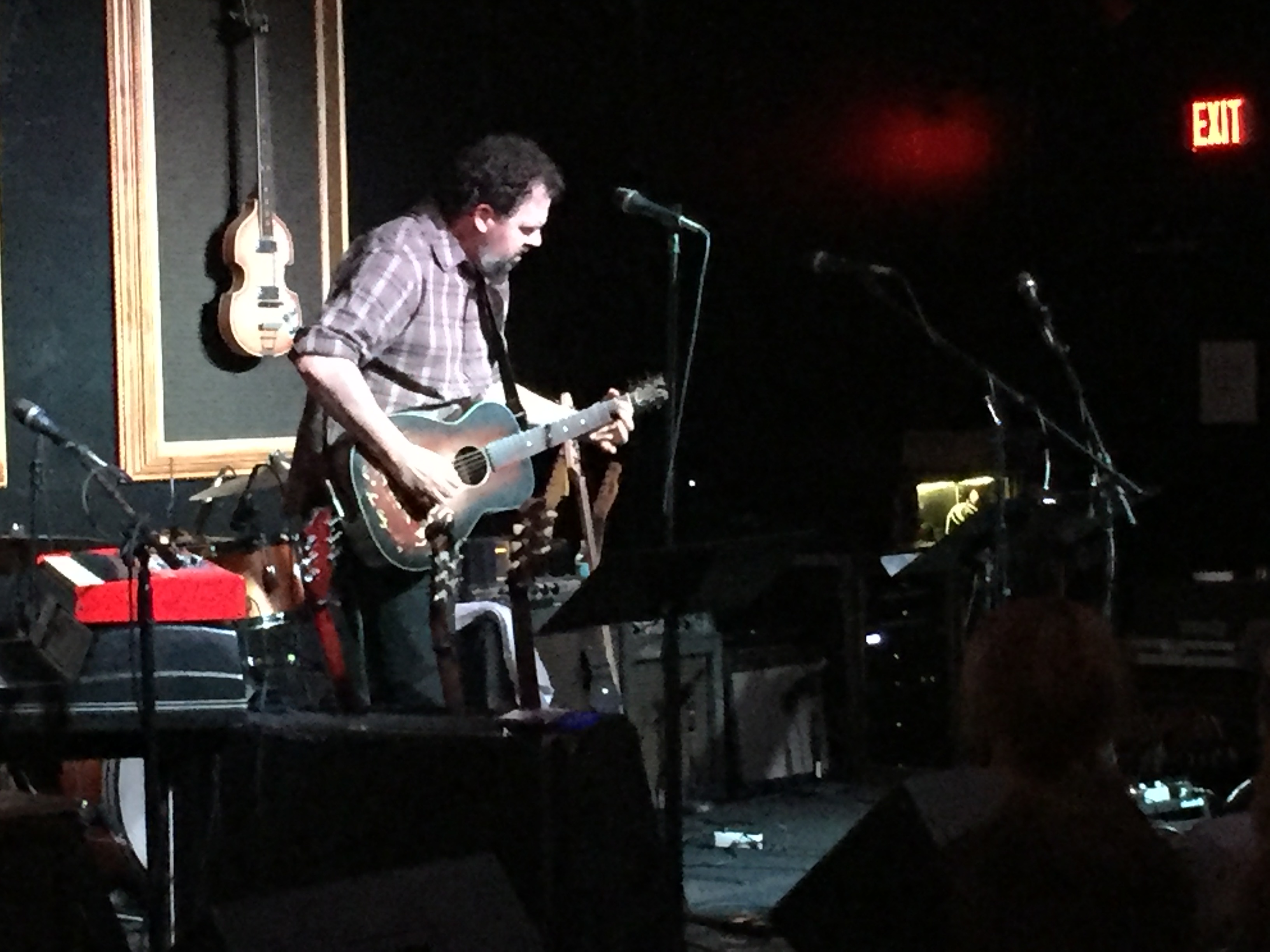
“Love each other, motherfuckers!”

It was all I could do to not dissolve in tears, but there’s no sobbing on a bar stool, motherfuckers, so I did what everybody else did and damn near yelled myself hoarse in assent.

Either beginning works, so I’ll go ahead and start in the middle of last year’s festival.

Anybody who knows me knows that I love The Bitter Southerner. And you also know I pretty much love my now-and-future hometown of Tallahassee – especially the Word of South festival, our yearly mashup of music and literature. About a year ago, over breakfast with BS editor Chuck Reece and WoS founder Mark Mustian, I watched an agreement take shape that made Bitter Southerner the host for a stage at the 2018 shindig. A full weekend of whatever Chuck and his crew could cook up. I had no idea what was coming.

A year later, the Bitter Southerner Stage was the center of gravity at a festival that had no shortage of crackerjack talent. Whether it was sax killer Darius Jones trading verses with novelist Catherine Lacey, or novelist (and Lacey’s husband) Jesse Ball reading his austere prose from his latest novel, Census; or maybe a two-hour presentation from Guggenheim Fellow filmmaker Bill Morrison, or John T. Edge holding forth on the social and political implications of Southern Foodways, or civil rights activist and lawyer Ben Crump laying out harsh reality for the (lamentably) mostly white audience.

Maybe your high point came when 80s pop star Suzanne Vega lit up the night with her radiant voice and presence on the big stage. I sat down with a pal to “watch for one song” and move on, and one song became one more, and one more again until I had watched the whole show, amazed at the sheer beauty of Vega’s language and sound.
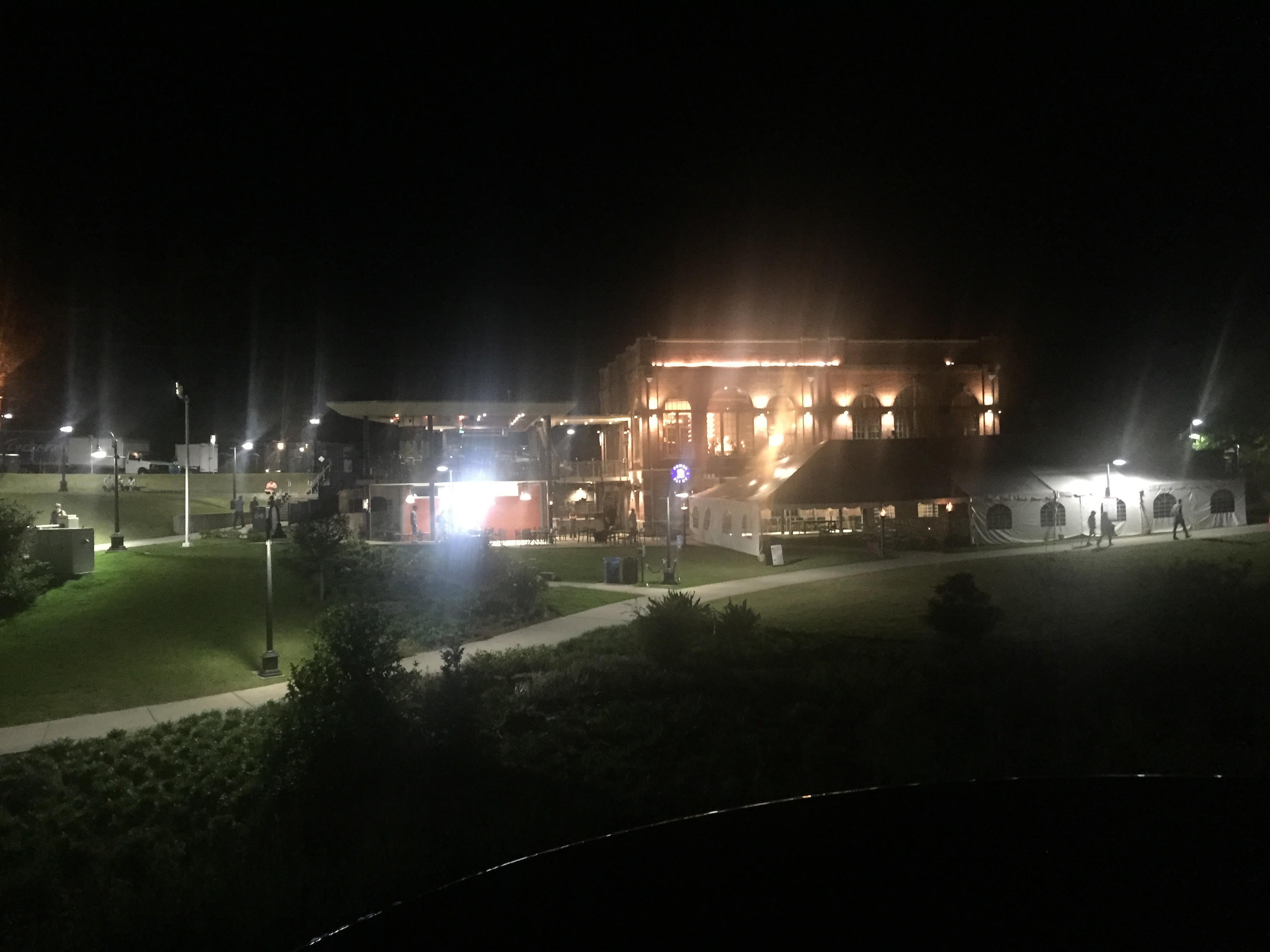
When I stood up after Suzanne Vega, this is what I saw. Our town cleans up right nice.

It would be ridiculous to try and pin down my favorite moment, much less the best moment of the festival. Because like any good fest, I missed more than I could possibly fit in, and you just know that FOMO feeling you have is justified.

But still, I’ll give center of gravity status to the Bitter stage, and not just because I love that crew like I love breathing. It’s because Chuck and team put together the kind of cogently thematic program that makes a festival more than just a collection of cool events. It’s the kind of thing that makes a statement, delivers a manifesto. BS teamed up with friend-of-the-publication Patterson Hood<fn>Himself the originator of the “duality of the Southern thing” concept that drives BS.</fn>, who hooked in his own pals – including the angel-voiced John Paul White, ex of the band Civil Wars – who each extended the network one by one until the program took shape.

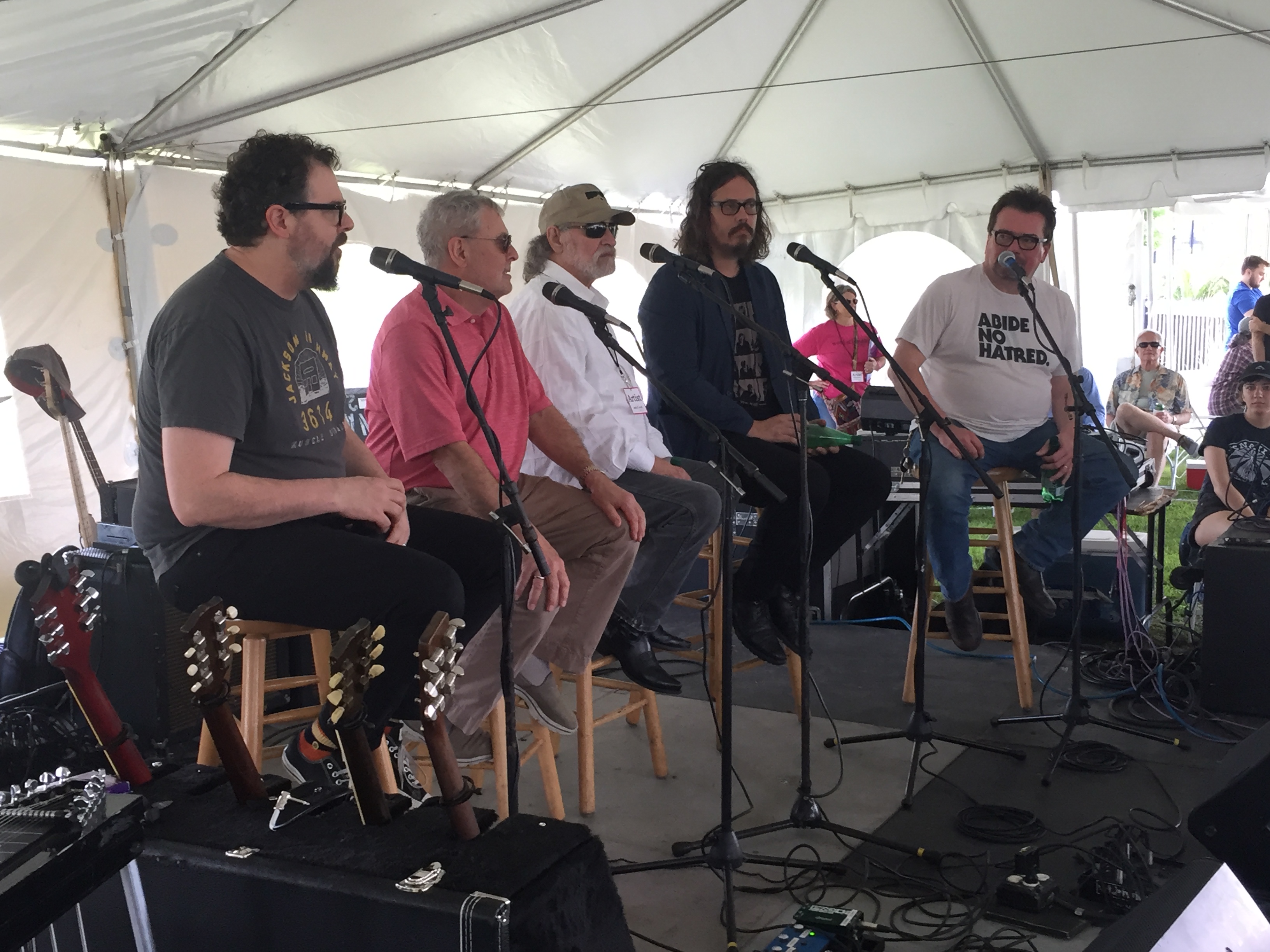
The festival began with White, Hood pere and fils, and another Muscle Shoals legend, Funky Donnie Fritts in a panel discussion with editor Reece. Tales of how it all began, what it was like to hang and play with folks like Aretha and Percy Sledge and Wilson Pickett and Mick and Rhymin Simon and, and. And how the tiny towns of the Shoals somehow became one of the most prized places to make a record (remember those) in the 60s and 70s.
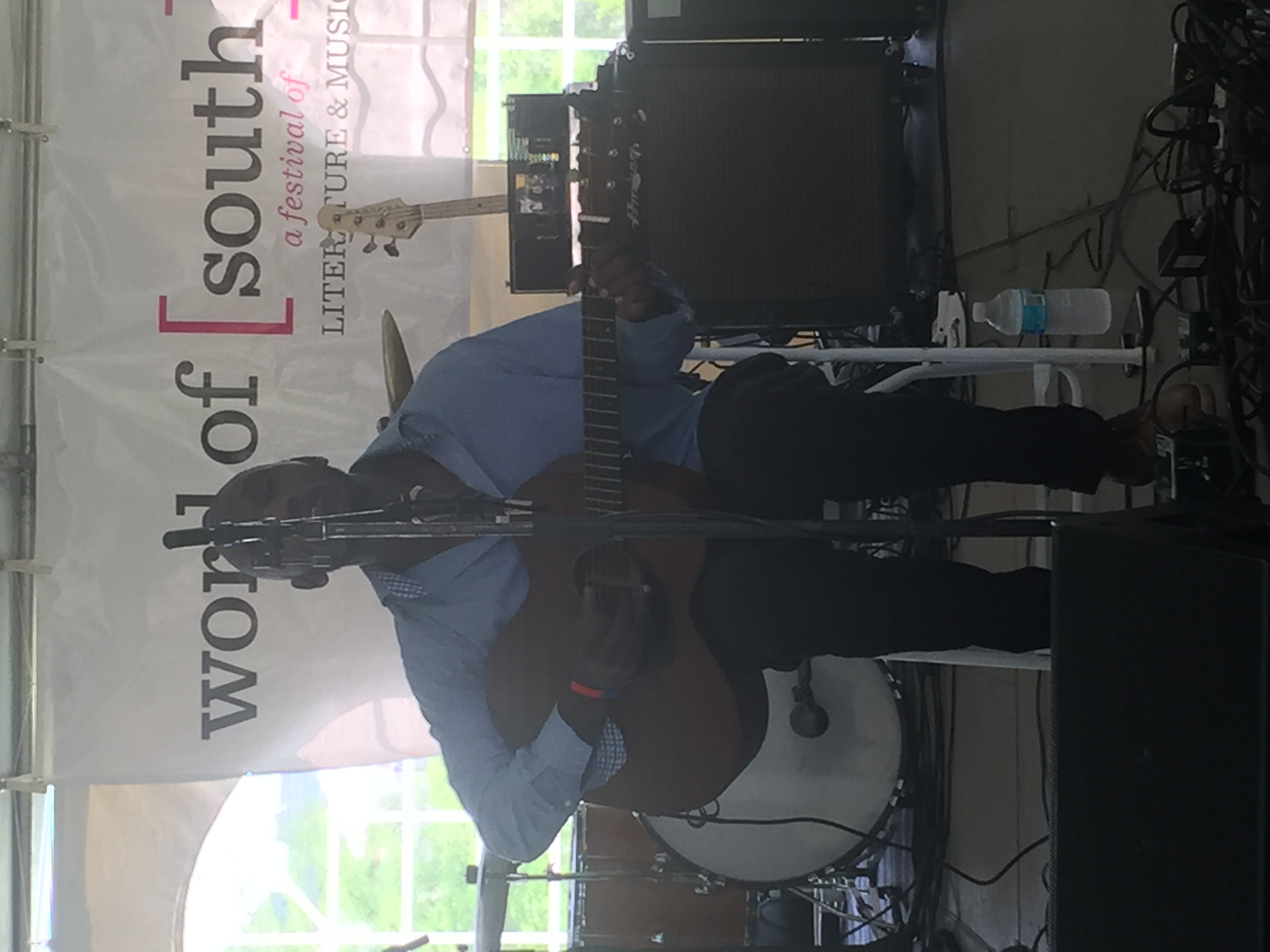
And then came guitarist Cedric Burnside, grandson of the legendary RL Burnside, with a set of deep in the groove blues from the Mississippi hill country. Serious roots.
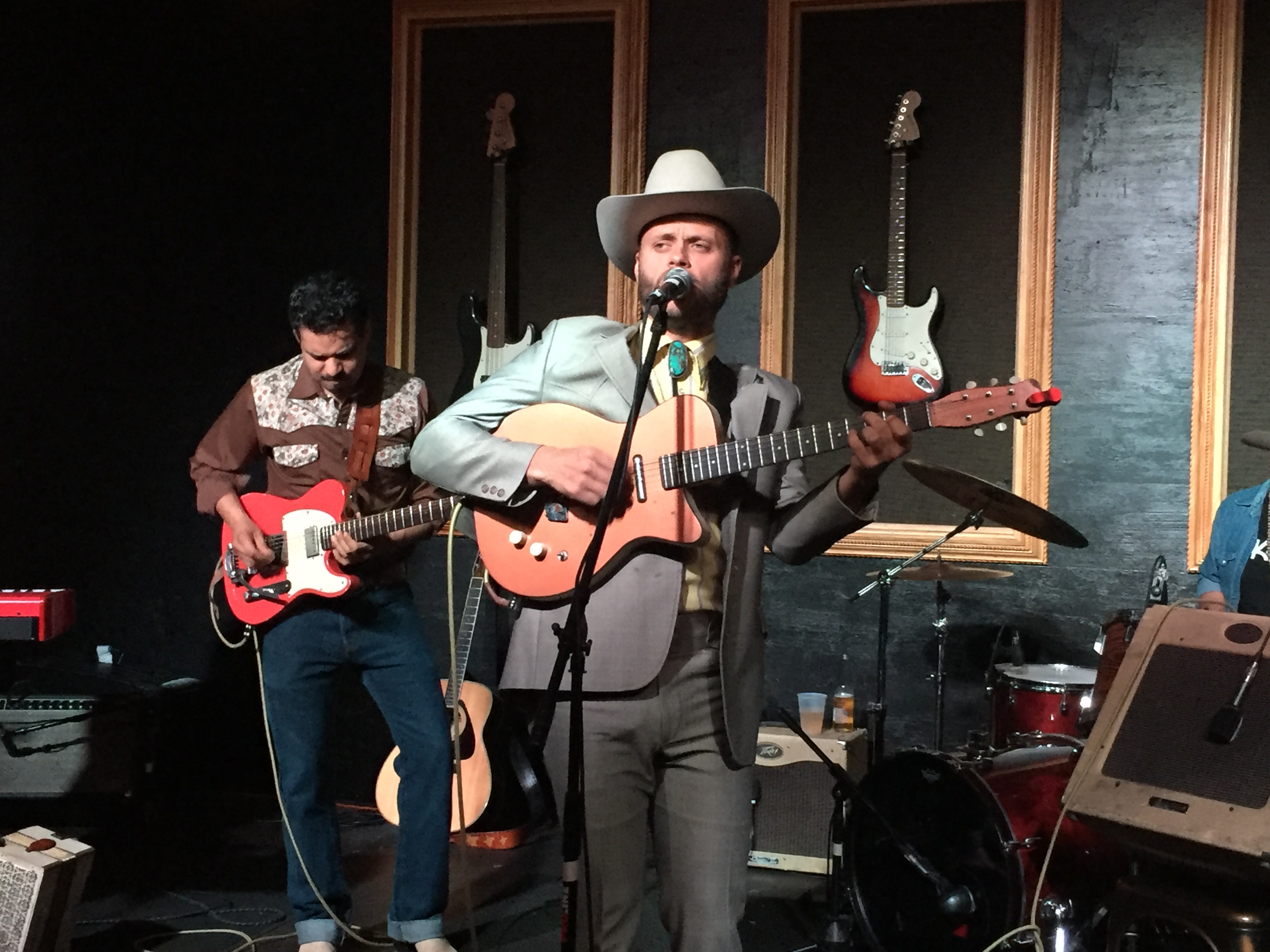
Then it was set by John Paul White and a tribute to the great Muscle Shoals songwriter Arthur Alexander, and I had to miss them both and endure the looks on friends’ faces when they said, “Dude, how did you miss that? It was amazing.”, which it most surely was, and which would have crushed me had I not been getting my gob smacked by Jesse Ball, or Jeff and Ann VanderMeer and their trusty bird sidekicks. And that led to Vega, which led to a kind of amazing after-party event featuring Charlie Crockett playing some ass-kick Texas roadhouse music.
The threat of overnight storms – the same line of storms that flat out shut down the French Quarter Fest in NOLA – led organizers to scramble to find indoor spaces for Sunday. Word of South has had its share of weather woes, and the danger of losing the energy of a festival by dispersing around town is very real. Our Sunday began with the Morrison film program – well attended despite the rain – an absolutely captivating overview of his career that led me to immediately subscribe to the FilmStruck streaming service so I can watch his stuff over and over again. You can get a 14-day free trial. Go ahead and sign up and watch Morrison’s Decasia. You can thank me later.

Then it was time to get back to the Bitter South, which had moved indoors to 5th & Thomas, a fine listening room that was just barely big enough to hold the crowd. I missed the all-star tribute to guitarist/songwriter Eddie Hinton, who wrote the second sexiest song of all time, “Breakfast in Bed”<fn>Marvin’s “Let’s Get It On” will never be beat.</fn>, and again I had to endure the “Dude, how could you?”, and I arrived too late for Allison Moorer’s set that had everybody buzzing.

But I was in place for Patterson’s solo set. Now here’s where I drop a mea culpa and admit that I have never, not even once, listened to the Drive by Truckers before.<fn>This is where most of you are thinking, “Dude, what the hell?” I know, right?</fn> No reason, it just never happened.<fn>This gap, along w my ignorance of John Paul and Civil Wars, is going to change, and fast. Is there anything as wonderful as finding music you did not know about?</fn> So I was completely unprepared for the way Hood got inside my head and heart, heedless of the passion and social consciousness this guy has going on. His evocation of the shared complexities of human existence – and the particularities of the Southern thing – literally had me shaking and in tears. And then all the Muscle Shoals-grown talent took the stage, and Little David struck up the bass line to “Respect Yourself”, and nah-nah-nah, the place damn near exploded, y’all, we were in the presence of The Spirit, that thing that undergirds everything there is, whatever the hell that might mean to anyone, much less this heathen scribbler trying to make some kind of sense of all this.
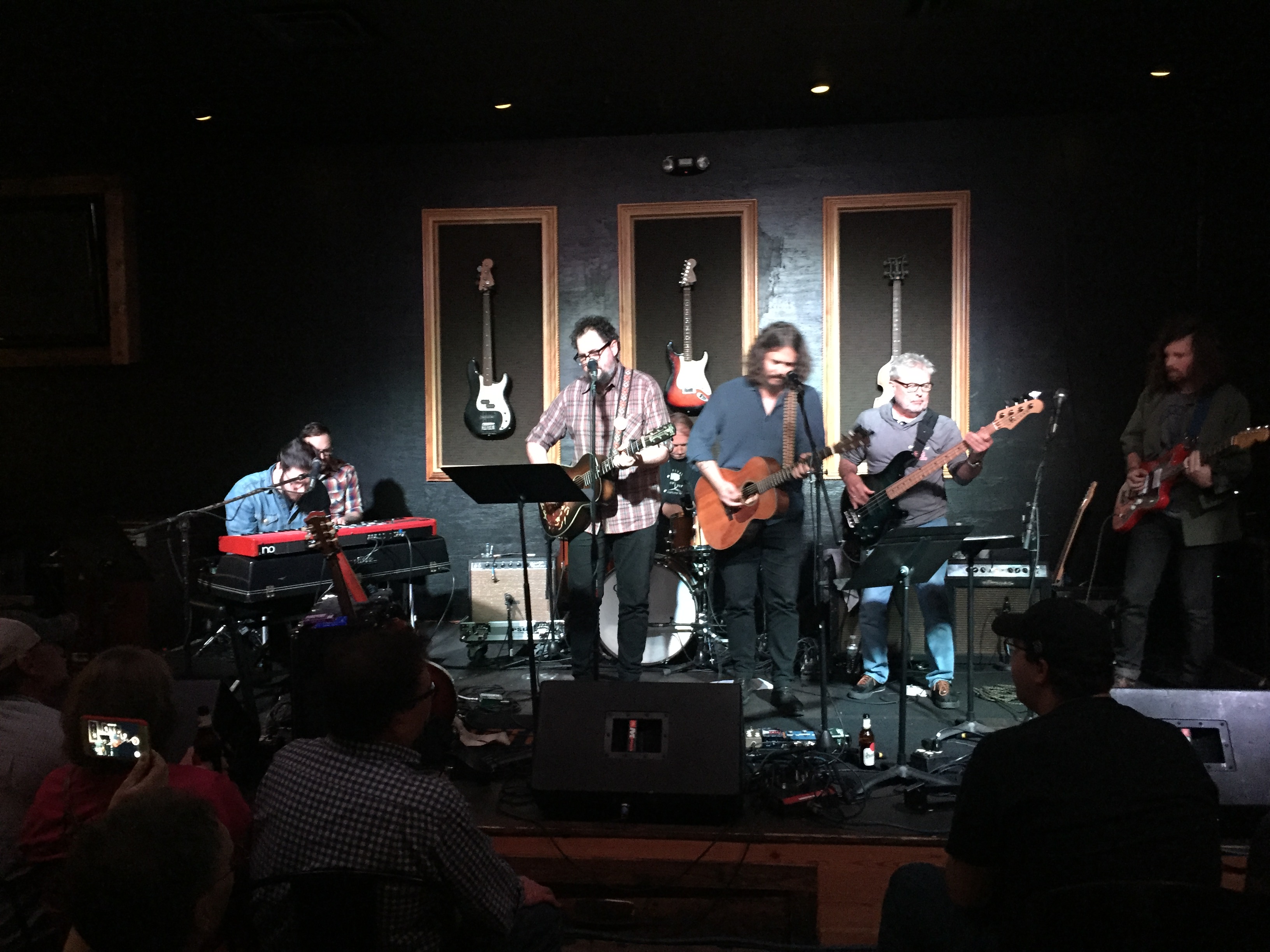
Respect yourselves, motherfuckers

I was fortunate to be able to share this thought with Patterson later: He had taken my heart and shown me what was inside, a direct challenge delivered with love and compassion. And when he invoked Patti with “Love each other, motherfuckers”, I was rendered paralyzed with hope and fear and resolve to maintain my own small engagement with the larger world in vain hope that I can change something, even if it is only my own limited understanding of how we thrive and suffer together.

And that has been the mission of Bitter South from the jump: to show us where we connect, where we are all the same even while we honor and embrace our (and your) difference. The programming of the Muscle Shoals crew – hell, of Muscle Shoals as an ideal to live up to – delivers the kind of thematic resonance that can take a good festival and move it towards greatness.

Most of these musicians could have made a much better paycheck doing another gig elsewhere, but they chose this weekend to make a statement and take a stand. They made the world a better place for the several hundreds of people in their orbit, and their work went to support my pal Chuck and my hometown – and Word of South itself. I love all these things fiercely, and as such, I love my new friends Patterson and David, John Paul and Reed and Adam and Ben. Thank you gentlemen.

Word of South stands at a hinge point. Four years down, it faces the question of “what are we going to be when we grow up?” From the first time I heard about Mustian’s idea, well before the first festival took place, I had a sense that this was the kind of event that could put Tallahassee on the cultural map, an event that would make people say, “We have got to go to Word of South this year”. It has been a very good festival, with year after year improvement. And I take nothing away from the rest of the talent at the 2018 fest: it was loaded and fabulous. I elevate the Bitter South contribution because it has the internal logic and structure that, as I said before, can make a good festival great.

There is rumor of BS returning next year. Let’s hope so. There is rumor of other collaborations of this sort. Bravo! As WoS celebrates its fifth birthday next Spring, I want my friends from Atlanta and NOLA and Knoxville, from Seattle and London and New York to look at the lineup, mark the dates and say, “Wild horses wouldn’t keep me away”.

The challenge is drawn, WoS. It won’t be easy, but I’m with you 100 percent.


Your Electric Picture Radio Box Matters #3: The Critical Importance of Myth (#BlackJesusMatters)

“We tell ourselves stories in order to live” – Joan Didion

“We tell each other stories in order to live together” – i2b

People accuse the i2b team of elitist snobbery, of being blind and deaf to the kinds of entertainment that “real people” might enjoy. P’tah, saith the team: The i2b brow covers the full range, from low to high and all points in between.

In that spirit: NBC’s Jesus Christ Superstar Live in Concert was just about perfect in every way.

The sets and staging, the costuming, the direction: all of this was as good as it gets. The cast was superb, especially the Broadway pros. Better: the cast was determinedly multi-culti and scruffy as hell, all angular haircuts and tattoos.<fn>America’s grumpy pervert uncle Bill O’Reilly took to Twitter to decry this last bit. Get off his lawn.</fn> In this production, Jesus is a Black man, his “companion” a White woman. You better believe Black Jesus Matters.

Sara Bareilles and John Legend as Mary and Jesus

The expected troll backlash from the religious right never really materialized. A fair number of theologically inclined folks complained that JCS does not include the actual stone-rolling-aside episode, a resurrection<fn>See what I did there?</fn> of a now 48-year old gripe, but it is hard to see that anyone thinks this production short-shrifted the Christ’s ascension. Not to blow the suspense with spoilers, but there has never been a more effective evocation of the Crucifixion than this.

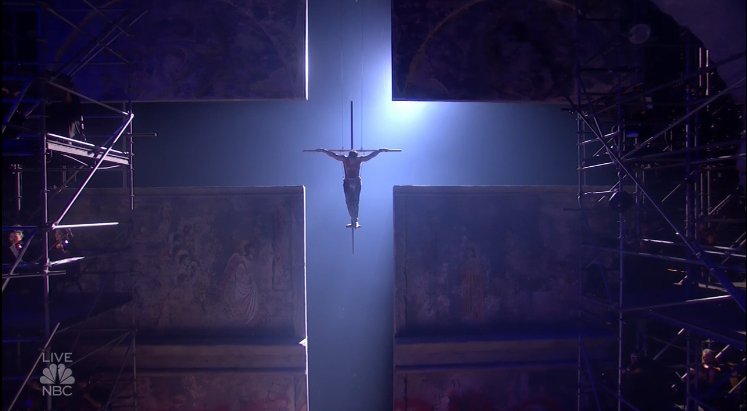
A Black Man, dead at the hands of a brutal state, becomes a symbol

Of note: as Jesus ascended, every member of the cast Took. A. Knee.

The Christ myth may indeed be the Greatest Story Ever Told. I write this as a fully convinced atheist, but that really isn’t germane, any more than are my thoughts about the reality of Hogwarts or Mordor. This is strictly about the narrative, and this story has it all: rebellion, romance, social justice, and brutal oppression. It’s about class division and capital punishment and the mechanics of social movements. And crucially, it is about betrayal.

When the original JCS album came out in 1970, I damn near wore the grooves flat. Raised in church, indentured as an altar boy until such time as I could effectively object, I was taken by the representation of Jesus as a man, a mortal product of time and circumstance. Divine? Maybe, maybe not.

Die if you want to, you innocent puppet.
– Pontius Pilate to Jesus

And what about Judas? History’s greatest villain, condemned by Dante to the 9th Circle, he remains by far the most complex and interesting character in the myth. But I, like many others, was raised with a black and white conception of Jesus-good-Judas-bad, a stance that pointedly ignores the fact that without Judas, there is no arrest, crucifixion, and resurrection. No Judas? No Christianity. This was one of our earliest lessons in ambiguity, and it remains perhaps the most prevalent.

Through many a dark hour
I’ve been thinkin’ about this
That Jesus Christ was
Betrayed by a kiss
But I can’t think for you
You’ll have to decide
Whether Judas Iscariot
Had God on his side.
– Bob Dylan, “With God On Our Side”

As good as Legend was as Jesus, Brandon Victor Dixon’s Judas stole the show. Already a Broadway giant, most recently as Aaron Burr in Hamilton, Dixon can write his ticket to any destination as of last night.<fn>The fact that Dixon was the actor who gave VP Mike Pence a public dressing down after a Hamilton performance only makes him all the more spectacular. And then the man offers the Wakanda Forever gesture during the curtain call?!?! FTW!</fn>

One of the great feats of JCS is the representation of Judas as something more than a cardboard villain, more nuanced than Palatine or Voldemort.<fn>The bad guy=pure evil equation has never offered much dramatic possibility.</fn> Judas had insight into the perils of personality cult. In the first song, he warns “all the good you’ve done will soon get swept away / You’ve begun to matter more than the things you say”, a timely caution for our favorites in current social movements as they navigate that assembly line of hero creation and defenestration that remains popular 2000 years on.

You’d have managed better if you’d had it planned.
Why’d you choose such a backward time in such a strange land?
If you’d come today you could have reached a whole nation.
Israel in 4 BC had no mass communication.

The depiction of the crowd as a gaggle of media hounds after the arrest of Jesus was a clever twist (as was the wide use of cellphones among the cast) that framed the events in relation to current movements like #NeverAgain and #BlackLivesMatter. The production may not have been conceived with these in mind, but you would have to deliberately choose to not see the echoes.

Every word you say today.
Gets twisted ’round some other way.
And they’ll hurt you if they think you‘ve lied.

Judas, famously, betrays Jesus with a kiss. In the JCS depiction, Jesus gathers Judas in a tight embrace, a clear display of affection for his old friend who, like himself, finds himself a pawn of forces beyond their reckoning. Is Judas, the universal symbol for betrayal and damnation, forgiven here by Jesus, the singular emblem of mercy and redemption in our canon? God, I hope so. Dante be damned.

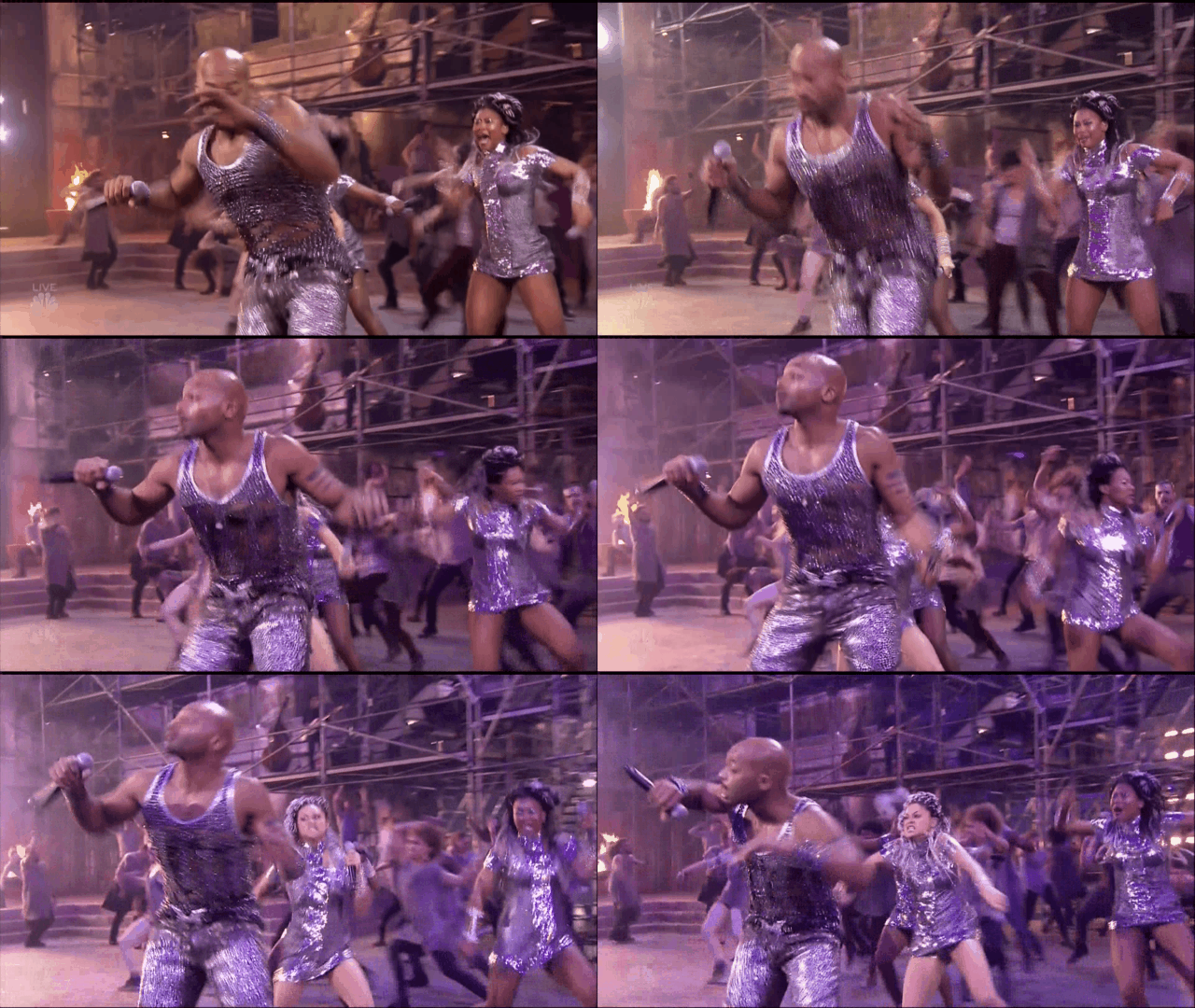
I’ll go toe-to-toe with anyone to defend the premise that re-tellings like JCS – and Scorsese’s Last Temptation of Christ – do more to imbue the myth with the kind of layered meanings that encourage considered reflection and exploration than do the Sunday school bromides of my youth. Is Judas a man beyond redemption? Perhaps, although it’s hard to imagine a more vibrant redemption than Judas returning from the grave in a sequined tank top to tear the roof off the joint with the anthemic title song.

When I come back from the grave, I want to be this fabulous.

I have not listened to JCS in more than 20 years, not since the Atlanta music community<fn>Spearheaded by multi-talented Michael Lorant as a gun control benefit vehicle following his own shooting during a botched holdup; some things never change.</fn> mounted a terrific production of JCS with the Indigo Girls in the two lead roles. Presenting the out and proud Amy Ray as Jesus – and she killed it, from the moment her disembodied voice blasted into the Variety Theater on opening night – and the out and proud Emily Saliers, as Jesus’ “companion” Mary, was a provocative and daring move, well beyond central casting’s White Jesus, and surely the most daring JCS casting ever sold. Until now.

The diversity of casting and the representation of the apostles as scruffy misfits alone made the NBC production a statement. The presentation of Jesus as a Black man, and his female companion a White woman, could fairly be interpreted as a poke in the eye of America’s conservative culture warriors. For centuries, Western culture has insisted on depicting Jesus as some kind of Nordic or Aryan icon. Not this night. I’ll say it again: Black Jesus Matters, and the fact that NBC presented a depiction of the Christ myth that leaned hard on inclusion and diversity, and on the holiest day of the Christian calendar no less, is no small incident in the current climate.

Or maybe I’m wrong, and this is all about nostalgia and the willingness of a corporate behemoth like NBC/Comcast to manipulate us all for profit. It is certainly possible. No doubt, nostalgia plays a large part in my emotional response to JCS. A big part of my childhood, I know the lyrics and music to this show inside and out. Judging from Twitter, I am one among many. It is as firmly imprinted as any cultural artifact can be.

But it has to be more than that. The score, not astonishing by any measure, is filled with earworms and memorable lyrics, and the libretto is filled with doses of sly humor. King Herod’s song is campishly funny, made even more so by the stunt casting of Alice Cooper. (How Legend managed to kneel in front of Alice Freaking Cooper through that piece without cracking up is beyond me.)

My favorite gibe comes during the Last Supper, when most of the apostles are drunk with wine and enthusiasm for a movement they do not fully comprehend.

Always hoped that I’d be an apostle
Knew that I would make it if I tried
Then when we retire we can write the gospels
So they’ll all talk about us when we die.

Perhaps the Gospels were the first tell-all memoirs, the Apostles the creators of the genre. Scores of ex-White House staffers offer their thanks.

There was a ton of energy surrounding the performance, and the decision to have a live audience served JCS well where other recent broadcast musicals fell short. There was an apparent emotional connection at work in the venue, and that spilled over to the broadcast, even where it created technical issues with sound balance and such. But quibbling over mix problems is as beside-the-point as griping about commercial interruptions. Success for such a production comes down to a central concern: can the viewer emotionally connect?

So?

I admit it. I spent most of the evening with my cheeks wet. Mary doesn’t know how to love him. Judas doesn’t either. Jesus has galvanized a movement that is spinning out of his control. He recognizes too late that his followers are not up to the tasks of the movement, aside from Judas, perhaps, a man who is destined to betray Jesus to death. Jesus confronts the money changers and runs them from the Temple. For his trouble, Jesus is swarmed by lepers and other afflicted supplicants; pulling and tearing at him, everybody wants a piece for themselves no matter the cost to their saviour. The devoted dozen fall asleep as Jesus fairly begs someone to stay awake with him in his last night of freedom. Then comes Peter’s betrayal, three times, and Magdalene’s comment, “You’ve gone and cut him dead.” Then there is the agonized death of Judas, the man who made Christianity possible, recognizing that he is, indeed, damned for all time.

And finally, most of all, the Crucifixion, Jesus ascending and drifting into the mist on his tiny cross – “My God, my God, why have you forgotten me?” – framed by a giant cross, backlit until he disappears into pure light? As powerful and moving as it gets. Michelangelo can only shake his head and say, “Damn, that was fine.”

Despite the insistence of the devout that Jesus is indeed a manifestation of the one, true God<fn>Setting aside Nicene confusions of a Trinity that is or is not in fact a single entity</fn>, the way we tell ourselves/each other stories all but guarantees that there is not a single iconic representation of Jesus that prevails universally, despite the best efforts of Renaissance artists and the various approved councils, papal conclaves, and authors like Dante and Milton.<fn>Always keep in mind that a great deal of myth that people assume is from the Bible is in fact addenda created centuries past the authoring of Revelations.</fn>

All of which means that when a major teevee network devotes millions of dollars to a star-studded presentation of the Christ myth – on Easter Sunday, no less – it is worth paying attention to how this story is being told. Which Jesus, or whose, is always a question worth asking. Is this the Jesus of Harriet Tubman or Robert E Lee? Is this blond and blue-eyed Jesus or Jesus with dark skin and napped hair? Is this Jesus divine or mortal?

JCS does unbelievers the service of offering a Jesus that can belong to anyone.<fn>This may in fact be the greatest objection conservative theologians have to the proceedings.</fn> Watching it, I am reminded that even the non-believing “I” can have a Jesus, just as I can have my Beowulf, my Hamlet, my Ulysses, my Jean Valjean. Interpret the myth as you will, in a way that enables and ennobles you.

If your slate is clean, then you can throw stones.
If your slate is not, then leave her alone.

These are stories we tell ourselves, in order to live. They belong to everyone.


The Embiggening: Day 4

The i2b team of one continues their coverage of the Big Ears Festival in Knoxville, TN. Please share widely. And if you are feeling generous, click that DONATE button over there so we can buy gas and go home.

Day 4 began with some drama for the i2b team. We had hoped to be through with the excitements once we bailed out the photographer, but alas, no. We don’t know how the copy editor actually got to Dollywood, not the exact nature of the alleged unpleasantness that so alarmed the Pigeon Forge constabulary, but on behalf of the entire i2b team, we offer our regrets and apologies. However, any restitution for damages shall be the sole responsibility of the copy editor, who we had conveniently sacked several hours before whatever unpleasantness may or may not have occurred at whatever time – past or future – the alleged acts may or may not have etc and so forth. There will be no further comment on this matter.

We finished our Day 3 summary just in time to scamper to the Mill & Mine for the highly anticipated Tyshawn Sorey Trio performance at noon. Aside from being named a 2017 MacArthur Genius, Sorey has a rich discography as both leader and sideman. Fantastically talented on drums, piano, and trombone, Sorey has also been making his mark as a composer.

But not every event can live up to expectation, even at Big Ears. Beginning with a long, pensive introduction by Cory Smythe – a terrific pianist who we saw several times with the International Contemporary Ensemble – every section of this 75 minute, single composition performance seemed to go too long. Multiple apparent endings would come and go, a comma appearing where a period would have provided much needed respite for the audience. Still, moments of the set were thrilling. Smythe is a remarkably inventive pianist and Sorey’s reputation as a percussionist is well deserved. It was not a bad show, but it certainly was not great. Combine the need for editing with the fact that we were a standing audience in the over-sized (for this show) Mill & Mine: the overall effect was to add to the exhaustion that three full days of music-chasing had created.

This sense of exhaustion hung over the final day of the festival. You could see it in the faces of the listeners, the festival staff, the security guards, the good people vending the beverages and the snacks. But kudos to Knoxville and the event attenders: even with this pervasive fatigue, everyone remained friendly and patient. We are just glad that the all-day rain of Saturday had drifted away.

A quick note on weather: it was not good for the festival until Sunday afternoon, when the sun came out and the winds died down. Aside from forcing a relocation of the epic fiddler jam, the weather had little impact on the festival programming. Venues were full and lines for food and drink around town were formidable. The price we paid for bad weather lies in the diminishment of the street scene. Where last year found the plazas and sidewalk cafes jammed with scores of people speaking a dozen or more languages, this year saw people huddled indoors, always taking the most direct line between venues to limit exposure to the elements. For a town as charming as Knoxville, this was indeed something to lament.

But you can ask Memphis Minnie about the weather: crying won’t help you and praying won’t do you no good. Plus, the Sunday schedule somehow seemed less packed than the first three days, not that it was free of desire conflicts. With a glimpse of the sun, we settled into a seat on the square in front of coffee and pastry, happy to watch the lovers stroll and the children frolic, bemused that the strolling lovers were, many of them, destined to become the parents chasing children in frolic. An older gentleman busked with his violin, playing some Eastern European pieces that spurred our research assistant to drop a few bills in the fiddler’s open case.

Fortified by this interlude, we shook off our lethargy and ambled over to catch the set by guzheng maestro<fn>We really need a non-gendered version of this word.</fn> and banjo avatar Abigail Washburn at the Bijou. Now, we’ll be honest: Our expectation for this set was low. It had all the earmarks of a boardroom planned cultural pastiche ready made for a PBS fundraiser program. Our plan was to catch a tune and get back outside for a nap in the sun.

We were wrong. This show was the quirky surprise event of the weekend. Abigail and Fei, it turns out, have been friends for years. The songs in the set were developed on the front porch during afternoons spent watching their children frolic. (They both live in Nashville and have kids around the same age.) What could have been a corny commingling of cultures turned out to be one of the most generous and refreshing things we’ve witnessed in a long time.

Turns out they have been gigging this material in coffee shops and open mic nights around Nashville; this was perhaps their first proper concert; Fei expressed her gratitude at playing someplace where nobody thought they were weird. They began standing back to back, each singing into the soundhole of a guzheng stood on end. The harmonies and resonances matched anything heard all weekend. Okay, then, one more tune. And then one more, and one more, until the hour had passed by.

One piece they examined was a Chinese Communist anthem that was used to spur worker productivity. Turns out it began as an old time farmer’s tune about chickens,. They paired that with the Appalachian traditional “Old Cluck Hen”. They are, it seems, the same dang tune, and the effect of harmonized English and Chinese lyrics is literally tear inducing. Another song about a dutiful daughter from the countryside, sent to the city to earn a living at the mill or factory – only to be turned into an escort for a well-heeled man – took a fine turn when the destination city turned out to be Shanghai.

Throughout, Fei and Abigail demonstrated a solid social conscience. The two pieces described  above convey a solid awareness of the commonality of their rural working class backgrounds, and later, their performance of a piece about the (true) historical figure Mulan was prefaced with a comment about strong women and “douchebags in power”.

Washburn, who at seven months pregnant assured us that her doctor had given her clearance to clog dance her heart out, is a natural born comic and story teller. Fei is her straight person, a dry as toast foil to Abigail’s good humored jokester. Dang, we love these women, and cannot wait to hear the album they promised is coming this fall.

Just a little while later – long enough for another cup of joe in the sunshine – the trio Bangs took to the Bijou stage. Pianist Jason Moran announced that Bangs – with guitarist Mary Halvorson and cornetist Ron Miles – had been together for six years and four gigs. It was beautiful, dreamy music, with a solid balance of composition and improvisation, swinging tunes and outside abstractions. The i2b team has loved all of these musicians over the years, but this was the first time catching this rare combination. They offered a CD for sale that was sold out before we could get to them, but rumor suggests copies are available online. We’ll be listening as soon as we think we can absorb more music.<fn>Big Ears proves that one can ingest a sufficiency, at least, that demands a recovery period.</fn>

We were at a critical juncture. We could have called it a weekend, succumbed to the temptations of one or the other of Knoxville’s fine taverns, secure in the knowledge we had done our best to hear as much as humanly possible. But that would have been a lie, so onward to the Tennessee Theater for a transition from Bangs to Banging on a Can.

Local heroes nief norf presented Steve Reich’s 2013 composition “Quartet” for two pianos and two marimbas. We usually expect the interlocking melody lines from Reich. Here, the polyrhythms played out in muscular block chords. Just the thing to boost flagging energies and to prepare us for what came next. During the Reich, we noticed music stands and microphones set up around the audience, so we made sure to get a central seat for the Bang on a Can All Stars 30th Anniversary blowout.

With a little help from nief norf, BoaC began with Michael Gordon’s “Big Space” for thirty musicians: 15 on stage, 9 in the balcony, and 3each in orchestra seating right and left. Gordon is quickly shaping up as one of our favorite composers. Just as with “Rushes” for 7 bassoons – and “Timbers” from last year’s fest, for six 2×4 boards – Gordon aims to fill the space with repetitions that layer to create sound cascades through the performance space, and while this may appear merely “Reichian”, Gordon has developed his own spin on things. The surround sound effect was miraculous, aside from Electric Ascension and Godspeed, nothing we heard approached this level of sonic envelopment. (Granted, we missed Lightning Bolt; reports from that front described volumetric heights that triggered scientific instruments out at Oak Ridge. Or so we heard.)

Paring down to 6 musicians, the All Stars followed up with Julia Wolfe’s “Big, Beautiful, Dark & Scary” and David Lang’s “Cheating, Lying, Stealing”.<fn>Gordon, Lang, and Wolfe are founding members of BoaC.</fn> This was as much prog rock as it was classical music, whatever that means anymore. Against the backdrop of these pieces, Philip Glass’s “Closing” sounded damn near romantic, lush and calm and lovely. This respite saved us for the final assault, Steve Martland’s “Horses of Instruction”. Let’s just say that Martland learned his Crimson lessons well. This piece was all energy, a runaway train of shifting time signatures, tricky ostinato figures, and hell for leather tempo. It was a fitting crescendo.

And it was then, when we wandered into the gentle evening air, that we knew we were done. Apologies to Craig Taborn, who turned in what we heard was a fine performance, but we had nothing left. Our ears proved not quite big enough.

But we were well beyond happy, both with the music we heard and the conversations and new friends that bubbled up. We wandered down to Old City, where we saw the entrances to several more Big Ears venues that we had never made it to, and found our way to Pretentious Beer & Glass Company for some post-show replenishment of essential bodily fluids. An amazing place, where everything you see was made by hand: tables, stools, the bar, the beer, and most incredibly, the glasses themselves. One side of the joint is a glass-blowing studio where our pals Duet for Theremin and Lap Steel had performed to accompany some glass making. So very cool.

We are sorry to have missed that performance – along with our inability to be eight places at once to catch Anna & Elizabeth, Jon Gibson, Peter Evans a few times, Diamanda Galas, and Anoushka Shankar. Sure, it hurts to miss something you know you would have loved – especially when your friends tell you, “Dude, I can’t believe you missed *that*. It was so awesome.” But on the other hand, there is something comforting in knowing that you literally stuffed yourself to the gills with music most excellent, and still there is a surfeit out there just waiting to fill your ears for the first, or five hundredth, time.

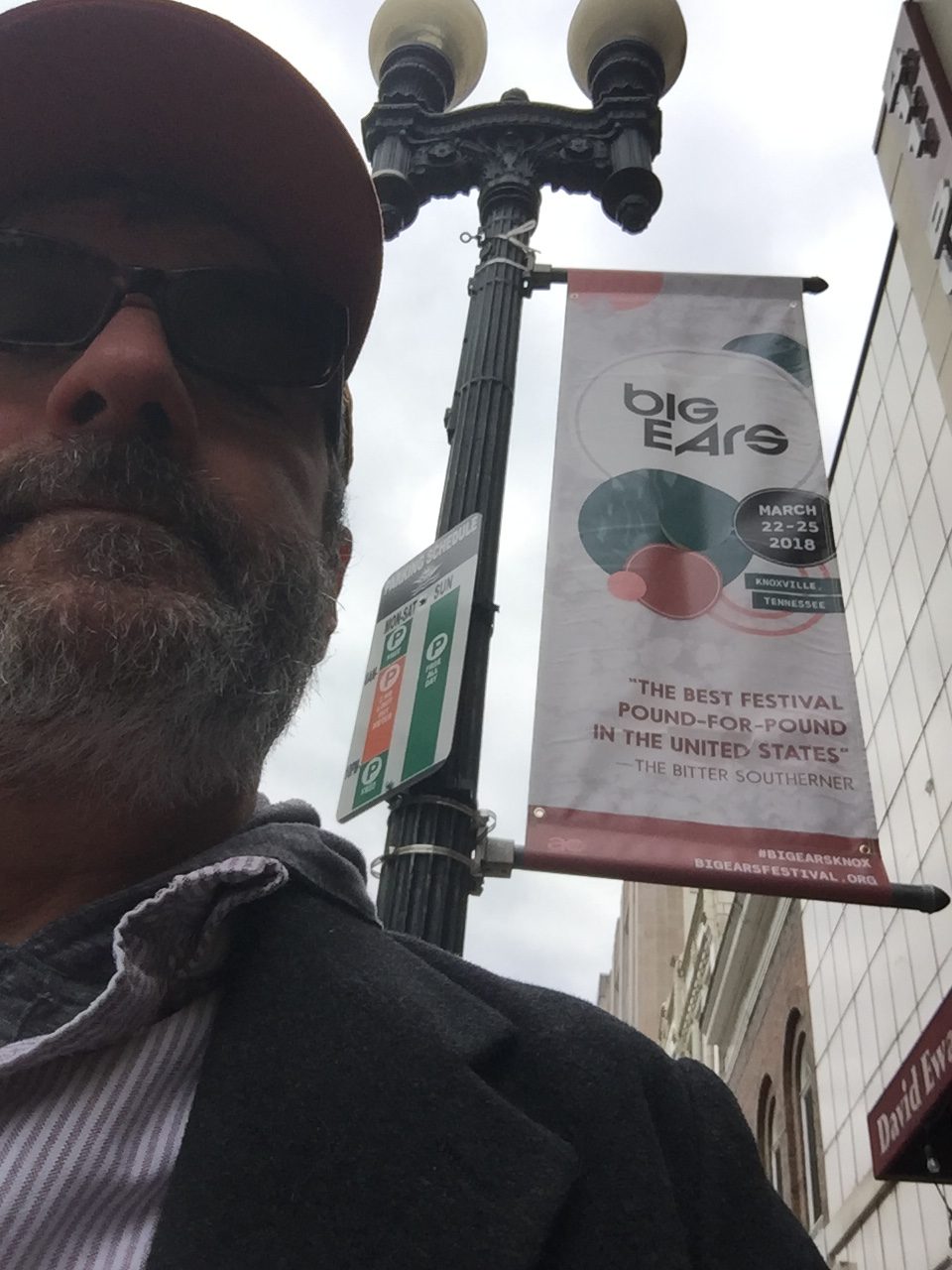
Last year, some smart-ass writing for the Bitter Southerner offered that Big Ears is “arguably the best festival pound-for-pound in the United States.” I ran into that guy, who insisted I take his picture. He wants you to know that he stands by that assessment.


The Embiggening: Day 3

The i2b team of one continues their coverage of the Big Ears Festival in Knoxville, TN. Please share widely. And if you are feeling generous, click that DONATE button over the so we can bail out the photographer. Don’t ask.

It’s a safe bet that Day 3 of the 2018 Big Ears Festival reached the highest concentration of sheer ecstatic power we will witness this year, and perhaps in the history of the festival. As Day 2 had managed to slip over into the wee hours of Day 3, so too did Day 3 roll right into Day 4. As of this writing, Day 3 may even still be in process for the hardcore attendees of the 13 hour overnight Drone Flight, the world’s coolest slumber party. But let’s begin at the beginning.

Our day began with an hour or so chat with guitar icon Nels Cline. We talked mostly about Coltrane changed his life. Cline, aside from being one of the great creative guitarists around today<fn>I am told he belongs to a rock’n’roll combo, too. Something called Wilco.</fn>, is a walking encyclopedia of music history, and his passion for Coltrane is enormous.

Other topics included his gig with Jenny Scheinman (“that felt really great”) and his frank assessment of his popup gig with Cup (“really terrible”, due to TSA removing a critical cable for his wife’s electronics rig, “but it was a great crowd”). He spoke of his love for the music of Ralph Towner and John Abercrombie. And we got geeky together over our enthusiasm for the music of the late Jimmy Giuffre. More on this in the future as we transcribe the interview. Suffice to say that we were off to a great start for the day.

Wandered over to Jenny Scheinman’s Appalachian ode, Kannapolis: A Moving Portrait. Commissioned by Duke University to create a soundtrack for recently discovered Depression era film footage of the region. Joined by Robbie Fulks and Robbie Gjersoe on a smattering of string instruments and vocals, this was traditionalist Scheinman. Her voice is pure and her fiddle playing strong.

Honestly, we thought we would dip into Kannapolis for a few minutes on our way to hear Rhiannon Giddens’ keynote address, but the combination of the music and the imagery kept us in our seat for the duration. Aside from the generosity of spirit in both the music and the footage, the film’s concentration on so many young people could not help but evoke the March for our Lives kids who were at that moment leading a movement in something like 800 cities. Kids playing catch and hopscotch, riding bikes, preening for each other in mating ritual. Kids goofing off and making funny faces for the camera. It was just sweet, y’all. We won’t falsely romanticize the era, or the place; this was the heart of Jim Crow segregation, and the Depression hit areas like the Kannapolis region especially hard. The contrast between watching kids being kids then versus watching kids today remind us that they are the mass shooting generation is stark and more than just a little sad. And it’s a reminder that as awesome as Big Ears is, the real action in our world today was set in motion by a group of kids who are fed up with the shitshow we’ve handed them.

It was a damp cold day, suitable for a leisurely stroll to the next venue, thoughts of the Parkland kids filling our hearts. Good fortune smiled, and the perfect music for our mental and emotional state was waiting for us at the Knoxville Museum of Art. The Rushes Ensemble was formed to play one specific piece of music. Michael Gordon’s Rushes, an hour-long piece for seven bassoons, found its perfect setting in the hands of this group in the atrium of this lovely and richly resonant museum. Against a backdrop of the city skyline – complete with Sundome looming – we were invited to move freely though the atrium during the performance to “experience the different overtones that can build up in different parts of the space”.

It began as a faint glimmer, layers of 8th and 16th notes in the upper register of the bassoon. Slowly, range expanded, and volume increased as the layers and echoes began to commingle to create ghost images of instruments that were not there. Voices, organs, chimes, violins: all were present in a room where none were present. Wandering around revealed strange sound quirks, and standing in a corner v. under a curving staircase offered striking sonic contrasts. But in the end, we decided that this was music for sitting still.

With rain streaking the windows and a raw wind moving the trees, we were warm inside this music. It eventually filled the room so completely as to constitute a physical manifestation, which is of course absurd because nothing could form out of a bunch of vibrating air molecules, right? Crazy talk. It never got loud, per se, but the music occupied every available space, both inside and outside our bodies. As we approached the fifty minute mark, we had to close our eyes.

And then, suddenly, it stopped. The massive roar of Silence was so stunning that we reactively looked up and around to see what had come into the room. For around a minute, there was pure Silence. The genius of this piece lies in its creation of a sound structure so enveloping and gorgeous that it emphasizes the stark beauty of Silence itself.

Onward through the rain to hear the Evan Parker Electro-Acoustic Ensemble. Again, we were presented with music that leads us to consider the relationships between sound and space and time and space. The chapel was full. Where Rushes suggested we treasure Silence by taking it away completely, albeit gently, Parker’s team parceled Silence out in fragments, a brilliantly executed piece of group improvisation.

We finally found a minute for food before the highly anticipated Milford Graves – Jason Moran duo show. Hundreds were standng in line, in the rain, for admit to the Bijou Theater. We were among the lucky ones; many more were turned away.

Moran is one of the music’s great young leaders, a masterful pianist with a deep knowledge of musical history. Graves is, well, a legend, one of the creators of free jazz, and a revered elder. They carried on an intergenerational conversation, at turns dense and foreboding or puckish and playful. The audience was with them at every turn, and nobody left their seat until it was over.<fn>When shows reach capacity at Big Ears, a notification goes out announcing that they are now at “one out, one in” status. In this case, no one went out.</fn>

The team was exhausted by this time, so we huddled over a steam vent under an awning and took a nap to gird ourselves for the eagerly anticipate Roscoe Mitchell Trios performance, again at the Bijou. We entered to a stage filled to capacity: two pianos, three drum kits, two percussionists, and an array of wind instruments and electronics gear. Nine musicians, who manifest as 4 distinct Mitchell trios, among other combinations, took the stage. The place was buzzed,

Again, the watchwords here were time and space. On the leaders cue, a resounding chord shaped by all nine players tuned the room. It was a thunderclap, but for the longest time, it was to be the only really “loud” sound we would hear. Under Mitchell’s direction, each player – or some subset combination of players – took their turns defining certain sectors of the soundscape. Following a set of coded gestures by Mitchell – gestures which correspond to various “cards” and motifs – a slowly developing landscape unfolded. Over time, the subsets became larger, the sound began to gather density and weight, until the group achieved a critical mass condition and embarked on what the Art Ensemble used to call an “intensity structure”.

Oh and mercy, it was intense. Thunderous, waves crashing, Mitchell and fellow reed player James Fei blistering their horns, the five (!) drummers and percussionists exploring every manner of coaxing apocalyptic din from their respective batteria. Perhaps the most alarming character was pianist Craig Taborn. We had seen him earlier with the Parker ensemble, where he had come across as thoughtful in the context of less cacophony. Here, he was sheer power unleashed, one of the most exciting and free-roaming piano performances we’ve seen since Cecil Taylor.

The overwhelming energy pressed the audience back in their seats. We were absorbed and surrounded by a sonic tsunami. And then, on a dime, the group dropped into Mitchell’s Odwalla, the Art Ensemble classic that signals the end of the show. Mitchell is a dry person, very serious but with a great sense of humor just underneath. His introductions of the band members were quietly funny. And then we were done.

The faces around us were rapt. Big Ears promoter Ashley Capps looked to have achieved nirvana. Rova member Steve Adams wondered aloud what they might be able to do in this same space a few hours later. How do you follow an elemental force of nature?

We had thought to nap before the midnight show, but instead found ourselves in the hotel lounge with Roscoe Mitchell, legendary record producer Chuck Nessa, and most of the Mitchell bands. Roscoe was very happy with the event, and the musicians themselves had the aspect of battle-weary warriors just off the field.

A few talked about some of Mitchell’s instructions such as “Silence is your friend” and “We have all the time in the world. Don’t be in a hurry.” with the kind of reverence Henry V spurred at Agincourt. For his part, Mitchell, sitting with old friend Nessa, spoke expansively of past glories, future projects, and funny escapades. It is rare in life that we have an opportunity to enjoy the company of people who literally changed the course of our lives. This was one of those moments.

Narrator with Heroes

But the game is afoot. No time for modest stillness and humility. Once more unto the breach!

Back to the Bijou for Rova Channels Coltrane: Electric Ascension. Thirteen musicians, including Cline on guitar and effects; Jenny Scheinman and Mazz Swift on violin; Okkyung Lee (who still wishes to inform you that everything you think you know about the cello is wrong); Ikue Mori and Yuka Honda on electronics; Chess Smith and Cyro Batista on drums and percussion; and the Rova boys.

The ROVA String section

Christ almighty, what a blast of sound. In its day, Ascension was iconoclastic, a point of argument between Coltrane classicists and those who embraced his forays outside the norm. But 50 years on, listening to Ascension is almost tame in comparison to much of what has come since. Rova’s spark of inspiration is re-telling the tale with a completely different instrumentation. And it works, you see. It works.

Rova’s Larry Ochs was beaming. “I told you, didn’t I?” Yes, he did. Cline spotted us and with a big smile asked, “Well? Did we do it?” Well, yes, dammit, you did, and then some.

By now it was 1.15 a.m., and we had one more stop before bed. The Duet for Theremin and Lap Steel was holding forth at the all-night Drone Flight, joined by guest saxophonist Jeff Crompton. Just as it is rare to spend time with your inspirational heroes, it is equally rare to watch good friends spotlighted at an event as significant as Big Ears. Surrounded by 100 or so people, most of them laid out on the floor of The Standard with pillows and sleeping bags, D4TaLS plus Cromp delivered a perfectly gorgeous meditation amid a kaleidoscope of lights and abstract projections. It was the perfect end to an astonishing day.