The Embiggening: Day Two

The i2b team of one continues their coverage of the Big Ears Festival in Knoxville, TN. Please share widely. And if you are feeling generous, click that DONATE button over the so we can feed the copy editor.

Day Two started off with a bang. The Roscoe Mitchell Trio Five, featuring Vincent Davis on drums and Junius Paul on bass. Mitchell began on alto, angular intervallic leaps with lots of space, the rhythm section responding to his prompt. Then it began to build, the phrases getting longer until the circular breathing kicked in. That’s when things got really compelling and the legend of Roscoe Mitchell manifested. There’s a reason he has been one of the most important musicians in the so-called “jazz” world for more than 50 years.

Beautiful and occasionally terrifying, the cascades of notes became by turns molten and solid, a dense wall of sound that explored everything the alto had to offer for around 20 minutes. After a bass/drum interlude, Mitchell picked up the sopranino. Again, circular breathing set the stage for a vigorous exploration of the highest ranges of this high-register instrument. Fifteen to twenty minutes later, another rhythm section feature and a switch to soprano. Finally, a switch back to alto and the Trio brings it home with Mitchell’s “Odwalla”, a the classic Art Ensemble of Chicago walk off music since the 70s.

This was creative music of the highest order. Mitchell is, simply, a master musician, with prodigious technique backed by a theoretical and philosophical framework that allows him to engage in the improvisation he describes as “in the moment composition. It is never random.”

“Look, it is exactly the same a composing, you just have to make decisions faster. If I’m working on a score, I can make the decision today or next week, whenever. But when we improvise, we make exactly the same kinds of decisions. We just do it right now.”

The place was packed. Friends of mine bailed on trying to get in after pictures of the lines outside circulated on the internet machines. Inside was jammed with one of the best audiences you can imagine. Mitchell remarked later that the crowd was especially good: Rapt, deep listening people who stood patiently for the hour-plus set.

Honestly, there were times when out team thought someone had slipped some psychedelics into their coffee, closing our eyes from time to time to protect against sensory overload. The thought occurred that we were witnessing something akin to the late Coltrane, with the relentless sheets of sound that became something other than simply notes through a saxophone. Music is a peculiar thing. The best musicians spend a lifetime cultivating an ability to excite the air molecules around us in specific ways, and somehow, those bouncing molecules can become transformational, something near-solid that transmits intelligence, intention, and impact.

A quick word on bassist Junius Paul. We talked before the set, and he mentioned how awe-inspiring it is to be the bassist in the re-formed Art Ensemble of Chicago, filling the role held by the late and great Malachi Favors. He can stop worrying. The Malachi chair is in more than capable hands as Mitchell readies the group for an AEC 50th Anniversary tour in 2019. Rejoice, people!

Onward, sort of. We found it hard to settle into the next couple of events after the Roscoe onslaught. We dipped in and out of a few well-attended events, finally coming to rest in front of the collage films of Lewis Klahr at the UT Downtown Gallery. It was just the tonic, something to embiggen the eyes and let the ears reconstitute themselves in the new world Roscoe created.

We made it to the International Contemporary Ensemble performance at the Church Street Methodist Church, another truly lovely venue undergoing some expansion construction. As the group settled into their chairs, the construction crew arrived back from lunch and set to work with their jackhammers. It actually sounded very cool, but they were offered another lunch hour so the music could continue. Various combinations of percussion, cello, harp, oboe, flute, voice, and piano took shape to explore compositions by Pauline Oliveros, Anna Thorvoldsdottir, Ellen Reid, and others. Gorgeous and very spacious music that resonated wonderfully in the church space.

Next up, the legendary (that word again) percussionist Milford Graves. Graves, like Mitchell, has been part of the jazz world since the 60s. He played with Albert Ayler at Coltrane’s funeral and recorded with Sonny Sharrock, Pharaoh Sanders, Paul Bley and a gazillion more. At the Bijou Theater, Graves sat alone behind a drum kit with only one cymbal, a hi hat. He proceeded to drum and chant, calling down the Elders and Ancestors and keeping a capacity crowd on the edge of their seats.

Finally, a gap for food, though it was a gap that meant missing Arto Lindsay, Aine O’Dwyer, and Ned Rothenberg. Hey, the team’s gotta eat.

Reinforced, we dove into violinist Jenny Scheinman’s Mischief and Mayhem quartet, featuring Nels Cline on guitar. Scheinman is a radiant presence and a remarkably good improviser. Her compositions gave the band plenty of room to stretch and explore, and while the focus was largely on the melodic instruments, the rhythm section was tight and playful, kicking the front line players up a notch. Cline demonstrated why he is considered one of the world’s great guitar players, his mastery of effects matched by a strong melodic sense and a penchant for creating souuuuund. Way cool.

A long walk across town gave us a chance to catch the last 15 minutes of Evan Parker’s solo soprano sax performance at St John’s Cathedral. Parker, a contemporary and occasional collaborator with Mitchell, has made a science of the circular breathing technique, and the richly resonant Cathedral was perfect for him.

Again, attention was flagging and more fuel was necessary to continue. Ran into some pals who convinced me to check out Norwegian singer Susanna at the Bijou. It was a quiet revelation. Backed by a trio of harp, accordion, and violin – and guest singer Bonnie “Prince” Billy – Susanna’s high, clear voice and spare arrangements are hypnotic. Song selections like the American folk standard “Rye Whiskey” and Leonard Cohen’s “You Know Who I Am” were recast as haunting Nordic laments. Exceptionally Beautiful.

A quick dash to Mill & Mine to check out Tal National, a guitar-driven quintet from Niger. Think a stripped down King Sunny Ade show: heavy on the syncopation and interlocking guitar parts, this was shake your moneymaker music from the jump.

Then down the street to hear The Thing, a Scandanavian free jazz trio featuring saxophonist Mats Gustafsson, bassist Ingebrigt Håker Flaten, and drummer Paal Nilssen-Love. This was pure energy, muscular free improv among three players who know each other – and their instruments – very well. It was a fitting bookend to a day that began with Roscoe Mitchell mining the same vein in his own way, and a demonstration of the range that is on offer in the free improv world.

We could have quit, but pianist Jason Moran was about to begin just down the street, so we stopped in to catch his Fats Waller Dance Party. Moran is one of the music’s great players, and he can hit it in any style, even with an enormous Fats Waller mask over his head. But his introductory segments to “Honeysuckle Rose” and “Ain’t Misbehavin” raised expectations beyond what Waller’s catalog re-imagined as hip-hop could support, at least to these old man ears. Get off my damn lawn.

Staggered, the team fell abed soon after, and no amount of flogging could induce the writer to write until this morning. Day Three dawns with an embarrassment of riches on offer, a series of impossible decisions, and rain on the horizon.

If this ain’t living good, ain’t nothing that is.


The Embiggening: Day One

Follow @immunetoboredom on Twitter or check back here for updates throughout the Big Ears Festival. Share this widely if you please. 

Day one is in the books<fn>Actually, it is still going on, but this boy is done.</fn>, so let’s recap.

Went to the opening remarks, which drew a standing room crowd at the Visit Knoxville listening room. Glad I went, as I was able to hear Anna & Elizabeth harmonize beautifully and to get a 15 minute master class demonstration from Bela Fleck, from raga to “Sound of Silence” to jazz standards to traditional breakdowns, the history of the banjo in a pair of hands.

But the first official concert was the International Contemporary Ensemble (ICE) performing “In the Light of Air” by Icelandic composer Anna Thorvaldsdottir. That this was performed by an ensemble called ICE was more than fitting. This music made cold palpable and, oddly enough, alluring. Five musicians – piano, harp, violin, percussion, and cello – created washes of sound, waves cascading over waves. The feeling of traveling on a boat, slowly, with great chunks of ice clanking against the hull, giving way to sunrise, and noonlight glimmering on water, to sunset, to chill nighttime, to another sunset.

The Mill & Mine hosted this show, and it was the perfect venue. The ensemble was arrayed on the floor, with the audience encircling the players. This configuration is where Mill & Mine shines. The warehouse resonates like the finest concert hall, with the added benefit of the audience sitting literally a few feet away from the musicians. The proximity is key to the transformative effects of the music. Not just transformative: transportive. The capacity crowd was transfixed for an hour, and likely could have taken an hour more.

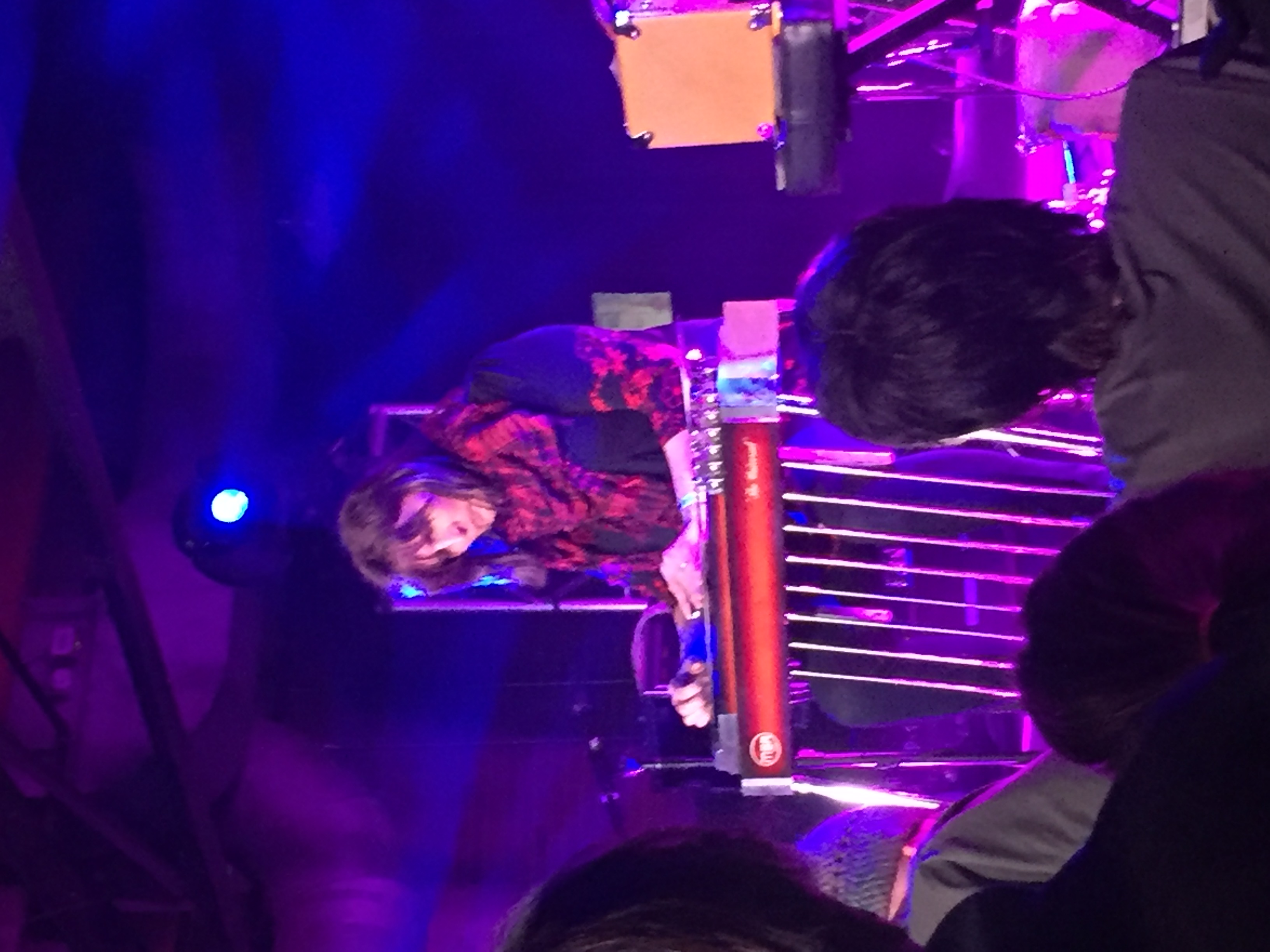
Quickly from there to The Standard to hear Susan Alcorn redefine the parameters of the pedal steel guitar. She played a piece by Messiaen and two pieces by tango legend Astor Piazzola. The “Invierno porteno” – the Winter Tango – was devastating in its beauty. Alcorn has uncovered elements of the pedal steel that were hard to imagine, but that seem perfectly logical once you hear and see her work. Her original compositions – especially the one inspired by the sickness-inducing meal she got on a transatlantic flight – are little gems.

The i2b team spent a few minutes at the gorgeous Tennessee Theater listening to Marc Ribot and David Hidalgo. They delivered gritty blues and Latinx folk tunes, an affable pair of pickers who seemed more like they were on someone’s front porch than a theater stage. Good stuff, and the crowd loved.

A quick scamper back to Mill & Mine for a solo set from cellist Okkyung Lee. This was a take no prisoners event. Lee has all the chops you could ask for from a well-trained cellist, but she was not bringing that style. Scrapes, harmonics, low bleats, swirls of sounds: this is her bag, Ascension via cello, relentless and committed. At one point, her high register scrabblings began to sound like a Braxton or Roscoe Mitchell sopranino solo, complete with keypad tappings and the dog whinny yelps. Gorgeous work, exceptionally well received.

Okkyung Lee wishes to inform you that everything you think you know about the cello is wrong.


Dash across the railroad tracks, back to The Standard for a set by my pals Duet for Theremin and Lap Steel (D4T&LS). I have heard these guys dozens of times – and played with them a few – and I have never heard them better than tonight. At last, a sound system that can deliver what they intend, from delicate whisper to ground-rattling bottom to shimmering clouds of ambient float. They have two more appearances this weekend. Catch one or be sorry.

Finally, back to Mill & Mine for the sonic mayhem of Godspeed You! Black Emperor. I can think of several reasons to not like this performance – lack of  rhythmic/tempo variety, overly simple composition and harmonic development chief among them. But I loved it. It was way, way, way fucking loud, a blast of feedback and howling from the 9-piece group. They know each other, and they know what they are trying to do: their music is an outgrowth of the Coltrane Ascension aesthetic, a headlong pursuit of transcendence through sheer sonic excess.

It’s easy to hear references to the great sonic explorers of rock – Hendrix, The Who, Led Zep, Floyd, and especially King Crimson – all of whom absorbed the Coltranian zeitgeist that transformed not just “jazz”, but rock-based seekers as well.

Both D4T&LS and Godspeed benefited from intelligently curated film imagery. Godspeed’s film technician really deserves full band member credit, his elaborate dance – managing four 8-mm projectors and a large spinning carousel of film loops to choose from – as much a part of the performance as anything else.

And speaking of film, there is an enormous film festival component to Big Ears. Can your intrepid correspondent find time for a moving picture show?

Stay tuned.


Ears Embiggened: Rova

Follow @immunetoboredom on Twitter or check back here for updates throughout the festival.
Share this widely if you please.

The Rova Saxophone Quartet played in Atlanta tonight, a little sneak preview of the coming sonic onslaught of Big Ears. Two sets, unamplified, in the beautifully resonant Existentialist Congregation Church in Candler Park. There was a decent little crowd in attendance that knew how to listen and unpocket their cash for CDs.

Rova is appearing twice at Big Ears, once in the Knoxville Museum of Art (Friday at 2 p.m.) as a quartet. The sound in that building is perfect for Rova, which is celebrating its 40th year as an ensemble.

Consider that, the level of commitment that entails. No knock on the fellas (who are really fine company over a good meal), but this is not music to get rich by. Yet they have hung together, recording around three dozen albums and collaborating along the way with a brigade of prominent musicians, dancers, and composers.

Tonight’s show was primarily material from their latest album, In Transverse Time. The high point of their two sets was the lengthy composition “Hidden in Ochre”, a composition by tenor saxist Larry Ochs. At 24 minutes, this is not an easy pull for most audiences. The moods shift, there are alternating segments of silken beauty and percussive splats. It is in some ways a prototypical Rova piece, a stealthy mix of composition and improvisation that – like the best of what was once called ‘avant garde’ or ‘new music’, and is now really just music – often leaves the listener wondering where the composition/improvisation border resides. No matter. The crowd fairly exploded at the quiet conclusion of this piece.

Pre-show, the quartet played a few notes of Coltrane’s Ascension, a brief teaser for their Saturday midnight show at the Bijou. Rova Channeling Coltrane: Electric Ascension will feature the quartet alongside the likes of Nels Cline, Jenny Scheinman, Okkyung Lee, Cyro Baptista, Yuka Honda,  Ches Smith, and Mazz Swift. It is one of the red star, must see events of the Big Ears banquet.

Coltrane’s Ascension, recorded summer of 1965, is one of the most radically transformative works in the music some call jazz. It is also one of the most controversial: the seemingly unbridled energy belies a structural underpinning that listeners often miss. This structure forms the foundation of Rova’s recreation. This is not cover band mimicry, but rather an attempt to tap into the energetic stream that Coltrane was cultivating in his later period. This is music in pursuit of ecstatic immersion, a headlong dive into the possibilities of transcendence through souuuuund. It is also a logical extension of Trane’s pursuit of the transcendence – a headlong pursuit of what some call Godhead – that became apparent with A Love Supreme.

But damn. Ascension was hard listening for anyone trying to squeeze it into a jazz frame, or into any kind of frame that isn’t Ascension itself. Since then, sonic explorations of this nature have become part of the accepted vocabulary, and at its worst, a set of cliches deployed by players who lack the depth and chops to make it really work. But even in the most capable hands, this is not easy listening by any stretch. Here comes that word again: commitment.

Lucky for us, Rova and their assembled cadre have the inside-playing credibility to turn their outside excursions into something worth hearing. It’s worth the commitment.

Some folks – like me – believe music can change the world. The fact that Rova has the impulse – much less the sheer audacity – to bring Ascension to life  50 years after the fact indicates that they believe it, too. This may be one reason why they have persevered for 40 years.


Ears Embiggened: Seven Bassoons. No, Really.

Follow @immunetoboredom on Twitter or check back here for updates throughout the festival.
Share this widely if you please.

Last year, Big Ears kicked off with nief norf  (more on them soon) performing Michael Gordon’s composition “Timber”, a piece for six percussionists playing amplified 2×4 pieces of wood with mallets. It was one of the great surprises and thrills of the festival. It’s a terrific piece, hypnotizing and thrilling at the same time.

This year, nief norf is back (they are based in Knoxville at UT) and Bang on a Can is bringing it as well. But that’s for another post.

Hidden among the riches in the 2018 Big Ears schedule is the Rushes Ensemble on Saturday from 2-3 p.m. at the Knoxville Museum of Art. Now strangely, there is no mention of Rushes Ensemble on the festival lineup page, so they might be easy to miss.

Don’t. Miss them, I mean.

Rushes is a group of seven of the best bassoon players in the world. That alone is enough to pique interest, but their entire raison d’etre derives from a commission that led Michael Gordon to write a piece specifically for…yep…seven daggum bassoons.

It is hard to describe. The music takes much from Steve Reich’s pulsation methods, and while the overall effect is of something like a Fripp Soundscape – all washes and gorgeous drone – the ensemble is playing to a click track to ensure that the pulsations are overlapping precisely. Eventually, overtones begin to build that create illusions of instruments that are not actually there. I’ve experienced this effect before as both a musician and an audient. It is one of the rare and wondrous physical manifestations of music. The impact on deep listeners can be profound and emotional. It is both gentle and not for the faint of heart.

You can dig around on YouTube and find a performance of this piece by this group. I say, don’t do it. Just turn up Saturday afternoon and experience this for yourself in the acoustically lively atrium of the museum. This could well be the hidden gem of the whole danged festival.

You heard it here first. i2b never sleeps.