Ears Embiggened: 50 Years of ECM

(The first in a series of preview posts as we count down to the
2019 Big Ears Festival in Knoxville, TN.)

Back in the old days – way before the internet machine made hearing just about any recorded piece of music in the world as easy as finding a homemade porno of some celebrity and/or politician – finding out about music beyond the typical commercial channels took some real work. Much of this involved poring over publications of varying literacy levels to find out who was playing with who, where, and how often.<fn>God bless the Village Voice.</fn> You had to spend time dialing in college and alternative radio stations (no internet radio! You had to be within hailing range.) and hoping against reason that the stoned DJ <fn>I resemble that remark.</fn> might remember to announce the name of the track you were dying to identify. Often, you would listen to six or eight more songs in a row, only to have the hapless jock (mea culpa) announce only the last two because, well, he forgot, man.

You had to haunt the record stores. There used to be mammoth stores – stores like Peaches and Turtles and Virgin – aisle after aisle of record bins sorted by genre, carefully filed in alphabetical order. This was for the new, sealed releases. Very expensive, at least 5 or 6 bucks a record.

Then there were the used record stores, meccas for music geeks where you could stand for hours flipping through the stacks hoping to find a gem that you could make off with for two clams, three if it was a double disc set. You could drop 20 bucks on a pile of records just on whim. Maybe you saw a name you recognized, or the album cover was cool. Whatever. If you liked it, you win. If you didn’t, you could bring it back the next week and trade it in for a dollar credit. A buck for a listen or two seemed like a deal.

After a while, you spent lots of time with the album covers, checking out the liner notes and musician credits. Patterns emerge. You start to recognize more names, and not just the players. Engineers and producers start turning up again and again – Rudy van Gelder, Bob Thiele, Teo Macero. You start to keep an eye peeled.

You learned to recognize the record labels. You started to realize that any Blue Note album was worth the 2 bucks. Same for anything on Impulse. Specialty labels like ESP Disk were always worth a tumble, even though you might end up with a squabbling wall of artifactual noise that all but obliterated whatever the music was trying to be.<fn>Many Sun Ra albums, especially on his El Saturn label, were like this, but you learned to buy them anyway because you just never knew what you might find.</fn>

And then there was ECM. Pretty standard rule of thumb: If you saw an ECM in the cutout bin, you bought it. If not for you, then for one of your pals. Don’t recognize the Scandinavian cascade of consonants and diacriticals? Don’t worry, just buy it. If it had Manfred Eicher’s seal of approval, it was worth the candle.

Codona: A typically lovely ECM cover design.

By the time I got serious(ly addicted) about vinyl collection and music that could be safely characterized as out-of-the-mainstream, ECM was a ten year old label with a solid reputation for attention to detail in curation, design, packaging, and recording quality. The covers were thick paper and beautifully printed, the liner sleeves a refined, no friction material, never rough paper. No cheap, junked vinyl here; the discs were heavy and thick, an obvious cut above the major labels pressings on horse chips. They had to be, you see: the ECM sound would not survive the surface noise of standard-issue vinyl.

What about that sound quality? The first few years of releases had varying sonic personalities, but by the mid-70s the characteristic ECM Sound was firmly established, notable for its cultivation of audible space and silence. Even on recordings that were somewhat wall of sound-ish (e.g., Steve Reich’s Music for 18 Musicians) Eicher’s close attention to microphone selection and placement provided clearly defined separation of instruments in the mix. Add to that a well-articulated stereo image and a layering of reverb that served to build a concert hall in your living room. And no matter who was playing, it was the same concert hall every time.

In a 1999 interview with Home Studio Magazine, Eicher explained that he

…listened to a lot of jazz records, mainly Impulse! Or ESP releases; I found the music very interesting, but I didn’t like the way it was produced, mainly because I felt something was lacking, a part of the message had disappeared. My main concern, when I founded ECM, was to respect every aspect of the music. That meant be able to hear every nuance of the instrument, every colour, and respect the dynamics of sound, as given by the musician. This was quite a different way of recording jazz, and public was sensible to it.”

Some of this attention to detail no doubt grew from his experience at the classical Deutsche Grammophon label, long admired for its close attention to audio excellence. <fn>DG is another label, like ECM, that has somehow managed to maintain fierce fidelity to its guiding principles and pursuit of quality, still going strong 120 years after its founding. Maximum Respect!</fn> But there is a marked difference between the ECM and DG sound signature. Eicher was drawn to the atmospherics of reverb – both natural and simulated – where DG cultivated a drier studio sound. One is not necessarily better than the other. Vive la difference! But one thing is certain: You could identify an ECM project within a few seconds of listening.

These days, that ECM aesthetic is more widespread, signal of the influence ECM has had on the way we record and listen to music in the wake of their example. (For better or worse, the whole “New Age” genre pretty much owes its existence to ECM and Eno’s Ambient Music releases.)

The sound – the company motto calls it “the Most Beautiful Sound Next to Silence” – took some critical shots from those who found it icy, cold, antiseptic. Because Eicher, and many of his favorite artists, were from Scandinavia, the label was dubbed “fjord music” and “the Great Northern Sound”. As with too many critical shorthands, the jibes are better as provocative copy than accurate description.

Still, the sound was an ECM signature, and on some releases (like Eberhard Weber’s 1979 Fluid Rustle, which happens to be the ECM debut of Bill Frisell), the sound itself is often more notable than the performance. Descriptions of ECM as the “beautiful music” label emerged, and not in a kind context. To be sure, there were more than a few releases that were just perfect for those 3 a.m. oh-god-I-just-can’t-come-down episodes, times when an ECM record provided just the right amount of sonic-envelopment and gentle massage. This aesthetic would find broader – and less satisfying – expression with the emergence of so-called New Age music from labels like Windham Hill in the 80s.

But the perception is at odds with the reality. Close listening to something like Fluid Rustle offers satisfying elements of compositional innovation, and the performances are superbly delivered. I won’t likely spin this one often, but there is more there, there, than meets the ear. And on balance, the ECM catalog is studded with recordings that are definitional in their realm, with ambitious releases from the likes of the Art Ensemble of Chicago, Dave Holland, Meredith Monk, Steve Reich, Arvo Part, &c. that more than make up for those releases that one might be tempted to dismiss as sonic wallpaper. More than a few people have told me in no uncertain terms that Reich and Part are really just fancy-pants Muzak. For myself, I had long considered Keith Jarrett’s Sun Bear Concerts, a ten-album set of solo improvisation recorded live in Japan in 1978, little better than background hum. Yet here I am, about 3 hours into the box’s roughly 7 hours of music, and I find myself in a serious re-evaluation of my opinion of Jarrett overall and this recording in particular. YMMV.

With the Big Ears Festival’s celebration of ECM’s 50th anniversary less than a month away, I find myself immersed in the ECM catalog, revisiting so much music that has fallen out of my regular listening rotation. Most of the label’s 1500 or so releases are available via your favorite streaming service. <fn>This is ECM authorized streaming, so you can listen guilt-free, though you should buy some of the recordings anyway. Streaming fees are not enough to keep them going for 50 years more.</fn> This is some deep nostalgia for me, a traipse through the soundscapes that helped establish my overall aesthetic philosophy about what music – and art in general – can accomplish in a world in need of healing action.

How I think about music, how I respond to certain creative gestures and techniques, owes much to the ECM ethos. (Especially to my favorite of their roster of artists, the Art Ensemble of Chicago.) My interest in music that comes from other realms and cultures, music that defies easy categorization, or music that can appear harshly repellent or deceptively beautiful at first listen but that reveals more and more depth with every listen. Music that asks us to open our ears to the unfamiliar, to the possibly difficult and challenging. This aesthetic informs my engagement with pretty much all creative work, both my own and from other artists.

If you get right down to it – and apologies for presuming to speak for the Big Ears director – I expect that this is similar to the formation of Ashley Capps’ aesthetic, too. We came of age around the same time and around a lot of the same music. (AC and I met at the Bijou Theater in Knoxville in 1980 at his presentation of the Art Ensemble, one of his first shows.) We both were college radio geeks, the kinds of people who would spend hours flipping through the cutout bins in search of some holy grail recording of someone only we knew about.

And that is likely why Big Ears resonates so strongly for me. When I look at the lineup, it is as though I had just sat down and made a list of the artists I really want to hear and see. It rings the bells that Manfred Eicher started pealing in my head 40 years ago, bells that have shaped much of my life since.

ECM was not the first label to establish such a distinct personality, nor the last. Labels like India Navigation, Soul Note, Black Saint, hatHut, and dozens more have since created powerful catalogs of work in the jazz realm, and Nonesuch is prominent in its delivery of important creative music after its humble origin as a discount bin classical label in 1964. But not many labels have the longevity of an ECM: Fifty years on, Eicher’s vision remains intact (albeit expanded to embrace more classical music since c. 1985) and the company’s business model presumably solid. Hell, 50 years in the recording industry is about three lifetimes. Certainly such a thing is impossible.

And yet, they persisted. Happy birthday, ECM, and thanks for everything.

(Credit to the Home Studio Magazine interview with Eicher and Tyran Grillo’s superb website, a heroic labor of love from a guy who just wanted to write a thoughtful review of every album ECM ever released. And immense thanks to the Big Ears Festival
for throwing ECM a big ass birthday hoolie this year.)


The Prodigal Returns

Forgive me readers, for I have sinned.

The primary directive for bloggers who wish to be well attended: Keep your content fresh. Post frequently so that your legions of followers know they will always find something new every time they check your page.

In this, I have failed. Mea maxim culpa.

But I’m back, better than ever, so fatten up a calf for me and gather round to hear my plans.

First off, you may ask yourself: How can I (the reader) trust this bounder (your inconsistent correspondent) to keep up his end of the bargain, to toil diligently so that I (the reader) might enjoy high quality distractment at my (the reader’s) beck and call. Because instant gratification is the coin of the realm, evidently.

Hey, just trust me, okay?

I swear on my grandchildren…

Besides, there is so much more that I want to write about that nobody wants to pay me to write about that I might as well just start typing and putting it up here for free.

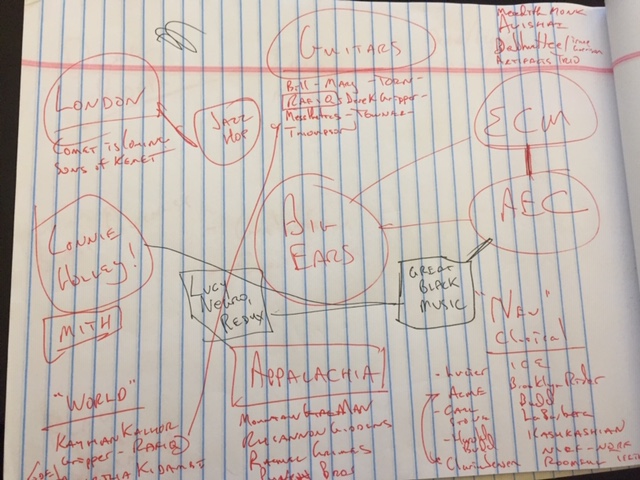
I’m working on a site re-design, because four years is plenty for the same look. But that’s just cosmetics. Expect a great deal more of the music/lit/tv/film content, starting with the annual wall-to-wall cogitations about the 2019 Big Ears Festival. The scope of this year’s festival is making me dizzy. It is not just the challenge of navigating performance schedules<fn>Saturday afternoon’s lineup in particular is a fantod-inducing embarrassment of riches, thanks very much.</fn> that trigger my most extreme option anxiety. Even the (allegedly) simple task of sorting and categorizing the proceedings – something any decent music writer has to be able to do – is an exercise in recursive Venn diagramming and cross-category perplexity that would make a lesser writer quail, if you could find one.

The tidy process of an orderly mind

So get ready for some flailing attempts at exegesis and grand-scheme syncretism. I’ll get my head around this thing or collapse trying. From the 50th anniversaries of ECM records and the Art Ensemble of Chicago to the brand new ballet (yep) from Rhinnon Giddens, this festival has got my blood all het up. Don’t even get me started on the guitarists on tap.

The blog will also pay more attention to the cultural highlights here in Tallahassee. It still isn’t quite NYC, but significant things are happening here and there is a real scarcity of arts coverage in this town. I’ve noticed several significant events come and go lately with scarce a word of notice, to the point where we only find out about some of these happenings after the fact. I will do what I can to fill the gaps.

The April calendar is chock a block with world-class creative work. It also happens to be Tallahassee’s most lovely time of year: temperate climate, azaleas in bloom, and enough pollen to stun an elephant. Get your travel plans ready.

The Tallahassee Film Festival brings an expanded scope of activity April 5-7. On top of smartly curated films, there will be a Saturday night shindig at The Wilbury featuring Baltimore-based electronics wizard and DJ Dan Deacon, described as “notorious for his wild and spontaneous live shows that meld the vibe of a performance-art happening with his free-thinking permutations on decades of avant-garde music lineage.” More details on this cool fest as the schedule firms up, but it promises to be a big treat.

The weekend of April 12-14, our annual Word of South Festival is gonna be terrific (lineup is under press embargo for now, but trust me…LIT!). Aside from a ticketed concert on Friday night, everything is free. The fest sprawls across Cascades Park in everything from small tents to bigger tents to huge tents to the mainstage amphitheater. Once again, the crew at The Bitter Southerner is programming their own stage for the weekend. They were so well attended last year that they have been moved to the large stage adjacent to The Edison. It’s a smart move. More details on WoS here when the schedule is released.

(I also have a WoS feature landing in Tallahassee Magazine first week of March and a review of last year’s hoolie here on the blog.)

Piling on. Saturday, April 13 – smack dab in the middle of Word of South, finds the sonic blasts of the Nels Cline / Larry Ochs / Gerald Cleaver trio at 5th and Thomas.<fn>5&T is establishing itself as a first rank room for listening to good music. Primarily a venue for touring Outlaw Country and roots rock bands, this booking happened almost by accident, but let’s just genuflect for a moment at good fortune and get our assess out to fill the joint for this one so we can convince management to bring more in this vein.</fn> Cline is one of the most active and influential guitarists on the scene, or rather, on many scenes, maybe even every scene. Best known as the guitarist for arena rockers Wilco, Cline’s curiosity ranges across every style you can imagine and his trickery with electronics and sheer souuuuuund will leave you wondering how/what the hell happened. On this gig, you get to see him up close. I pity the fool who misses this. And I pity lovers of creative music in Tallahassee if we don’t fill the room for this one.

Larry Ochs, one of the founders of the Rova Saxophone Quartet, is a beast on tenor and soprano, a thoughtful composer and arranger, and restless seeker of high grade collaborators like Anthony Braxton, Kronos Quartet, John Zorn, and Sam Rivers. Drummer Gerald Cleaver is a veteran of the jazz and free jazz world, often heard alongside creative giants like Roscoe Mitchell, Henry Threadgill, and Craig Tabor. People, this is a true creative music supergroup. You can listen to and order their first recording, released last month, at the Clean Feed website. <fn>You will be hearing a lot more about Clean Feed here in the coming months, too. It is an insanely prolific and high-quality record label based in Lisbon. Yowsa.</fn> Recommended track: “Shimmer Intend Spark Groove Defend.”

What else can I offer to regain your trust and traffic? How about thoughts on the use of moral philosophy as a plot platform in (ostensibly, perhaps) funny television programs? Or maybe the intersection of racial discrimination, education policy, banking practices, and criminal justice reform? Maybe you just want the occasional reading recommendation, or maybe just a recipe for a good soup.

I am not running away from the political, but damn if anything I write about the ongoing atrocities does not seem outdated by new atrocities before I can even hit publish. But campaign season is nigh upon us, a full year before the first caucus or primary, so I’m sure I will find a way to make myself look foolish soon enough.

As always, I love hearing from readers. Complaints, outrage, fawning praise, whatever. Seriously, there’s no money in this here bloggy vineyard, so let me know you are out there.

Unless you aren’t. In that case, carry on.


A Half Glass

Let’s give it another go, shall we?

My last missive was, shall we say, a tad down in the mouth. Things could not possibly be so dire. As one critic would have it, it sounded as though my dog had died.

Well, she did, in fact. The day before the election. And there is an enormous Maggie shaped hole in my heart.

Here Lies Maggie: She Had a Wonderful Life

But moving along. The initial results of our national exercise of the franchise – an exercise that far too many still feel is not worth turning off Duck Kardashian and going to the fucking polls – were not especially comforting to those who favor science, inclusion, education, access to health care, gun control, social justice, &c. You know. Sane people.

And truly, the trend by 10 p.m. Election Night – alongside the punditry’s thigh-rubbing enthusiasm for yet another Dems in Disarray narrative – was utterly dispiriting. But despite a desire that results arrive tidy and timely, ballots do not bend to a tidy timeline.

So here’s why I’m feeling optimistic on this brisk and sunny Sunday morn.

(ed note: Optimistic? Who are you and what have you done with The Writer? Security!)

What was looking to be a pretty solid denial of the Blue Wave has actually turned out to be a very convincing argument that this is a nation that is tiring of the end game degradation of GOP politics as embodied by the Mar-a-Lago Hapsburgs. Despite the best attempts of GOP apparatchiks to gerrymander and vote suppress their way to victory, the results are clear: The nation is ready for a drastic course correction.

Yes and sure. We remain a starkly divided nation. The middle has not held, and while that may be some cause for worry among the terribly and deeply concerned civility fetishists<fn>I’m looking at you Senators Collins, Flake, Corker, et al</fn>, the middle has been dragged so far right over the past 40 years that it has become damn near synonymous with what used to be called Conservatism.

(There is no middle. Get over it. Consider the “great” centrists of our day; there have been ample opportunities for them to demonstrate independence from Trump, yet their opposition has extended only as far as handwringing twitter agonistes just before they fall in and vote the party line. One-time pseudo centrists like Graham have become enthusiastic attack dogs for the likes of Kavanaugh.<fn>And spare me, please; John McCain was no fucking better.</fn>)

But let’s take some comfort in the outcomes where we can.

In the House, a place where Dems consistently win the raw national vote total by several millions while still falling prey to the clever gerrymanders of the state-level GOP, the Dems were striving to pick up 23 seats. This was bare minimum to flip control and, most importantly, place subpoena power in the hands of Democrats who would presumably be less quisling in their approach to Trump’s depredations than the current crop of Vichy chairmen.

(And yes, all men they were. In a delightful turn of events, Rep. Maxine Waters will hold the gavel in the House Financial Services Committee, where she has made clear a thorough inquiry into the Trump Family business practices are top priority. Pass the popcorn.)

As of today, the Dem pickup total is 37 seats. This is fairly huge, comparable to Democratic gains during the Watergate midterms. Also huge: the first Native Americans (both women) and first women Muslims have been elected to the House. Also huger: 35 new women House members (bringing the total to 135, still proportionally low, but an alltime high) and 5 new women governors. The number of successful Moms Demand candidates, running almost solely on the need for sensible gun control and the defenestration of the NRA, was another heartening trend.

The battle for the Senate was severely aligned against Democratic gains. Of the 33 seats under contest, 23 were D-held. Dems needed to gain two seats to flip control of the Senate. Flipping an incumbent is never easy. The three GOP retirements were in solid red states: Arizona, Tennessee, Utah. And Dems were defending seats in some fairly red spots: North Dakota, West Virginia, Montana, Missouri, Indiana. And one of the big hopes lay in unseating Ted Cruz in uber-Red Texas.

By end of election eve, it looked as though the GOP would increase their Senate majority. But wait a few days: by the time all the provisionals and absentee ballots are counted, we may (BIG ‘may’) see the Republican advantage actually reduced by one. And damn if the Dems didn’t flip Arizona.<fn>Maybe. Recount underway, but not even GOPer candidate McSally seems to doubt the outcome at this point.</fn>

But that “may” is big, and it seems to have a Florida shape to it.

The contest between incumbent Bill Nelson (D-Cosmetic Surgery Clinic) and current Governor Rick Scott (R-Sulfuric Pit of Corruption) is in recount territory. Manual recount, to be precise, wherein we may experience the shudder of deja vu of the Bush/Gore nightmare. One key difference: the Dems have learned their lesson about knife fighting. There will be no Gore-esque capitulation in the hopes of bringing our fractured polity together. Nelson’s team is fighting for every vote. Naturally, that means the Republicans are calling the recount “illegal” and accusing the Dems of trying to “steal” the election and Nelson of “embracing fraud.” No less a genius than our Toddler-in-Chief has taken to the Twitter to declare this so.

Despite the tantrum, the Governor’s race is also headed to machine recount. If that recount reduces the margin to less than .25%, it will then undergo manual recount.

GOP outrage is one source of my optimism.<fn>Hit dog gonna holler.</fn> The gap in both races has diminished steadily as final ballots are counted. As of this morning, Nelson is down by 12,500 out of 8 million votes cast. Gillum is down by around 33,000. And in the Agriculture Commissioner’s race, the outcome flipped since Tuesday with Nikki Fried set to become the first Democratic cabinet official in nearly ten years. Her thin lead of around 4000 votes could very well survive the recount.

But let’s get real.

Rick Scott is still odds-on likely to become a U.S. Senator. And the odious Ron DeSantis is almost certainly going to be our Governor. The raw numbers are not promising. If these outcomes persist, it will represent a crushing disappointment for those yearning for a self-enlightened electorate in Florida. But.

Just as with the almost-but-not-quite Beto O’Rourke in Texas, Gillum is now a bona fide progressive star. He is young and he is no quitter. If some miracle rolls along, he will make a fine governor, and even after two terms would still be only 48 years old, plenty of time for a run at the national stage.

And if he falls short, there is a big, fat Empty Suit of a target looming in Marco Rubio for the 2022 Senate race. He would also be an attractive running mate for the 2020 challenger to Trump. We have not seen the last of Andrew Gillum.

Other bright lights. The national percentage of Democratic votes for Senate was just north of 57%. In House races, it came to around 52%. Combined gubernatorial numbers point to a full percent advantage for Dems. On the one hand, these numbers are meaningless in terms of outcomes. On the other, they are a fair indicator of national sentiment towards GOP governance. It remains to be seen if Democrats can maintain their energy and convert this into an electoral college triumph in 2020 (a big if given the disproportionate advantage the EC provides rural states).

This morning, Nate Silver at 538 released an analysis that overlays the 2018 House vote on the Electoral college map. Just counting Dem victories of 5% or greater, it would amount to 278 EC votes for the Dems. The number jumps to 324 by including margins of less than 5%.

Nate Silver’s House Vote / Electoral College overlay

So yes indeed, I am brimming with optimism, a shiny happy people happy happy.

(ed note: The authorities have been notified.)

Poet Ilya Kaminsky posted this on Twitter this morning, a fine thought from historian Howard Zinn to carry us through the coming week, month, years…

To be hopeful in bad times is not just foolishly romantic. It’s based on the fact that human history is a history not only of cruelty but also of compassion, sacrifice, courage, kindness.

I’m gonna go dance among the daffodils now.


Letter from Tallahassee: Election Day Hangover

I woke up today feeling wretched and I didn’t even bother to drink too much last night.

For the first time since 1972, I went to bed early on Election Night. The statewide results in Florida were too painful to bear, and the chirpy happy talk from the MSNBC/CNN yapping heads was doing nothing to make it go down easier. Yeah, flip the house, lots of ponies in that stable full of dung, but dammit, if I go to sleep and never wake up, I will never have to face a world in which the idea of Senator Rick Scott and Governor Ron DeSantis is a real thing.

Alas, I woke up, and it’s all I can do not to go back to bed and stay there.

Florida is, in a word, fucked. Our governor elect is a man of few ideas beyond sycophantic devotion to Trump and simmering resentment at liberals who, evidently, wish to turn Florida into Venezuela. Naturally, he makes no sense beyond the fevered imaginations of Fox News inmates, which is DeSantis’ prime and only true base. He is a pure bred Fox hothouse flower, anointed by Trump and carried to victory by his partisans. He ran a terrible, inept campaign. He appealed to the ingrained racism and resentment that may be this state’s number one cash crop, painting a decent and good man as a crazed, soft on crime socialist who wants to destroy “our” jobs and economy. You know, the black guy, nudge wink say no more amirite?

And he won.

The man DeSantis will replace is widely known for shady ethics, crony favoritism, a “blind trust” with surprisingly good eyesight, and a multi-billion dollar Medicare swindle. Rick Scott plunked down $51M of his own money to buy a U.S. Senate seat, much as he bought the Governor’s office. Keep in mind that he walked away from the Medicare scam with around $350M in severance. That means that Rick Scott has bought his political career with your money. Nice work if you can get it.

Scott will represent Florida alongside the Emptiest Suit in Florida Politics, Marco Rubio, a man notable for his earnest conversion from Trump critic to Trump taint licker. Scott’s addition to the absurdly labeled “world’s greatest deliberative body” provides him a broad range of platforms upon which to ply his habitual grift and graft.

Other depressing news? The Agriculture Commissioner, Chief Financial Officer, and Attorney General are all dyed in the wool Trump-fondlers. The A.G. outcome is especially dispiriting, her campaign largely financed by outfits like GEO and Core Civic, private prison corporations who make money hand over fist based on the policies of people like AG-elect Ashley Moody. Anyone hoping for a glimmer of criminal justice reform in this aggressively carceral state has got another thing coming.

The Florida electorate also engaged in an orgy of Constitutional amendment passage. Among the bright spots: the gradual elimination of Greyhound racing in the state, a barbaric holdover from yesteryear. Amendment 9, which bans offshore drilling in state waters, also bans vaping in most workplaces. It’s a bizarre conflation of unrelated issues.

Among the lesser lights: passage of several measures that require super-majorities to raise taxes and educational fees, exactly the kinds of policies that all but crippled California in the decades following Proposition 13. Along with a couple of mandated caps on property tax valuations, these GOP-pushed policies are designed to ensure that funding levels for government programs, specifically education, continue to wither. As Grover Norquist has longed advocated, the GOP is intent on shrinking government to the size where they can “drown it in the bathtub.”

Then there is passage of Amendment 6, aka Marsy’s Law. This pander-heavy “victim’s rights” measure received massive national backing from law and order groups. In short, it attempts to circumvent defendant rights in favor of emotional appeals to stricter “justice” for victims. It remains unclear how this might differ from good old fashioned vengeance aside from the fact that victims will not be allowed to administer corporal or capital punishments themselves. For now.

Expect this one to face legal challenges for its overreach, though hopes for winning those challenges is diminished by the ongoing right wing takeover of the Federal and State judiciary under Trump and DeSantis, whose first official action will be appointment of three State Supreme Court Justices on his first day in office. This is in fact the one and only specific policy DeSantis articulated during the campaign. One wonders what he will do to occupy himself for the remaining 3 years and 364 days.

The brightest spot on the statewide ballot was the overwhelming approval for Amendment 4, which restores voting rights to most formerly incarcerated felons who have served their sentences, roughly a million voters, predominantly minorities. This is a huge progressive win, though anybody who thinks a DeSantis administration will not go out of its way to undermine this initiative has not been paying attention to the GOP’s near-religious devotion to voter disenfranchisement over the past four decades.

But here’s a real puzzler. Amendment 4 took about 64% of the vote. DeSantis and Scott each took closer to 50%. Who are the 13-14% who voted yes on reinstating the vote for returning felons while simultaneously voting for two guys (and their party) who are staunchly opposed to that outcome?

Bright spots? Sure, there are a few. Democrats managed to flip a couple of U.S. House seats and a handful of state house slots. But despite its popular image as a purple or swing state, the political leverage in Florida remains firmly in the hands of the Tea Party GOP. The vote margins might be thin, but their grip on power is decidedly strong.

The next four years are not going to be pretty for progressives in Florida. The enthusiasm behind Andrew Gillum’s race has been huge, especially among the traditionally underserved communities across the state. Can that energy form the basis for an ongoing progressive movement in Florida? Can Beto’s almost victory in Texas do the same there? These are two superb and charismatic campaigners. How might their personal appeal translate to support for a progressive movement writ large? Is it dependent upon a savior figure? Or will scores of first-time political enthusiasts now sink back into their non-participatory torpor, proven right once again that political engagement just isn’t worth the candle?

It’s a tough call. The Trump base craves a movement that feeds its sense of resentment, and in that they are more than served by the current regime. Their prevailing desire is to somehow “stick it to the libs”, even if that means undermining their own interests. The progressive base craves policy change, an often dull and incremental process that is far less emotionally satisfying than laser-focused rage.

But not even I can miss the bright spots. The fact that Gillum and O’Rourke came as close as they did in traditional hotbeds of reactionary and racist attitudes is indeed a sign of hope. The slim reed of Stacy Abrams’s campaign in Georgia, still alive as of this writing, is another enormously encouraging sign of a populace (perhaps) awakening from complacency.

Victories and activism by dozens of progressive women, people of color, and LBGTQ figures were essential to the Democrats taking control of the U.S. House and a big handful of governor’s races. We are rid of such perennially toxic figures as Scott Walker and Dana Rohrbacher. (Alas, Tennessee has delivered upon us the latest version of Michele Bachmann in the guise of Senator Blackburn, yet another in a tragically long line of “godly” Stepford candidates who reliably view the world through an “I got mine” lens.)

The brightest spot? A Democratic majority in Congress poses a legitimate barrier to Trump’s rampaging authoritarianism and violation of law. A number of superbly qualified Democrats will take up the gavel across the House committees, bodies that will be empowered to investigate and subpoena the Trump administration in ways that quisling toadies like Devin Nunes and Jim “Gym” Jordan would never allow. This is a huge improvement over the current condition, no question.

Nancy Pelosi will once again be Speaker of the House. I have little patience with the ‘dump Pelosi’ faction among the Dems. She has been the most effective legislative leader over the past 30-40 years. Granted, I also have little patience with some of her statements, such as this one in the hours after last night’s results became known.

“We will have accountability and strive for bipartisanship. We must try. We have a bipartisan marketplace of ideas that makes our democracy strong. We have all had enough with division.”

Well excuse me and all, but, fuck, no. There is no hope for bipartisanship in this political moment. The GOP leadership has made that clear since Obama nominated Merrick Garland for the Supreme Court. I can only hope that Pelosi is playing the formal game here and that she has no intention of looking for points of compromise in the coming fight.

And make no mistake. This is the fight of our political lives. Two years of Trump, and the GOP’s slavish submission to his toddler whims, have degraded our civic society to a low level not seen in 160 years. The sick irony is that it is fueled by the same questions of power and racial animus that powered the drive to secession.

What would civil war look like in America today? There is no neat geographic division between North and South to demarcate who would remove themselves from the larger whole, to delineate where hostilities might be generally contained. Civil war would be more a Beirut or Belfast model, bitter foes living next door to one another with the norm looking like recent spasms of violence in Kentucky or Pittsburgh or Charleston, or even the recent yoga studio shooting here in Tallahassee.

We may have already arrived. Did Fort Sumter happen and we just didn’t notice?

For now, the civil war is asymmetric, one side predominant in the hostilities. There remains a hope that our fabled democratic norms and institutions will offer a path away from complete social disintegration. It is my hope, and the reason I will continue to pursue – and even believe in – the imperfect ideal of creating an enlightened self-governing republic. I admit that I find the prospect bleak.

And yet, we persist. To do otherwise is even bleaker.