All the Critics Love U in New York

If there’s any celebrity you can be sure you did not know in any significantly real way, it was Prince. Shape shifter, name shifter/eraser, master of every style you can name. Intensely private and essentially flamboyant. Exhibitionist. Hermit. You don’t know him except in the ways you think you do, and that has as much to do with what you wanted him to be as it does with which little pieces of mythologizing he wanted you to see at any given time. Like the classic Trickster of legend, he could present multiple faces at the same time, and the face you got to glimpse, briefly, depended on which side of the road you were standing on. If Prince had been around then, Kurosawa could have made this pint-sized product of Minni-freaking-sota the centerpiece of Rashomon. That would have been cool.

What do I know of Prince? We’re roughly the same age. He’s probably the most under-appreciated guitar player in like ever. Over the years that I have been heralding him as easily the best thing since Hendrix and sliced bread I’ve received more than a few puzzled looks and dismissive chuckles about me just being a contrarian. This week, many people were surprised when Billy Gibbons described his playing as “sensational”.

But even that is only a piece of it. From his textbook knowledge and respect for those who came before him – JB, Sly, Jimi, Miles, George Clinton, &c. – to his savage dance chops and ultra-sharp fashion sense, to his early adoption and mastery of technologies like the Linn Drum; the guy put a package together that was both historically intelligent and, somehow, way out in front of the coming surge of hip-hop and Michael Jackson/Madonna style pop that followed him by a few years. The man had his gifts. Add in an almost incomprehensible work ethic, and you have Prince.

How Prince helped me know myself comes down to this simple question:

How could anyone possibly fail to recognize such evident talent?

Probably the way that I did.

Because instead of listening, I reacted to the packaging cues that came with the Prince product. And because he hit the scene in the late 70s with a funky beat, puffy shirts, lots of synthesizers, and a (deceptively) silly reliance on lyrics about fucking, I saw him clearly for what he was: just another callow Disco Boy, a Travolta, a Bee Gee.

It’s hard to remember (or, if you are a little younger, comprehend) the degree to which DiscoSux fever encompassed the world of funky music. Earth, Wind & Fire, James Brown, P-Funk: all these and more took their share of unfriendly fire from people who were essentially painting the entirety of black popular music as beneath-contempt shit.

DiscoSux fever was a symptom of reaction against gay and minority encroachment into the historically masculine world of rock and pop. This music was aimed at gender-fluid communities and urban black folk. For a generation of mostly white, hetero-norm critics and fans for whom rock’n’roll equaled priapic guitar stroking and golden-maned Dionysi sporting socks stuffed into spandex trousers, this was music that threatened the natural order. <fn>The pulse belonged on the 1 and 3, dammit, none of this 2 and 4 backbeat shit. Whaddya, Disco Duck?</fn> It was outsider art storming the academy. And I was a privileged, by-birth member of the patriarchal academy, though I didn’t even know that such a thing existed; such is the blindness of by-birth membership.

Prince said fk all that noise, and it was pretty clear that he was throwing down on, well, people like me.

Look out all you hippies, you ain’t as sharp as me
It ain’t about the trippin’, but the sexuality
– All the Critics Love U in New York

Hey. I resemble(d) that remark.

So I could “listen” to When Doves Cry or 1999 and quickly sort this alleged genius off into the “just another over-hyped fraud” bin.

In that same song, this upstart had the nerve to sing:

It’s time for a new direction
It’s time for jazz to die

As a burgeoning jazz-bo, I tooks what I tooks and it was more than I could takes. I didn’t need to hear the music behind this pixie poppinjay. These crude insults told me all I needed to know! Pistols at dawn!

Later, when Miles compared him to Duke Ellington and Chopin, it was easy to dismiss the comments as Miles trying to glom onto the popularity of the younger phenom. Because come on: he’s really just another Disco Boy, and everybody knows that DiscoSux, so pass the bong and cue up some Coltrane or some real rock’n’roll. Dude.

One night in 1993 I watched a terrific Neil Young Unplugged on MTV<fn>In those days, children, the M stood for “Music”. You can look it up!</fn>. The next show was Prince live in some mega-arena, and I watched it and thought, “Meh, pretty good” and then he walked offstage and into a limo that took him somewhere and he walked into a small club and took the stage and proceeded to melt my face with a yellow guitar and the most scorching Hendrix-style blues I’d heard since before Stevie Ray died. For the next hour I was slain. I’ve been listening to Prince ever since.

So what does the phenomenon of Prince teach me about myself? Every time I hear his music, even as I am digging it down to my toes, I am reminded that I am a fallible human being, prone to unpleasant bigotries and prejudices that cause me to stop paying attention to what is real and true. The impulses that put me on auto-piloting sort mode – this person is this, that music is that, I don’t like “those” kinds of people/music/movies/food/&c. – are the things that make me miss the My Favorite Worldness of life. It’s good to have a ready reminder – one that the iPod throws up randomly and often – that for all my pretense to erudition and discernment and such like, I am just as likely to react like a dope as I am to apply any kind of intentional awareness to, well, anything.

Which means, naturally, that any opinion I hold is inherently suspect and worthy of re-examination. Consider yourself duly warned.

The most delicious part of the irony is that the song I quote above, had I bothered to listen to it in 1983, would have delivered exactly the kind of face-melting guitar heroics that won me over ten years later. Check it.

https://www.youtube.com/watch?v=pJxt_Ey6tbo

Who knows? I was full of myself in those days<fn>Unlike now, when I am extremely humble and enlightened.</fn>, so I might have dismissed it anyway.

Thanks, Artist Who Formerly Bestrode The World as Prince. Somehow, having you be the constant reminder of my proclivity to dopiness ain’t all that bad. You sexy motherfker.


The Wheel Turns

At the end of the Civil War, the United States assumed ownership of Robert E. Lee’s family plantation, high on a hill in Arlington, just across the river from the Nation’s – the unified nation’s – capitol. The family home remains, but the grounds of that plantation, a place where hundreds of slaves worked and died, became the final resting place for more than 15,000 dead Union soldiers.<fn>This ranks among the finest and most appropriate nose-rubbings in American history, and dog knows we have a history nose-rubbings both noble and ig.</fn> One hundred fifty years later, the body count approaches half a million.<fn>It is a bitter pill that, as the cemetery expanded to fit all the fallen, a large community or freedmen was evicted to make room for more corpses.</fn>

The first memory I have of Arlington is a Spring Break trip there with my Dad to visit the memorial marker for his younger brother, a Top Gun pilot who died in a training run in 1964. This visit was c. 1973, near the end of the Vietnam War. There was something about the way the geometry of all the grave sites shifted as you moved down the road that made it look infinite. And it occurred to my callow self, all of 14 years old, that every white dot was a dead soldier. A guy just like my dead uncle. And somehow the horror that I had never registered through years of watching Vietnam carnage on teevee landed with a careening thud. And I remember this horrific, engulfing sadness, mingled with a concern that I was going to start crying, sobbing – in front of my dad! – and how could I possibly save myself from such embarrassment, so my horror and fear mixed into this massive spaghetti ball of empathy for the victims and fear of shame for myself, which I managed to escape by stuffing my feelings down the way well raised males of a certain age know all too well.

What I didn’t know is that my dad took my picture while this internal riot was raging. It has hung in his (every) home ever since. Did he know?

Every time I’ve visited since then, the massive horror of the place envelops me. I am angry. I see the grand monuments of the generals and admirals, the ostentatious stones and crosses planted for the men who sent the rest of that half-million mostly forgotten horde to mostly senseless slaughter. I am no fan of war, no admirer of military “might”. Much of what the National Cemetery represents is senseless waste, cock-strutting ego. It is evidence of a madness that is evidently irresistible to many who gain power.

But somehow, there is always an overwhelming sense of awe and serenity, a presence of commitment and memoriam that I’ve experienced only a handful of times.

Nothing rings that bell more than the Tomb of the Unknowns.

Today found me – 43 years after my father brought me to Arlington for the first time – bringing my own son to Arlington. It’s our first day of a Spring Break romp through American History, a subject that we both enjoy. As we walked into the grounds, I felt the tingle. This place just gets to me. We wandered past the Kennedy flame and on up the hill to the historic Lee home. Every few minutes, a thundering boom of commemorative cannon fire or the crack of rifle shots broke the silence. Apparently, there are upwards of two dozen interments every week day. The gravedigger’s job is never finished.

We had time to stroll. The markers were often unintentionally funny. Many higher-ranking officers had their wives buried next to them, their stone reading simply “wife”. This “wife” had a name, that one didn’t. Best monument of all: a Navy Admiral whose stone specified “And His Second Wife”, a last gasp middle-finger extended from the beyond toward wife #1, who must have really been a piece of work to deserve such an enduring “ah fanabla”.

Clouds of gunpowder smoke hung over the hills. And despite the fact that there was a considerable crowd of all-American event-attenders, there was none of the antic quality tourist crowds bring to almost every other “point of interest”. Even the kids we’d watched using the Metro hang straps like monkeys somehow knew to dial it down.

As we approached the Tomb, the silence grew deeper. It was crowded. One small child was crying, but his Dad – a Marine by the looks of his t-shirt and hat – lifted him gently and carried him out. A few minutes later, both were back. Quiet.

The Honor Guard upheld the ritual that has been played out thousands of times. Twenty-one steps to the south. Heel click. Twenty-one second pause. Turn to the east. Click. Twenty-one second pause. Turn north. Click. Twenty-one second pause. Shift rifle from the east shoulder to the west shoulder. Twenty-one steps north. Click. Turn to the east. Repeat.

There is an honor guard on duty 365/24/7. Whatever the weather. Last time I was there, it was New Year’s day c. 1992 or 3. It was very cold, like skin cracking cold. Because my Dad has a family pass, we were able to drive directly to the Tomb. We were the only people there aside from the guard. It was grey, damp, windy. We lasted about 20 minutes, just long enough to watch the Changing of the Guard. It was a solemn, precise ritual. There was no audience for this aside from three of us. It didn’t matter. They do this in the rain, the snow, in the dead of night. Twenty-one steps, twenty-one seconds. Over and over.

Ritual. Commitment. Memoriam.

So as the Changing ritual began today, we – like everyone who witnesses it – we rose to our feet. We held our hands over our hearts whenever active military would offer a full salute. The Changing was immutable, constant, reliable. A few cannon shot echoed from another ceremony.

And then, through no good planning on our part, we found ourselves witnessing an expanded ceremony, this one a wreath-laying ritual with an extra guard and musician. Four high school students “helped” the guard place a new wreath in front of the tomb. Another guard laid the previous wreath at the base of the Tomb.

All this was happening under the stern command of Master Sergeant Calderon, a truly formidable presence with a voice that demanded attention. But where we stood, we heard the other side: a gentle man, a gentleman, who softly explained to the teens exactly what to do and when to do it. The modulation from fierce to tender was precise and – really, the only word I can call up – genuine.

I was feeling misty-eyed, taken by all the sadness and beauty of 150 years worth of dead children – because truly, most of the bodies here never saw two dozen winters. A bugler presented. A robin – the first of the spring? – flew from left to right across the Tomb site. And the first notes of Taps, a crystalline tone borne on angel’s breath, took me. Flow my tears.

In the distance, a formation of fighter jets were coming up the river. I thought it a nice coincidence, here they come, nice coincidence, hey they’re flying right over us and there goes the third jet, peeling away from the formation up into the sky until the clouds swallowed it and it was gone, the traditional tribute to the missing man. I don’t think any of us were even breathing at this point. And then, the extra players marched away, leaving the lone guard with his incessant count of twenty-one, twenty-one.

It turned out the flyover was for another ceremony on the grounds. Life and death go on. Some of the dead are sent away with cannon shot. Some get rifles hoisted and fired. And some, no doubt grandees of military renown, still have the juice to garner a quick flyover of four billion dollar airplanes.

(Ed Note: Pal of i2b DD points out that the flyover was more likely for a deceased pilot, perhaps even a Top Gun like mon oncle, and not (his words) “some brass monkey”. Duly noted.)

As we walked away from the Tomb, we saw a horse-drawn hearse roll by. We followed it for a bit, then realized it had already discharged its coffin load, so we wandered back towards the exit, across the Memorial Bridge that leads to the Lincoln Memorial, a bridge that aspirationally exemplifies the rapprochement of Union and Confederacy that, somehow, remains as salient a divide today as it was that day at Appomattox. Son stopped at one point and wondered if the President might sometimes visit this place after closing, just to get a reminder of the awesome power he holds. All these lives. The weight of responsibility must be – one can only hope – truly terrifying.

We crossed the river and wandered to the front of the Lincoln, one of my favorite places, with the idea that we would read the Gettysburg Address and add some resonance to the day’s experience. But the steps were mobbed with event-attenders in full flight, and Son refused to climb the steps, refused to even look up at the statue of Abe, preferring to wait for a chance to see it when the proper reverence was at play. Smart boy. We’ll go back after dark one night.

The Boy, Considering
The Boy, Considering: I sent this pic to my Dad. My guess is that it made him misty-eyed. Whaddya gonna do?


It’s Darker Than You Think

You’ve got to be taught
From year to year,
It’s got to be drummed
In your dear little ear
You’ve got to be carefully taught.
– Rogers/Hammerstein

It’s not dark yet, but it’s getting there. – Bob Dylan

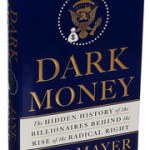
I recently ordered the book pictured above, a in-depth investigation of how the radical right has gained power over the past 30 years. Alongside the essential trilogy by Rick Perlstein (reviewed favorably by an obscure blogger here), Jane Mayer’s Dark Money: The Hidden History of the Billionaires Behind the Rise of the Radical Right fill in the blanks on one of the pressing questions of our time:

How in sulphuric hell did an utterly discredited economic and social philosophy come to have such a dedicated cadre of fanatical devotees, even though it works directly against the interests of many of its more fanatical followers?

The hell happened?

Set aside the flimsy tissue of melodramatic horseshit that is the scribbling of Ayn Rand. For better or worse (better), not many impressionable youngsters are going to slog through her horrible writing and plotting to have their brains turned to mush and their hearts to stone. And for better or worse (worse), a certain type of bookish youth is always on the lookout for a book that sets them apart as some kind of forward-thinking intellectual.<fn>Someone who looks like me resembles that remark.</fn> And if Rand is the prop du jour, bad tidings inevitably ensue.

There are two novels that can change a bookish fourteen-year old’s life: The Lord of the Rings and Atlas Shrugged. One is a childish fantasy that often engenders a lifelong obsession with its unbelievable heroes, leading to an emotionally stunted, socially crippled adulthood, unable to deal with the real world. The other, of course, involves orcs. – John Rogers<fn>fwiw, Rogers was also the creator/showrunner of the under-appreciated teevee show Leverage, which is well worth your binge-investment.</fn>

But Rand alone is not enough to explain the spread of the “greed is good” mantra that is driving policy debates over things like health care, taxation, income inequality, campaign finance, &c. Too many people who wouldn’t know Salma Hayek from Friedrich Hayek are parroting the Randian gospel. An Irish pal of mine told me about a great Old Country turn of phrase re: child rearing: “Well, she didn’t pick that up off the floor.”

Nope, they’ve got to be carefully taught. And that’s where Dark Money comes in. Perlstein did a great job of describing who the behind-the-scenes architects of the radical right were, and what they were trying to achieve politically. Mayer digs into the funding and the strategies, which boil down to a long-term effort to re-package ideas from the lunatic fringe and move them into the realm of ‘of-course-that’s-true’ assumptions.

Lunatic fringe? A tad over the top, you say? Nope. Any resemblance between the current radical right movement and the John Birch Society is strictly intentional.

The Koch Brothers are front and center here, but it’s not just those toffs ponying up millions of dollars to change the way America thinks. They have a lot of filthy rich friends, too. But the Kochs are the prime movers, and they have for at least 30 years pursued a strategy of re-branding their policy preferences as something benevolent and compassionate, despite the fact that they are at root a grab bag of fuck-the-poor depravity.

Over the years, the Kochtopus<fn>I wish I’d thought of that one.</fn> has funneled hundreds of millions of dollars into not just political campaigns, but into issue advocacy, junk research institutes, think tanks, and, crucially, buying what they can of the higher education infrastructure. Here in my little hometown, the Kochs have funneled millions into buying off the Economics Department and large parts of the business and law schools. Their money comes, not with strings, but with ropes attached. Any deviation from the neo-Libertarian doctrine is punished with cessation of funding. You can be sure that faculty hires are carefully assessed to ensure that no offense is given to these “generous” benefactors. It is hardly necessary for Charles Koch to denounce a specific faculty or administration candidate; any shrewd dean or financial officer understands all too well how their bread gets buttered and the consequences of biting that hand.<fn>A mixed metaphor. Mea culpa.</fn> And this desperation of universities to secure outside funding is a direct result of conservative efforts to defund education, thus making it reliant on the highest bidder. It’s a clever little chicken and egg game they play.

Sopranos_ep211b
Nice university you got there; be a real shame if something happened to it.

Here at FSU, the introductory economics course now teaches that “…Keynes was bad, the free market was better, that sweatshop labor wasn’t so bad, and that the hands off regulations in China were better than those in the U.S.”<fn>p. 365</fn> Never mind that the ascendancy of free-market fanaticism that took root under Reagan – and that has rampaged to this day – has been proved a failure in almost every way. (See for example, the financial health of Kansas, Louisiana, Wyoming, and North Carolina under extremist governors and legislatures.) The dogma that Keynes “failed” is an article of faith that is being taught as fact to college freshmen, despite the fact that most serious economists believe the opposite to be true.

Some of these tender minds embrace the ideas. Here at last, a way to learn the greed-is-good ethos without slogging through interminable monologues about railroads and steel production that Rand uses the way Barbara Cartland panders heaving breasts and glory-of-his-manhood fantasies. Nope, this is served up in tasty morsels under such names as Well-Being Studies and Economic Liberty. Who could be against well-being? Stupid liberals, that’s who!

Some of these tender minds progress to graduate programs, where they can receive generous financial aid…so long as they understand the bread-buttering equation. And then, the school will teach you how to write op-ed pieces extolling the virtues of greed well-being and liberty, which they will help you place in the local fishwrapper, thereby building your resume as an intellectual on a par with Jonah Goldberg and George Will. But only if you got your mind right.

You got your mind right, Luke?

Ah hell, they don’t need the Captain to beat ’em with a stick. Being a water-carrier for the .01% can be a pretty lucrative gig. And I truly believe these propagandists to be sincere in their arguments.

It is difficult to get a man to understand something, when his salary depends on his not understanding it. – Upton Sinclair

The most effective chains are the ones we choose to wear.

I wish I could echo the Captain and say that we’ve witnessed a failure to communicate. But the assembly line has been extremely effective in setting the terms of debate. The puzzle of why Americans vote against their own interests so often isn’t much of a challenge: we’ve been carefully taught, over the years, to believe that lowering taxes on the wealthy benefits the common wealth (it doesn’t); we’ve been taught that environmental regulation is unnecessary, that businesses will preserve the environment out of the goodness of their hearts (they won’t); we’ve learned that the minimum wage and labor solidarity destroy ambition and make people into slaves (ffs). And so on.

Worst: we’ve been taught that if we are not wealthy yet, we could be if only we work hard and bootstrap ourselves into prosperity. The stench of bullshit becomes overwhelming.

Bernie Sanders has been instrumental in bringing this con into focus. The game is indeed rigged, and good on him (and the Occupy Movement) for generating broader awareness of this fundamental truth. Why we have to re-learn this obvious lesson remains a puzzlement. Sinclair nailed this con as early as 1917.

“…the priests of all these cults, the singers, shouters, prayers and exhorters of Bootstrap-lifting have as their distinguishing characteristic that they do very little lifting at their own bootstraps, and less at any other man’s. Now and then you may see one bend and give a delicate tug, of a purely symbolical character: as when the Supreme Pontiff of the Roman Bootstrap-lifters comes once a year to wash the feet of the poor; or when the Sunday-school Superintendent of the Baptist Bootstrap-lifters shakes the hand of one of his Colorado mine-slaves. But for the most part the priests and preachers of Bootstrap-lifting walk haughtily erect, many of them being so swollen with prosperity that they could not reach their bootstraps if they wanted to. Their role in life is to exhort other men to more vigorous efforts at self-elevation, that the agents of the Wholesale Pickpockets’ Association may ply their immemorial role with less chance of interference.” – The Profits of Religion: An Essay in Economic Interpretation

In Sinclair’s day, bootstrapping was touted by peddlers of faith-based redemption; even if you did not rise, you were earning god’s blessing. These days, celestial faith is boiled down to a simpler equation: win at all costs, because if you are poor, it’s proof that you have failed to earn god’s favor. The poor deserve their lot. Losers.

2-Glengarry-Glen-Ross-quotes

A true expression of Libertarian belief would state clearly that it’s every man for himself, maybe a woman here and there, and that if you are dog food it’s because you deserve it. That would be a pretty tough sell, especially in a country where most people are struggling to survive. Better to wrap it up in a pleasing fairy tale, something that rubes and suckers will eat with a spoon. If you need to add a dollop of race hatred and sexism, well, whatevs, broken eggs and omelets, amirite?

Bottom line<fn>Since that’s all the really matters any more, apparently.</fn>: Read this book. I bought it out of a sense of obligation. I expected it to be a castor oil read, something that would go down rough but would be good for me in the end. In fact, Dark Money is a straight-up page turner. Mayer’s writes clearly and compellingly, and her research is thorough and even-handed. As the pro critics love to say…destined to be a classic.


Welcome, Bitter South!

Krewe du Jieux, Resplendent in Divergence

Come on in, Bitter Southerners. Welcome to the Immune to Boredom vineyard, where The Writer toils day and night to amuse and delight you.

As if.

If you clicked over from the big Mardi Gras opus, please hang around a spell, maybe click the Follow button, maybe check out some of the existing posts that have amused and delighted tens and dozens of your fellow human persons over the past year or so.

Short story: I am an Unreliable Narrator seeking connection in a fragmented world.

Longer story: I love music, books, movies, food, drink, people, stories, culture of all kind (lo, mid, and high brows are all dandy). The blog is my outlet for smart-assery and deep-ish thinking. I am militant about the Oxford comma. I play guitar, try to be a decent parent/spouse/neighbor. I think that covers it.

I hope you’ll stick around, or come back and visit from time to time. Door is always open.

As for the epic Mardi Gras article, some honorifical hyperbole and harumphage is in order:

  • Mad huge thanks to the Bitter Southerner team for the opportunity to share a story and for the incredible art direction and execution.
  • Ryan Hodgson-Rigsbee knows how to point and shoot a camera box. Seriously, the guy has the eye for New Orleans. I’m honored to see my words next to his images.
  • Tip of the band hat to Ben and the Panorama team for support and patience. Not many people make it upstairs at The Spotted Cat; the honor is mine. People: go buy everything they have to offer. You have my personal guarantee.
  • Mazel tov to the Krewe du Jieux heroes who took me in even as they had no idea what I might say about them. I hope they don’t regret their kindness.
  • My tight bud and wingman Thelonious Morganfield gave me guidance, inspiration, and essential designated driving support as we conducted “research”. I am most fortunate in my choice of friends.
  • Mi familia. Words fail. I am the luckiest boy ever.

Thanks for checking in. And Happy Mardi Gras.