Disruptive Sharing Pt 1

A couple of phrases that get tossed around pretty casually these days are sharing economy and market disruption. While these terms have been so overused as to disable any attempt at precise explanation, this same overuse makes it crucial to at least try to scrape some of the barnacles off. Allow me to declare at the outset that though I am likely to fail to penetrate to the hull, I might succeed at knocking away a small part of the encrustation.

Last week, the people of Austin, TX, voted to subject rideshare Leviathans Uber and Lyft to some of the same regulatory regulations that govern traditional taxi operations. From the coverage I’ve seen, we are to believe that this represents the irrational citizens of Austin flipping Uber/Lyft the electoral finger and “forcing” them to leave the riders of the nation’s 11th largest city stranded and bereft. Talk about disruption!

Forbes magazine has been especially exercised, with headlines like “By Losing Uber, Austin is No Longer a Tech Capital” and “The Misplaced Celebration of Austin’s Victory Over Uber”. The National Review, in its typically sober and reasoned approach, declared that Austin has “…confirmed its status as a second-rate city by effectively banning Uber and Lyft from offering rides.”

In fact, the ballot initiative was sponsored by Uber/Lyft themselves in an attempt to exempt themselves from a regulation that requires drivers to undergo fingerprinting and background checking. Passed last year, this regulation came in response to multiple sexual assault charges against Uber/Lyft drivers. Uber/Lyft placed an exemption initiative on the ballot and spent around $8M on advertising. Their pitch came down to one simple claim: if the regulations stand, we will be “forced” to leave Austin, so give us what we want or fuck you.

The people – presented with epic corporate arrogance – voted the amendment down, decisively. So Uber/Lyft scarpered. Voluntarily. Nobody forced them.

Now it’s easy to see why Uber/Lyft tossed such an insulting ultimatum in the faces of the Austin voters. They’re used to getting their way; much as the Wal-Marts and manufacturing concerns extract massive concessions from local governments for the privilege of having them move to their community, Uber/Lyft muscles local governments for favorable treatments. Woe betide any locality that presumes to question the wisdom of the Leviathan.

I’ve had great luck with Uber. It’s a pretty convenient and affordable way to get around. (I have not used Lyft yet.) It’s easy to understand how it has gotten so popular, so quickly. Yes, taxi cabs are often slow, run down, expensive. Uber provides prompt, economical, and not-necessarily-sincere-yet-reliably cheerful service.

But.

Their success rests upon a couple of less-than-admirable business practices. One is its absolute insistence that Uber/Lyft be exempt from many of the regulatory practices that have, admittedly, made traditional taxi service so problematic. Worth recalling that this regulatory system arose in response to abuses and safety issues of their own as the network of cabs, hacks, and ‘gypsies’ grew without curb. There were very real problems that demanded some kind of remedy.

The other is that Uber/Lyft is profiting greatly by classifying their drivers as independent contractors, thereby evading the basics of employee obligation to its workers. No benefits. No overtime. No job protections. All terms dictated by the employer, upon whom the worker is solely reliant. (Recall as well that labor and employment law has also developed in response to significant abuses and safety issues.) Uber/Lyft claims, more or less accurately, that their drivers enter into this agreement willingly, so it should be up to them and their drivers to sort it out.<fn>One might also suggest that over the years, many other high-risk/lo-pay workers have assumed their jobs “voluntarily”. Nobody ever put a gun to a coal miner’s head. Unless they went on strike.</fn>

This is the sharing economy at work. As with the low, low prices at WalMart that force smaller businesses to the ground, the cheapness/convenience of Uber lies not so much in the inherent genius of the folks at the top as it does with the ongoing knuckling of the little guy at the end of the chain. The guy who accepts his fate “voluntarily”.

Shutting down a hugely profitable operation in Austin simply to avoid a requirement that drivers get a background check seems damn near hysterical, response-wise. Reckon that’ll teach the rubes who’s boss. Just as when compromise boils down to “giving me what I want”, sharing here aligns with a “what’s mine is mine and what’s yours is mine” equation.

Employment law has pretty well devolved to this condition: you are free to work, or not. But if you want to work, the conditions will be set by the employer with no practical limits to the terms that they wish to impose. That this will often be – especially in fields demanding higher levels of education and expertise – characterized in terms that makes it feel less indenturing<fn>Hey, we’re all in this together! Everybody needs to sacrifice for the team! We’re a big family!</fn>, the reality is no less harsh. Employers know that decent paying jobs are scarce; that most college graduates of the past 10 years are carrying gargantuan levels of student loans; and that if you won’t take that job at half what it costs to live, you can bet someone else will. You are free to stay. Or go. Whatevs. You’re just a worker. Workers are commodities. Enjoy the foosball table, widgets.

That’s sharing.

Uber/Lyft drivers scramble to deliver an awesome experience, often pleading with the customer to go online and rate the worker, which in turn determines whether the worker receives (un)favorable treatment in the future. The key currency in this arrangement is anxiety.

Never mind that Uber/Lyft retain the right to change compensation and rate agreements at any time, without prior notice. The “independent” driver, who is “freely” participating in this out-of-balance arrangement – because jobs and wages have gone to shit – is perfectly free to shove off if she doesn’t like it. Perhaps the dissatisfied Uber driver would like to try her luck in one of the farther-down-the-ladder professions, such as chicken processing.

Many of them said they were forced to urinate or defecate where they stood or leave the line without permission, because no help arrived. At some plants, workers have come to expect no relief, leading them to take embarrassing measures to withstand the conditions.

Any guesses what happens to workers who “leave the line without permission”?

On a related tangent, the NY Times continues its series this weekend on the rampant spread of forced arbitration clauses across our society, in this case its widespread implementation among “startup” companies. The gist is this: an employer or vendor like Google, or Verizon (or your doctor) can require you to sign away your rights to seek redress through due process in the courts in the event you have a “dispute”. Often, this clause is buried within multiple pages of 8 pt. type; in other cases, like with a former doctor of mine, they are right up front about what they are doing, and you are invited to piss off if you don’t like it.<fn>I pissed off.</fn>

One of the dirty secrets is that the arbitration hearings are conducted by “independent”<fn>There’s that word again.</fn> companies who are under contract to the vendor/employer. The party adjudicating the dispute is paid by one of the parties to the dispute. I would urge us to perish the cynical thought that this might lead to bias or partiality, except that the numbers sure do point to a statistical likelihood that the arbitrators will find for the defendant (your boss or doctor, the guy paying the adjudicator) in a disproportionate percentage of cases. Probably just a coincidence.

You are, of course, “free” to decline to sign, at which point your employer (or doctor) is “free” to tell you to go pound salt. It’s all free choice!

Except of course it isn’t, as any prat can see. The power balance is skewed, making the concept of “freedom” a farce. Won’t sign the arbitration agreement? Take your critical illness elsewhere. Find a job somewhere else.

The law, in its majestic equality, forbids the rich as well as the poor to sleep under bridges, to beg in the streets, and to steal bread.
– Anatole France

Freedom, bitches!

But there’s always the time-honored option of Bohemianism, of choosing a life of the artist, the writer. Let us embrace the modern-day version of living like Baudelaire or Kerouac, free of the restraints of our perhaps-benevolent overlords.

A terrific essay by artist/critic Hito Steyerl called Politics of Art: Contemporary Art and the Transition to Post-Democracy  <fn> Thanks to swallowawindchime for the tip.</fn> looks at the role of contemporary art as a reflection of and comforting balm to what our current shorthand calls the one-percent.

As with other willing participants in the sharing economy, our creatives come to the enterprise of serving the one percent with gusto, making the best of a bad situation:

Thus, traditional art production may be a role model for the nouveaux riches created by privatization, expropriation, and speculation. But the actual production of art is simultaneously a workshop for many of the nouveaux poor, trying their luck as jpeg virtuosos and conceptual impostors, as gallerinas and overdrive content providers. Because art also means work, more precisely strike work. It is produced as spectacle, on post-Fordist all-you-can-work conveyor belts. Strike or shock work is affective labor at insane speeds, enthusiastic, hyperactive, and deeply compromised.

As long as it pays (a little) or provides the all-important “exposure”, it’s all good. Right?

The phrase “strike work” has its origins in Stalinist efforts to induce a jump in production by bringing in “superproductive and enthusiastic” cadres who will deliver a shock to the enterprise.

This accelerated form of artistic production creates punch and glitz, sensation and impact. Its historical origin as format for Stalinist model brigades brings an additional edge to the paradigm of hyperproductivity. Strike workers churn out feelings, perception, and distinction in all possible sizes and variations. Intensity or evacuation, sublime or crap, readymade or readymade reality—strike work supplies consumers with all they never knew they wanted.

“All they never knew they wanted.” And at such low prices.

Steyerl’s invocation of Stalinism as an analogue of current labor conditions is no accident, and represents a vast improvement to the overused, overwrought Overton impulse. (As dense as her prose can be, she offers no shortage of laugh-out-loud relief.) The apropos comparison of latter-day capitalism to the bugaboo of Communist authoritarianism is a telling condemnation of the fantasy of “freedom” in our economic relations.

As with labor in all areas of our economy, the deck is stacked, a situation made worse by the legions of well-meaning and ambitious folks willing to work for little (or nothing) just for the chance to prove their chops, all in the hope that paying work will follow. Alas, the future work is just as likely to go to the next (low cost) ambitious person in the queue. We are all lined up, ready to parade our talents one after the other. We have made a choice, freely. That this condition applies equally to those who choose to string words together, or perfect a performing art, &c., goes without saying. We are all too eager to place our talents in the hands of whatever entity is willing to pay. And we will do so with enthusiastic superproductivity!

<fn>There is a perfectly appalling tv ad these days for some new pharmaceutical. It stars a manic pixie dream girl in leotard as the antic embodiment of a person’s irritable bowel syndrome. (Enthusiastic productivity!) It is likely the best payday this actress has seen (or will) in ages. I’m sure she was grateful for the income and exposure. I wonder how she will feel in 20 years when she’s remembered as “that explosive diarrhea chick”. (Perhaps that offer to star in a porno wasn’t all that bad. At least her parents don’t have to watch “Texas Dildo Masquerade” or “World’s Biggest Gang Bang 2” with the nightly news.) There are any number of female actors portraying gastric distress these days. Why no men? But, I digress. Again.</fn>

Last week, Jacobin magazine published “The Entrepreneurship Racket“, a not very favorable look at the hottest trend in higher education. It’s far too much to summarize here, so give it a read. It is basically an examination of how the buzzwords of the “startup” revolution (and we’re back to “sharing” and “disruptive”) have permeated the programs and curricula of academia, with special emphasis placed on the “entrepreneur”, a mythical creature who is part Edison, part Galt, part Savior and Guru. Is it any accident that the highest attainment possible for one of these creatures is to become a Unicorn?

Many universities are plowing huge sums into creating Entrepreneurship programs that reach across the range of what used to be quaintly known as academic disciplines. Partnerships with corporations and private foundations provide funding, often in return for some degree of control over curriculum and, in some especially grim cases, faculty hiring decisions. Programs will be assessed not just on graduation rates, but on job placements and average earnings. Programs that develop patentable inventions – that the University will own and administer – are especially favored as they create revenues for the institution, thereby making them less reliant on taxpayer funding. It all comes down to the Benjamins.

The dynamics of market economies are well understood, and the incentives of this arrangement can lead to both genius innovations as well as clever-but-benighted ideas that, nonetheless, accrue fantastic profits.<fn>e.g., bottled tap water</fn> It’s a little senseless to argue against the logic of a market economy, just as it is blindly optimistic to believe that such an economy can operate absent some set of rules or norms that will curb the excess that is its inevitable result. And yes, these rules will impose conditions that trigger their own market dynamics, which might lead to new efforts to curb excesses, and so on ad infinitum. But in general, the “market” is a more or less effective means of approaching questions of value as long as none of the parties in the exchange accrue an inordinate advantage of wealth or power. There’s the rub, eh?

But where we’ve managed to get off track – where this exaltation of the Galtian superhero entrepreneur sends us down a blind alley – is our gradual and all but complete adoption of a market society, wherein all of our relationships and values are subject to the dictates of the market, the tyranny of the spreadsheet.

Our every decision must establish itself on the ground of market-driven logic. That library? A hopeless money sink. A public park where there could be a private, membership driven club that produces revenue? A violation of the government’s duty to optimize taxpayer investments. That museum or small theater operating under grants and subsidies? Sorry, folks, that space could better serve as a venue for Toddlers & Tiaras or a mud-wrestling pit. Hey, the numbers don’t lie.

One of the great degradations of the Reagan years occurred when arts advocates agreed to defend the merits of “the arts” on economic grounds. Once “we” ceded the ground of the debate, the game was up. There’s no way to make, say, an arts facility more impressive on a spreadsheet than a Jimmy John’s or a mattress store. Ergo, the arts are worth less than a cardboardish-drenched-in-mayonaisse-sandwich or a new posture-firm-ortho-tastic dream machine with memory foam and adjustable sleep settings. The numbers are cold and clear.

It’s endemic. The calculations underlying the prevailing discourse tilt the game in favor of a gross, libertarian-esque evaluation of our social relations. If someone can afford to buy a state park and demonstrate it’s vitality as a commercial concern, who are we to stand in the way of this creative disruption with our soft bromides about natural beauty or stewardship for future generations? Such talk is, well, it’s downright irresponsible.

And it will be as long as we accept the tyranny of the market as the arbitrator of what we will hold dear as a society.

And fwiw, your angstifying Narrator is no less complicit in the farce than the sharpies who founded Uber or who opened the fifth mattress store on a single city block. I just got less to show for it. YMMV

COMING SOON: Part 2, a further examination of the language of entrepreneurship and some of its more attractive and positive elements. No kidding.


It’s Darker Than You Think

You’ve got to be taught
From year to year,
It’s got to be drummed
In your dear little ear
You’ve got to be carefully taught.
– Rogers/Hammerstein

It’s not dark yet, but it’s getting there. – Bob Dylan

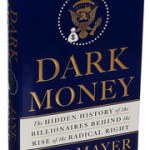
I recently ordered the book pictured above, a in-depth investigation of how the radical right has gained power over the past 30 years. Alongside the essential trilogy by Rick Perlstein (reviewed favorably by an obscure blogger here), Jane Mayer’s Dark Money: The Hidden History of the Billionaires Behind the Rise of the Radical Right fill in the blanks on one of the pressing questions of our time:

How in sulphuric hell did an utterly discredited economic and social philosophy come to have such a dedicated cadre of fanatical devotees, even though it works directly against the interests of many of its more fanatical followers?

The hell happened?

Set aside the flimsy tissue of melodramatic horseshit that is the scribbling of Ayn Rand. For better or worse (better), not many impressionable youngsters are going to slog through her horrible writing and plotting to have their brains turned to mush and their hearts to stone. And for better or worse (worse), a certain type of bookish youth is always on the lookout for a book that sets them apart as some kind of forward-thinking intellectual.<fn>Someone who looks like me resembles that remark.</fn> And if Rand is the prop du jour, bad tidings inevitably ensue.

There are two novels that can change a bookish fourteen-year old’s life: The Lord of the Rings and Atlas Shrugged. One is a childish fantasy that often engenders a lifelong obsession with its unbelievable heroes, leading to an emotionally stunted, socially crippled adulthood, unable to deal with the real world. The other, of course, involves orcs. – John Rogers<fn>fwiw, Rogers was also the creator/showrunner of the under-appreciated teevee show Leverage, which is well worth your binge-investment.</fn>

But Rand alone is not enough to explain the spread of the “greed is good” mantra that is driving policy debates over things like health care, taxation, income inequality, campaign finance, &c. Too many people who wouldn’t know Salma Hayek from Friedrich Hayek are parroting the Randian gospel. An Irish pal of mine told me about a great Old Country turn of phrase re: child rearing: “Well, she didn’t pick that up off the floor.”

Nope, they’ve got to be carefully taught. And that’s where Dark Money comes in. Perlstein did a great job of describing who the behind-the-scenes architects of the radical right were, and what they were trying to achieve politically. Mayer digs into the funding and the strategies, which boil down to a long-term effort to re-package ideas from the lunatic fringe and move them into the realm of ‘of-course-that’s-true’ assumptions.

Lunatic fringe? A tad over the top, you say? Nope. Any resemblance between the current radical right movement and the John Birch Society is strictly intentional.

The Koch Brothers are front and center here, but it’s not just those toffs ponying up millions of dollars to change the way America thinks. They have a lot of filthy rich friends, too. But the Kochs are the prime movers, and they have for at least 30 years pursued a strategy of re-branding their policy preferences as something benevolent and compassionate, despite the fact that they are at root a grab bag of fuck-the-poor depravity.

Over the years, the Kochtopus<fn>I wish I’d thought of that one.</fn> has funneled hundreds of millions of dollars into not just political campaigns, but into issue advocacy, junk research institutes, think tanks, and, crucially, buying what they can of the higher education infrastructure. Here in my little hometown, the Kochs have funneled millions into buying off the Economics Department and large parts of the business and law schools. Their money comes, not with strings, but with ropes attached. Any deviation from the neo-Libertarian doctrine is punished with cessation of funding. You can be sure that faculty hires are carefully assessed to ensure that no offense is given to these “generous” benefactors. It is hardly necessary for Charles Koch to denounce a specific faculty or administration candidate; any shrewd dean or financial officer understands all too well how their bread gets buttered and the consequences of biting that hand.<fn>A mixed metaphor. Mea culpa.</fn> And this desperation of universities to secure outside funding is a direct result of conservative efforts to defund education, thus making it reliant on the highest bidder. It’s a clever little chicken and egg game they play.

Sopranos_ep211b
Nice university you got there; be a real shame if something happened to it.

Here at FSU, the introductory economics course now teaches that “…Keynes was bad, the free market was better, that sweatshop labor wasn’t so bad, and that the hands off regulations in China were better than those in the U.S.”<fn>p. 365</fn> Never mind that the ascendancy of free-market fanaticism that took root under Reagan – and that has rampaged to this day – has been proved a failure in almost every way. (See for example, the financial health of Kansas, Louisiana, Wyoming, and North Carolina under extremist governors and legislatures.) The dogma that Keynes “failed” is an article of faith that is being taught as fact to college freshmen, despite the fact that most serious economists believe the opposite to be true.

Some of these tender minds embrace the ideas. Here at last, a way to learn the greed-is-good ethos without slogging through interminable monologues about railroads and steel production that Rand uses the way Barbara Cartland panders heaving breasts and glory-of-his-manhood fantasies. Nope, this is served up in tasty morsels under such names as Well-Being Studies and Economic Liberty. Who could be against well-being? Stupid liberals, that’s who!

Some of these tender minds progress to graduate programs, where they can receive generous financial aid…so long as they understand the bread-buttering equation. And then, the school will teach you how to write op-ed pieces extolling the virtues of greed well-being and liberty, which they will help you place in the local fishwrapper, thereby building your resume as an intellectual on a par with Jonah Goldberg and George Will. But only if you got your mind right.

You got your mind right, Luke?

Ah hell, they don’t need the Captain to beat ’em with a stick. Being a water-carrier for the .01% can be a pretty lucrative gig. And I truly believe these propagandists to be sincere in their arguments.

It is difficult to get a man to understand something, when his salary depends on his not understanding it. – Upton Sinclair

The most effective chains are the ones we choose to wear.

I wish I could echo the Captain and say that we’ve witnessed a failure to communicate. But the assembly line has been extremely effective in setting the terms of debate. The puzzle of why Americans vote against their own interests so often isn’t much of a challenge: we’ve been carefully taught, over the years, to believe that lowering taxes on the wealthy benefits the common wealth (it doesn’t); we’ve been taught that environmental regulation is unnecessary, that businesses will preserve the environment out of the goodness of their hearts (they won’t); we’ve learned that the minimum wage and labor solidarity destroy ambition and make people into slaves (ffs). And so on.

Worst: we’ve been taught that if we are not wealthy yet, we could be if only we work hard and bootstrap ourselves into prosperity. The stench of bullshit becomes overwhelming.

Bernie Sanders has been instrumental in bringing this con into focus. The game is indeed rigged, and good on him (and the Occupy Movement) for generating broader awareness of this fundamental truth. Why we have to re-learn this obvious lesson remains a puzzlement. Sinclair nailed this con as early as 1917.

“…the priests of all these cults, the singers, shouters, prayers and exhorters of Bootstrap-lifting have as their distinguishing characteristic that they do very little lifting at their own bootstraps, and less at any other man’s. Now and then you may see one bend and give a delicate tug, of a purely symbolical character: as when the Supreme Pontiff of the Roman Bootstrap-lifters comes once a year to wash the feet of the poor; or when the Sunday-school Superintendent of the Baptist Bootstrap-lifters shakes the hand of one of his Colorado mine-slaves. But for the most part the priests and preachers of Bootstrap-lifting walk haughtily erect, many of them being so swollen with prosperity that they could not reach their bootstraps if they wanted to. Their role in life is to exhort other men to more vigorous efforts at self-elevation, that the agents of the Wholesale Pickpockets’ Association may ply their immemorial role with less chance of interference.” – The Profits of Religion: An Essay in Economic Interpretation

In Sinclair’s day, bootstrapping was touted by peddlers of faith-based redemption; even if you did not rise, you were earning god’s blessing. These days, celestial faith is boiled down to a simpler equation: win at all costs, because if you are poor, it’s proof that you have failed to earn god’s favor. The poor deserve their lot. Losers.

2-Glengarry-Glen-Ross-quotes

A true expression of Libertarian belief would state clearly that it’s every man for himself, maybe a woman here and there, and that if you are dog food it’s because you deserve it. That would be a pretty tough sell, especially in a country where most people are struggling to survive. Better to wrap it up in a pleasing fairy tale, something that rubes and suckers will eat with a spoon. If you need to add a dollop of race hatred and sexism, well, whatevs, broken eggs and omelets, amirite?

Bottom line<fn>Since that’s all the really matters any more, apparently.</fn>: Read this book. I bought it out of a sense of obligation. I expected it to be a castor oil read, something that would go down rough but would be good for me in the end. In fact, Dark Money is a straight-up page turner. Mayer’s writes clearly and compellingly, and her research is thorough and even-handed. As the pro critics love to say…destined to be a classic.


The Monsters Are Due On Maple Street

UPDATED 11/23: Correcting one grammar error that allows me to add a gratuitous Trump insult; correcting one misplaced footnote that made Gwen Graham look worse than she is; and adding one detail that makes Trump look worse, but not quite all the way as bad as he is.

There be dragons, and they’re coming to get you. Hide! Be afraid!

Many nights I wake up,  between 2.30 and 3.30, and endure an hour or so of free floating terror. I’ll never again write a good sentence or play the guitar well. Maybe I’m completely out of ideas. I’ll never get hired again. Or if I am working, they’ll hate what I’m doing and they’ll never hire me again. My children will starve, my wife and I will live in a refrigerator box under a bridge. My dog will die. My dog will get sick, and because I don’t have enough work, I won’t have the money for treatment, and she will die. My kids will….

So you get the idea. After an hour or so, I’m so exhausted with worry and fear that I fall asleep for a couple more hours. Then I wake up, pull on my pants, and set out to find work, do good work, attempt creativity, strive. It’s not that I forget the various terrors that plague me, but I still try. It ain’t over til you quit.

And so, Paris.

People are terrified that it will happen here. A reasonable fear, but one that has been ginned up by various actors who stand to profit from our fears.

Be afraid. And CNN/Fox/MSNBC will be here around the clock to be sure you stay that way.

Be afraid. Only the stalwart leadership of {insert name here} can keep you safe. That other guy is going to let the evil-doers kill you in your sleep. Stalwart leader will keep them out! If only he can figure out how to tell the difference between a good guy and a bad guy.

Be afraid. Buy guns, more guns, and carry them everywhere, because you never know when you need to be a good guy with a gun who needs to stop a bad guy with a gun. As long as everyone can figure out how to tell the difference between a good guy and a bad guy.

Be afraid. Go ahead and assume that everyone is a bad guy until proven otherwise. Stand your ground! Ban everyone who looks/thinks/comes-from-somewhere different. Open fire if you feel threatened by someone who fits your idea of what a threat looks like. Sort out the bodies later. You can’t make an omelet…

And so, Paris. They could come here next! They might be here already! You know that they hate us for our freedoms, so how about you give up a bunch of those freedoms so we can keep you safe.

Lock the doors! Pull up the ladder. You can’t give a 100% guarantee that you can screen out evil-doers? Don’t let anyone in. That’ll fix everything.

Some of the pandering is not so extreme. Some of it is “moderate”. Maybe let in only the refugees who can prove they are Christian. That way we’ll be safe, because Christians never use violence to achieve a goal. Or maybe, as one pundit suggested, only let in the women and children. That’s the compassionate approach, to break up families.

But then we hear from Uber Panders who not only think letting women in would be unsafe (they blow themselves up, too!), but that letting in “orphans under the age of five” is also too risky. You can’t be too careful.

Round ’em up and ship ’em back. Build fences. Bomb the whole dang shebang.<fn>”Trump: “I would bomb the shit out of them.”</fn> All under the guise of “keeping us safe”.

Lots of terrible ideas are floating around, and the goatfuckers of ISIS are laughing their asses off.

Paris. Now we are supposed to be afraid of going to a great city, or to Europe overall. Cafes and concerts? Jesus, a guy could get killed there. Swarthy immigrants who may or may not believe in the god of our fathers? Round em up and ship em back. You can’t be too careful, amirite?

Now we are supposed to refuse basic humanitarian considerations, to abandon our purported national ideals and values. We are asked, in the name of fear, to do exactly what the terrorists hope for: overreaction, cruelty, inchoate violence.

We keep hearing about ISIS being an “existential threat”. It’s a stupid phrase, but people who speak it seem to believe it affords gravitas, a seriousness of purpose. But it’s bullshit. There is no threat to our existence from a ragtag army of lunatics. Sure, they can disrupt, sow fear. And then they rely on us to lose our collective shit. If history is any guide, they will not be disappointed.

ISIS cannot destroy our civilization, our “way of life”, much as they might wish otherwise. But we certainly have the means to do it. They need us to do the dirty work of abandoning the very elements of our society that make it worth protecting. On Saturday, “[a]bout a dozen protesters — most carrying long guns, some masked and one with his mother” marched outside a mosque in Irving, TX. Calling themselves the Bureau of American Islamic Relations, these brave protectors of the Fatherland insisted their guns were not to threaten, but merely a means of protecting themselves from the evil musselman within.

Also on Saturday, at a rally in Birmingham for the increasingly inexcusable Donald Trump, Tribble Top declared, “I want surveillance of certain mosques if that’s OK. We’ve had it before.” A week earlier he had called for shutting down mosques, so perhaps this is Trump being ‘moderate’.

We won’t shut ya down, but we’ve got our eyes on you. And maybe a few yahoos with hunting rifles patrolling the perimeter.

(Also at that rally, a Black Lives Matter protester was beaten, knocked down, and kicked as their Fearless Leader shouted, “get him the hell out of here”, followed by Trump mocking the man as “a loser.” Just another conveniently identifiable other.) UPDATE: In a interview the following day, Trump said the guy deserved to “get roughed up”. Very mid-century retro, nein?

The news is full of stories like these. They all have one, or both, of the key ingredients: ill-informed (and perhaps sincere) people engaging in dangerous and counter-productive behaviors and/or the demagogues using the fear to enhance their own personae and power.

As Winston Churchill said, “Never let a good crisis go to waste.”

As usual, the things we end up freaking out about (ebola, immigrants from wherever, terrorism, bacon fat) are typically not that big a threat in the scheme of things. We are all more likely to experience injury or death in these United States due to reckless driving (our own or someone else’s) or falls in the bathtub (around 50,000 deaths or hospital-level injuries per year). Texting while driving claims 6000 lives per year. Shit, 450 people die each year from falling out of bed. Even sleeping in you own bed is more likely to do you in than a terrorist attack.

But there’s no political upside in making you afraid to take a shower or a nap.

Last week, the GOP house – the same group of bedwetters who passed a cruel and useless bill to make it harder for refugees to come to America – attached two riders to the new budget bill that would cut the CDC’s anti-smoking budget in half. Nobody<fn>I think even the tobacco companies have quit fighting this.</fn> disputes the carnage caused by tobacco. Tobacco deaths in the US each year outnumber terrorist related deaths worldwide by a factor of about fifteen. In 2014, almost a half-million people died in the US – more than 40,000 from secondhand smoke. Terror-related deaths in 2014 totaled around 33,000, up from around 18,000 in 2013. That’s a lot of death, and the rising toll is something to be concerned about. But.

Most of those terror deaths occurred in places like Kenya and Mali and other places that most Americans don’t care about. No demagogue worth his salt is going to try to gin up the rubes over a place like that.

But Paris is different. Western. White. So it’s easy to conflate fear of terrorists with generalized fear of dark skin. It also makes them easy to target, to separate them from the core. It’s why we imprisoned Japanese-Americans during WWII, and not German-Americans and other overt Nazi sympathizers like Charles Lindbergh.<fn>Or Prescott Bush.</fn>

It’s an easy fissure point for a clever communicator like Trump. In the mouths of less-skilled demagogues, maybe not so much; the execrable David Vitter tried to salvage his gubernatorial campaign over the past weeks with blatant fear mongering and lies<fn>He even threw Catholic Charities under the bus; his wife is their General Counsel. Nice guy.</fn>, but got thumped anyway. But here’s the thing: his loss was because of his other “qualities”, not because he played the racist/terror card. I’m frankly surprised it didn’t work out for him. After all, what are a few tawdry prostitute scandals compared to the good old boogity boogity?

Some of our political figures are keeping their heads on straight in all this. Obama is demonstrating an admirable resolve to not let the hysteria drive his policy over the refugees. (The decision to send more troops back into the desert shitshow is more troublesome, as is the flow of arms we keep pumping into the Middle East.) As far as the vote in the House last week to punish refugees – because reasons – I guess I should be happy that only 47 Dems<fn>Just a few dozen quisling Democrats like our local congresscritter, Gwen Graham.</fn> joined the wannabe revanchists, especially compared to the cowardice on display post-9/11.

Locally, our Governor has predictably pandered to his bible banger base of rubes. In response, our Mayor was asked his thoughts on the refugees, and he admirably said that we should welcome them with open arms. This naturally led the comments section of our local fishwrapper to explode in a veritable orgy of fantasy hypotheticals and nativist bigotry more-or-less openly expressed. It is to weep.

This is not going to get better any time soon. Recall post-9/11, how every rumor led to panic led to changes in the color-coded oh-my-god-we’re-fucking-doomed Official Terror Alert system. It’s back. Last time, it led us into a war that has still not ended. And with a dozen-plus power hungry nitwits trying to win the Republican nomination (not to mention all the House/Senate numbnuts up for re-election), the calls for extremist reaction are not going to slow down. Because, as always, they’re only selling what they know people will buy.

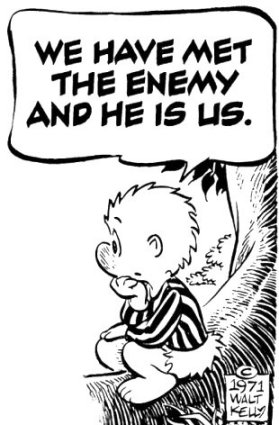
I might crawl under the bed myself. It’s not the terrorists that scare me. It’s us.

Pogo


Why We Is So Dumb #1

After a sweaty August in which our local guardians of moral probity beat down a book that contained a few naughty words, and in which an arriving freshman at Duke University pounded nails into his own palms at the prospect of reading a book that featured two women in flagrante, Your Narrator hoped that cooler weather and cooler heads might roll in with the new month.

Alas, it was not to be. Comes today news of yet another college freshman taking a noble stand against a bunch of books he has never – and never will – read. Read his complaints if you want; there’s really nothing behind it other than a ploy for attention, a cynical career move.

This wannabe George Will knockoff<fn>Really, just look at that smirking cockknob and tell me he didn’t stand in front of a mirror to practice looking like George Effing Will.</fn> takes an impassioned stand on something he knows nothing about and paints a picture of crazed liberalism running amok on our campuses where poor, besieged patriots like him are cowering in terror. The usual array of far-right websites picks up his story, leading other people who never read these books to fulminate against the atrocities inflicted by liberalism on our once-great nation. And a bunch of people who desperately wish to believe that they are under assault from mean old liberals find another reason to live another day. Never mind that his description of the books bears no semblance to reality, or that the course is one of several dozen optional seminars offered to University of North Carolina freshmen. He’s here to tell you that he’s suffering, and you should, too.

In an upcoming installment of We Is So Dumb, Your Narrator will find himself uncharacteristically generous in his assessment of human nature, freely stipulating that most people really do want to understand the world around them. In this sad case, such benevolence is inappropriate: this freshly-scrubbed whiner embraces blinkered ignorance with aggressive enthusiasm. But even worse, he zealously works to create stupidity among his readers by assuring them that not reading something because you think it might bother you is a good and proper choice.

It doesn’t matter that his thinking has as much heft as a flea fart in a hurricane. The news stories about his column take that bland both-sides-have-a-point tone that makes most journalism as useless as a urinal in a convent, leaving most casual observers with the idea that his complaint has equivalent intellectual validity as the books he claims offend him. And thus does the notion that universities are hotbeds of liberalism grow stronger, and the desperate fantasy that “we” need to “take our country back” from some amorphous “them” attains another level of certainty.

The past 35 years have witnessed a mushroom-like spread of conservative “thinkers” like our boy Alec Dent, and it’s no mystery why. Conservative punditry is a big business, and for someone with a more or less clever wit and a willingness to stand tall in defense of pure bullshit (at best) or grotesque misanthropy<fn>See, for example, Ann Coulter, among many.</fn>, staking a claim to right-wing outrage at an early age is a pretty savvy career move. Because no matter how low or outrageous, there is a network of think tanks and foundations and new media outlets that are more than willing to pay for whatever depredatious hairballs the hustling pundit wishes to spit up. With great and inexplicable luck, our brave sycophants might end up with a sinecure at the Post or the Times; at worst, a talk radio gig at 6 a.m. in a mid-tier market awaits the pundit who is willing to say anything without regard to veracity or simple human decency.

We Is So Dumb because people like this – anti-intellectual and cock-struttingly proud of his ignorance – are the recipients of approbation instead of fierce mockery and ridicule. In a sane world, someone would take this boy aside and let him know, gently, that he is displaying his ass in public, and should perhaps reconsider such juvenalia. Alas, such juvenalia has become a profitable business.

Be on the lookout soon for this Tar Heel putz – along with his kindred spirit from Duke<fn>What the hell is going on in the Research Triangle, anyway?</fn> – to publish a followup wherein he describes how hard it is for a sanctimonious humbug to find acceptance on a libertine campus while the jackboot of secular humanism has his neck pinned to the floor.<fn>He will, if he’s smart, describe an almost-consummated sexual encounter which throws shade and shame on some loose-moraled wench against whom he resists Galahadishly, and boy is he glad he saved himself, though most people will read that he protests way, way too much.</fn> Which of course the “legitimate” media will cover, because these kids are now famous thought leaders who speak for a generation. In 30 years, one of these guys will replace the retiring Ross Douthat on the NY Times op-ed page, while the other will probably be running the Breitbart Sanitarium for the Chuzzlewitted, and people will read their twaddle and assume that their presence in a newspaper or on their Internet machine means that they are in fact “legitimate”. Thus will this plague of Dumb pass from one generation to the next.

So cooler heads are in short supply, and it remains hotter than a sac of Balinese monkey balls, despite the almost change in season. It is to despair, no question.