Infinite Quest

Sept 12 – David Foster Wallace died 7 years ago today. Maybe died isn’t the right word, though it’s at least partly true. He killed himself; took his own life. This fact still makes me sad and angry and scared all at once.

The best way to counter these feelings is to read some of his work.<fn>If for no other reason than that his work is the only part of him that we have any legitimate claim to. Angry at the guy? Shit. I owe him.</fn> His essay from the January, 1996, issue of Harper’s, which became the title piece from his collection A Supposedly Fun Thing I’ll Never Do Again, is the single funniest and most “readable”<fn>Readable here connoting ‘something not too weird or difficult’. In fact, everything I’ve read by DFW – which is pretty much everything that’s been published plus a glimpse of a few of his notebooks at the Whitney Biennial – is terrifically readable and worth every second it takes to look up unusual words, refer to yet another footnote, or just to re-read certain sentences over and over because they are just too wonderful to take in at once.</fn> piece in his entire output. I’ve just finished it for the eleventieth time and it’s got me hungry for more.  E Unibus Pluram: Television and U.S. Fiction” is up next,and it’s sort of an essential piece for anyone interested in culture and the challenge of retaining our humanity amidst a dazzling array of shiny objects.

I find it by turns amusing and annoying that DFW is characterized as a fetish object of a hipster crowd way younger than me, that he somehow is the prototypical voice of ‘this’ generation. This is bullshit: DFW is of my generation. Our lives tracked more or less the same time span, though mine has endured a tad longer. In Infinite Jest, he wrote of a future that is more or less now; really, though, he was writing about a present-then that was the product of the culture of our childhoods.

It also pisses me royally that Infinite Jest is known as that book that everybody bought and nobody ever really read, save for a few precious bookish beardos. This tired trope likely arose from critics and other malcontents who felt the need to have/express an opinion but were too lazy to bother reading the actual book – thus inoculating themselves from accusations of laziness, because duuuuude, it’s like Finnegan’s Wake, knowhatimean?<fn>Pass the Bret Easton Ellis and the McInerney. It’s easier to chew.</fn> I grant the first 60-80 pages are little disorienting, but after that, it’s a roller coaster thrill machine that is every bit as addictive as The Entertainment that serves as the book’s macguffin. A book about addiction that is thoroughly addicting? Even better, a book that has its characters agonizing over and within their addictions while you, the reader, begin to wonder if maybe you ought to put the book down and eat or shower or go to work or something, but no, screw that, keep reading. That’s some badass legerdemain right there, people.

DFW is enjoying something of a mass(ish) cultural moment right now. There’s that movie with Jason Segal as Wallace, based on an interview transcript from the mid-90s, that has DFW’s surviving family suffering their own case of the fantods, suggesting with no small amount of justification that this kind of filmifaction of DFW is exactly the kind of mediated nonsense that he, DFW, would have hated and mocked with relentless passion. But no matter: it is, as the DC punditocracy like to say about every fabricated scandal, “out there”, and it thus seems to have generated a strange<fn>Strange because he died only 7 years ago, though it feels much longer, likely because he had been mostly silent for so long.</fn> renaissance in DFW fandomry and scholarship.<fn>Which, if you’ve read any of the scholarly work to emerge so far, is barely distinguishable from the fandomry, save a certain highly recognizable tone of pedantry apparently essential for academic publication.</fn>

Curiously coincident with the movie was the publication this year of an enormous brick – suitable for a guy who wrote the epically brick-like Infinite Jest and The Pale King – called The David Foster Wallace Reader, which presents around 1000 pages of essays, articles, short stories, and novel excerpts, and, most importantly, a few hundred pages of previously unreleased and obscurely published early works. My favorite part of the book are the notes and class syllabi he used for teaching. But mostly, I think, the people who bought it were, like me, yearning to place another DFW brick on their shelf, knowing full well that this was the closest we were going to get ever again.

I know there are other writers out there who deserve as much attention as I give Wallace. In fact, there are several who actually do get even more because of the relatively small output Wallace left behind.<fn>Rushdie, Moseley, Delillo to name a few. When do these guys ever sleep?</fn> But there is something about Wallace that drills right into my core.

Years ago, long before his death, someone asked me why I liked DFW’s writing so much. I said it was because reading him was like hearing my own voice inside my head if I had a better vocabulary and were much smarter. We were roughly the same age, grew up with the same general atmosphere of teevee, consumption, weird conformist culture, and tennis. Reading him felt like reading myself.

That was a pretty comforting thing, having someone out there grappling with the same kinds of angsty, middle-class, white boy problems, taking things on from a somewhat nerdly perspective but also bringing that weird Carlinesque outlook to the absurdities that our cossetted upbringing seemed to cultivate like mushrooms. Well, it was comforting right up until the day he killed himself. Then it became fucking terrifying.

Because here was the crux: here’s this guy, representing my mutant tribe of people who grew up inside the privilege and the comfort and the sheer whiteness of it all and knew that there was something amiss, that this incessant anomie was no accident, was actually not just a product but was actually a feature of the environment. And he saw it and got it and reported on it in a way that let us hold our deformity up for inspection and find some kind of strategy for dealing with the back-and-forth of we-have-no-right-to-complain-but-jesuschrist-things-sure-are-a-bundle-of-fuck. And in doing so, he won accolades, received a Guggenheim and a truck full of other awards. Had a fucking endowed Roy Edward Disney Chair in Creative Writing created just for him at Pomona College – dude looked like he had the world on a string.

And so one hears the news and goes, damn, that guy had it going on and I’m barely stringing a decent sentence or two together outside of my little whore gigs where I’m crafting allegedly pithy messages that are making the world a safer place for insurance adjusters or some such. And we’re the same age and have to wonder, his voice sounded just like my voice (if I were smarter &c.), and my shit’s nowhere near as together as his shit (the imagination at this point has its own engine and power source), but he took a look at it all and decided, nope, too much to bear, and took lights out. How do I measure into this equation?

Add to this that so far in that year two of my friends had taken the same way out, and that less than two months later another friend – all of us around the same damn age, mind you – made the same choice, and I gotta tell you: I was terrified.

We pretty quickly started hearing about how his was the end battle of a long life struggling with clinical depression, and that his family were not all that surprised by the event. I re-read Infinite Jest that fall and was struck by how much sadness was there. It was just bone-breakingly sad to read, so I read it again to see if I had been insane to recall the book as so wickedly funny. Turns out it was both – both incredibly funny and horribly sad and filled with almost too much truth about how we try to deal with a world that serves up both sad and funny in such apparently random and heaping servings. And that – crucially – that the only apparent strategy that made any sense was to find some way of connecting, really, with someone else. And then, to accurately describe how fucking hard that can be, to make that connection, not matter how much you know you should.

And so what does he – or at any rate, his thoughts that made it to a page – what do these ideas do for me now? I mean, crafty fking christ, if the guy who wrote the way you thought you’d like to write ends it all so gruesomely, what’s left?

Well, first I was left confused and scared and, frankly, pretty depressed. <fn>His death was not the cause of my depression, per se, but that this should have come along at a time when life was what h/we would refer to as fraught made things even more, well, fraught.</fn> But later – and especially after The Pale King came out, unfinished warts and all – I saw something else. Instead of thinking I might write that way if I were a “real” writer – and not just some ho for hire – I started to think about maybe, sort of, maybe actually being a real writer, maybe doing the hard work required to figure out if you have anything to say and the ability to say it.<fn>The jury remains forever out on this question. Ask any writer sitting in front of a blank page.</fn> But then time passed and nothing came of it and I ignored this kind of insistently annoying Epiphany-like thing that refused to be ignored. Which of course, the trying to ignore that which refuses to be ignored, only engenders more angsty fraughtness, &c.

And then, I endured My Apocalypse, and a couple of weeks after I left hospital, I was lying on the sofa in a dark room when – and I shit you not – when an entire written piece started to appear full-blown on the ceiling.<fn>And yes, there were footnotes on the ceiling, and complete sentences, too.</fn> And I rushed to the computer for like the first time in 4 months and sat down and wrote The Chronicle in its entirety and started “publishing” it in pieces on the Facebook machine. And lo, it was rough and sloppy and funny and tender, and my Epiphany-like thing just smiled quietly to itself.<fn>Some of you have read The Chronicle. It is under revision, but you got the bloggy first draft blast. You’ll tell your grandkids someday.</fn>

And here we sit, faithful denizens of this here bloggy vineyard – which by no coincidence whatsoever takes its title and raison d’ecrir from The Pale King the words tumbling down like a poorly constructed simile on a shifting foundation of soft metaphors. And I thank DFW for his words – his Work, for it was truly some audacious labor – and for his ability to stave off his demons for as long as he did. He gave us what he had. I can miss him and wish he were still writing for us, but I can’t be angry at him for checking out. Just sad. And, oddly and thankfully, a little inspired.

So today, hot on the heels of National Suicide Prevention Week<fn>Which irony would not be lost on D.</fn>, I’ll thank all of you to remember, also, too: shit’s never as dark as it may seem. When the imagination creates it’s own dark engine and gloomy source of power, reach out. Keep going. The quest, it is infinite.


My Favorite World #37

Eagle-eyed readers of this here bloggy pontificatory nonsense are well aware of Your Narrator’s affection for professional tennis. It’s what makes the two weeks that wrap around Labor Day my favorite sporty time of the year. Yep, it’s US Open time.

It’s not just that your guide has attended the US Open – once at the venerable Forest Hills Club, where he had the great fortune to have the great Pancho Gonzales take a leak in the urinal next to his, and where the legendary Alan King deigned to sign his player program and flick a cigar ash in his, Your Narrator’s, general direction.

“Have fun kid, don’t get drunk.”

Such a sweet man. Nah, I'm kidding. He was an arrogant asshole. But he did sign my program.
Such a sweet man. Nah, I’m kidding. He was an arrogant asshole. But he did sign my program.

Later, at the grandly named US Open Tennis Center out in Flushing Meadows, Young Narrator watched Laver and Connors and Rosewall and Stan Smith and some perky little blond named Chrissie playing her first big match against Billie Jean, &c.

The last visit in 1985 found Your Narrator yelling for/against Wilander and Edberg, Connors, McEnroe, and that guy who sounded like a disease. Gerulitis. Yeah.

And it’s not just because that stadium<fn>Specifically, Louis Armstrong Memorial Stadium, nee the Singer Bowl. By another turn of fate, someone who looked just like me and had my acne attended his first-ever bigtime rock and roll show in LAMS, nee Singer. The bill was Jo Jo Gunne, the James Gang, and the frankensteinian Edgar Winter Group. The world, it is small.</fn> in Flushing Meadows sits across the concrete plaza from Shea Stadium<fn>Where, as it happens, Narrator saw Game 4 of the 1969 World Series, but did not, repeat, did not see either The Beatles or Grand Funk Railroad.</fn>, and in the shadow of the 1964 World’s Fair tower/needle/useless phallic appendage, the selfsame place where the pre-elementary Narrator discovered It’s a Small World in the Disney Pavillion. To his parents’ everlasting despair.

Nope, it’s none of this. It is that Your Narrator is a kneeling, evangelical mendicant at the Shrine of the One True Sport. You can have your teams of people running around like noggin-deficient chickens, your behemoths beating each other senseless between the ropes, your vroom vroom, hyper-steroidal go carts spinning round in circles, your various stick and ball fiasci. As much as one may like these games (some more, some less), it’s the well played tennis match that makes the Narrator’s heart fly like a vicious down the line forehand screamer.

One could go on here about Andre Agassi, or Roger Federer, or Ashe or Steffi or any of the others whose games have made the world a better place for years. One could talk about the epc amalgam of grace, power, speed, and brute physical endurance that makes this the sport worth watching above all others. But not tonight.

Because tonight, since Venus and Serena are about to face off in the quarterfinals – with Serena on a path to the first true Grand Slam in almost 30 years – well, let’s make do with one curious observation.

After years of debating the visual acuity of every linesman and umpire, of disputing and arguing furiously over close line calls (“You CANNOT be SERIOUS!”<fn>All linesmen insults are the intellectual property of one J McEnroe</fn> ), we have all gone gently into that good night wherein an impossible technology automates line calls so effortlessly that the “integrity of the game” has been purified to its most error-free essence.

It’s not that the added drama and strategy around line challenges are lost on us. It’s that we’ve been robbed of the drama and spectacle of one of our favorites being literally robbed of a point, a set, a match, all because a human being blinked or had a bee fly by or simply lacks the visual acuity to make a decent call (“ARE YOU BLIND?”). And that we have simply acquiesced, in an act of faith as deep as any Road to Damascus moment, to the power of the machine to determine our destinies. Even the most Luddite of tennis fans turns to the Chase Official Review as the Diviner of Truth. It is, in its childlike way, almost touching.

It may be more fair, but is it better? Alas, the jury is not out, but rather has bellied up to the bar to watch the Sisters battle it out. And that’s where we should all be.


Why We Is So Dumb #1

After a sweaty August in which our local guardians of moral probity beat down a book that contained a few naughty words, and in which an arriving freshman at Duke University pounded nails into his own palms at the prospect of reading a book that featured two women in flagrante, Your Narrator hoped that cooler weather and cooler heads might roll in with the new month.

Alas, it was not to be. Comes today news of yet another college freshman taking a noble stand against a bunch of books he has never – and never will – read. Read his complaints if you want; there’s really nothing behind it other than a ploy for attention, a cynical career move.

This wannabe George Will knockoff<fn>Really, just look at that smirking cockknob and tell me he didn’t stand in front of a mirror to practice looking like George Effing Will.</fn> takes an impassioned stand on something he knows nothing about and paints a picture of crazed liberalism running amok on our campuses where poor, besieged patriots like him are cowering in terror. The usual array of far-right websites picks up his story, leading other people who never read these books to fulminate against the atrocities inflicted by liberalism on our once-great nation. And a bunch of people who desperately wish to believe that they are under assault from mean old liberals find another reason to live another day. Never mind that his description of the books bears no semblance to reality, or that the course is one of several dozen optional seminars offered to University of North Carolina freshmen. He’s here to tell you that he’s suffering, and you should, too.

In an upcoming installment of We Is So Dumb, Your Narrator will find himself uncharacteristically generous in his assessment of human nature, freely stipulating that most people really do want to understand the world around them. In this sad case, such benevolence is inappropriate: this freshly-scrubbed whiner embraces blinkered ignorance with aggressive enthusiasm. But even worse, he zealously works to create stupidity among his readers by assuring them that not reading something because you think it might bother you is a good and proper choice.

It doesn’t matter that his thinking has as much heft as a flea fart in a hurricane. The news stories about his column take that bland both-sides-have-a-point tone that makes most journalism as useless as a urinal in a convent, leaving most casual observers with the idea that his complaint has equivalent intellectual validity as the books he claims offend him. And thus does the notion that universities are hotbeds of liberalism grow stronger, and the desperate fantasy that “we” need to “take our country back” from some amorphous “them” attains another level of certainty.

The past 35 years have witnessed a mushroom-like spread of conservative “thinkers” like our boy Alec Dent, and it’s no mystery why. Conservative punditry is a big business, and for someone with a more or less clever wit and a willingness to stand tall in defense of pure bullshit (at best) or grotesque misanthropy<fn>See, for example, Ann Coulter, among many.</fn>, staking a claim to right-wing outrage at an early age is a pretty savvy career move. Because no matter how low or outrageous, there is a network of think tanks and foundations and new media outlets that are more than willing to pay for whatever depredatious hairballs the hustling pundit wishes to spit up. With great and inexplicable luck, our brave sycophants might end up with a sinecure at the Post or the Times; at worst, a talk radio gig at 6 a.m. in a mid-tier market awaits the pundit who is willing to say anything without regard to veracity or simple human decency.

We Is So Dumb because people like this – anti-intellectual and cock-struttingly proud of his ignorance – are the recipients of approbation instead of fierce mockery and ridicule. In a sane world, someone would take this boy aside and let him know, gently, that he is displaying his ass in public, and should perhaps reconsider such juvenalia. Alas, such juvenalia has become a profitable business.

Be on the lookout soon for this Tar Heel putz – along with his kindred spirit from Duke<fn>What the hell is going on in the Research Triangle, anyway?</fn> – to publish a followup wherein he describes how hard it is for a sanctimonious humbug to find acceptance on a libertine campus while the jackboot of secular humanism has his neck pinned to the floor.<fn>He will, if he’s smart, describe an almost-consummated sexual encounter which throws shade and shame on some loose-moraled wench against whom he resists Galahadishly, and boy is he glad he saved himself, though most people will read that he protests way, way too much.</fn> Which of course the “legitimate” media will cover, because these kids are now famous thought leaders who speak for a generation. In 30 years, one of these guys will replace the retiring Ross Douthat on the NY Times op-ed page, while the other will probably be running the Breitbart Sanitarium for the Chuzzlewitted, and people will read their twaddle and assume that their presence in a newspaper or on their Internet machine means that they are in fact “legitimate”. Thus will this plague of Dumb pass from one generation to the next.

So cooler heads are in short supply, and it remains hotter than a sac of Balinese monkey balls, despite the almost change in season. It is to despair, no question.


My Favorite World #36

Life brings you moments, events that are pebbles tossed into our little ponds. Most of them pass by, one to the next, leaving little trace. Lots of our moments roll right by without us realizing that there was a moment at all; we may notice ripples later on<fn>Sometimes years later.</fn> and wonder where they came from. Some make more of a splash, are harder to ignore. Either way, the moments accumulate and define what we become, our tastes, our habits, our passions.

And some moments land like a boulder. You see it happening, you know it’s happening, and you know that nothing is ever going to be the same again.

So it was one April night in 1979 in Athens, Georgia, when I went to hear some jazz group that was supposed to be good. What did I know? I thought Return to Forever and Jeff Beck played jazz.<fn>Hold your fire! They were/are great. But not jazz. No.</fn>

I walk in and see a stage literally covered with every imaginable gong, drum, saxophone, flute, squeaky duck, penny whistle, plastic tube, bicycle horn, &c. Seriously, there must have been a few dozen gongs and bells, conch shells, and at least 20 saxophones, flutes, and trumpets. These guys had all the instruments. The low, pre-show lighting bounced spangles of dancing coins off these gleaming surfaces. I’d never seen anything like it.

The band walked on stage, several of the musicians dressed in African tribal costumes with full face paint; one musician unadorned save his doctor’s lab coat; and the fifth musician dressed in street clothes. As per their custom, they stood silently facing the East for what seemed forever. The lights had come up full by then, and the dancing coins had transformed into a vibrant planetarium show of stars and suns. It was dazzling.

And then all of heaven and hell broke loose, with the thunder of a gong and a blasting cacophony of horns and drums and bells and godknowswhat that literally pushed me back in my chair. I held my breath almost the entire time, and when it was over I went home without talking to anyone because I couldn’t handle another piece of information of any kind. It was the strangest, most compelling and frightening and off-putting and enveloping experience of my first twenty years. It was music, it was noise, it was theater and dance and kabucki.<fn>Though I had no idea what that was at the time.</fn> It was multitudes.

I had run headlong into what the AEC called Great Black Music: Ancient to the Future, and I knew that nothing was ever going to be the same again. That was the beginning of my lifelong obsession with jazz in general, and especially with what critics have been calling avant garde jazz for going on 60 years now.<fn>How old does something need to be before it is apres?</fn>

I had no frame of reference. Aside from the drum kit (which represented about 1/20th of the total percussion array on stage), none of the instruments were part of what had been my pretty standard suburban white boy musical diet. I had to learn about these instruments and the people who made them come alive. I would literally buy 10 albums a week, and I was borrowing and taping a dozen more. At this time, you could go to the used record store and buy LPs for 2 buck apiece, 3 bucks for a double album. It made it easy to take a flyer on something you weren’t sure about; maybe you recognized a name of someone from another album, or maybe it was just the record label, or maybe the cover caught your eye, and if a record sucked, you could trade it back in the next week for a buck credit. I couldn’t get enough.<fn>Fun fact. I bought most of these LPs from a fledgling guitar player named Pete Buck. I heard he made it kind of big later on in accounting or something.</fn>

That’s almost 40 years ago, and I remember that show and its aftermath as clear as a bell. It remains one of the handful of transfiguring experiences of my life. And it opened, in turn, a willingness to seek out different forms of literature, art, theatre, films…you name it. Seeing AEC led me to Coltrane and Miles and Cecil and Ornette and Braxton and the list never ends because I knew there was music out there that could surprise and confound me and disturb me if I just looked hard enough.

Here’s a piece from their album Nice Guys. It’s a pretty good representation of the way they would blend incredible composition and delicate ensemble playing with the wildest free jazz around, and even better, how they manage to move from one realm to the other on a dime, smooth as silk. I still have a framed copy of the cover photo on an ECM promo poster.

So thank you Lester Bowie, Joseph Jarman, Roscoe Mitchell, Malachi Favors, and Famadou Don Moye, for cracking my bean wide open and filling it with such a magnificent array of riddles and sounds and possibilities. I can’t begin to imagine what kind of human I would have become without this.

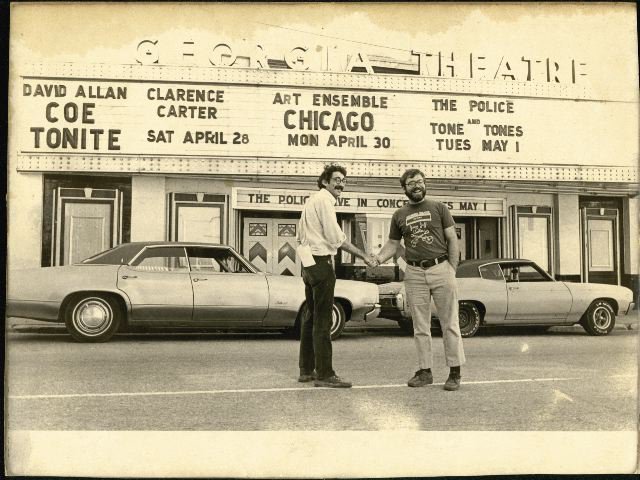
MItchell Feldman (left) was the guy who made this show happen. When he left Athens, I took over his Wednesday noontime jazz show at WUOG, Out to Lunch.

And thanks to Mitchell Feldman (left), the guy who made this show happen in a time and place where such a proposition – a Deep South presentation of Great Black Music – was decidedly unlikely. When Mitchell left Athens, I took over his Wednesday noontime jazz show at WUOG, Out to Lunch; this experience was probably the most valuable aspect of my undergraduate education. (Photo taken in front of the Georgia Theater the afternoon of the show.)

The video below is a 20 minute blast of AEC at their best. For a dozen years at least, whenever and wherever they took the stage, they were the greatest band on earth.

Bad. Ass. Mother. Fuckers.

Respect!

My. Favorite. World.