Your Electric Picture Radio Box Matters #2: Don Draper and the Flitcraft Parable

MAD MEN & MALTESE FALCON SPOILER ALERT!!!

Dashiell Hammett was one hell of a writer, wrongly denigrated as a “genre” scribbler.<fn>As were/are PK Dick, Raymond Chandler, Walter Mosley, &c.</fn> His most famous work likely is The Maltese Falcon, which is itself probably better remembered as a great movie starring Humphrey Bogart, Peter Lorre, Sidney Greenstreet, and Mary Astor and directed by John Huston.

cast-Maltese-Falcon
The stuff dreams are made of

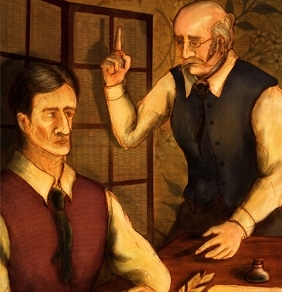
But one of the great passages of the book never made it into the movie. It’s become known as the Flitcraft Parable, a little story Sam Spade tells Brigid O’Shaughnessy to pass the time while they await the arrival of the oily Joel Cairo.

Flitcraft was a successful Tacoma banker, family man, well-respected man about town doing the best things so conservatively. And one day, on his way to lunch, he passed a construction site.

A beam or something fell eight or ten stories down and smacked the sidewalk alongside him. It brushed pretty close to him, but didn’t touch him, though a piece of the sidewalk was chipped off and flew up and hit his cheek. He felt like somebody has taken the lid off life and let him look at the works.”

Awakened by this near-death episode, Flitcraft kept walking<fn>“He went like that,” Spade said, “like a fist when you open your hand.”</fn>, leaving work behind like Don Draper fleeing a Miller Lite meeting, just chucked it all and took to the road, wandering and drifting and looking for whatever. And then he finally settled in Spokane, just a few hundred miles away from his first family where he became a successful car dealer, family man, well-respected man about town doing the best things so conservatively. And pace Don, under a new name.<fn>The name? Charles Pierce! I am slain.</fn>

He wasn’t sorry for what he had done. It seemed reasonable enough to him. I don’t think he even knew he had settled back naturally into the same groove he had jumped out of in Tacoma. But that’s the part of it I always liked. He adjusted himself to beams falling, and then no more of them fell, and he adjusted himself to them not falling.”

It’s not as though he forgot the falling beam, the sense of the thin line between life and death. He just got used to it.

So about Don/Dick. All along he has told himself that the things that came before, no matter how traumatic, don’t matter, that all he needs to do is move ahead, determined. Recall when Peggy gave birth to a son that she would never know, Don told her in the hospital, “Peggy, listen to me, get out of here and move forward. This never happened. It will shock you how much it never happened.”

It’s been pretty easy to see how untrue that’s been for Peggy, and how, as a life strategy, it’s been pretty much disastrous for Don. Even in this final episode, he’s trying that line out on Anna Draper’s niece, Stephanie. But where Peggy tried so desperately to live Don’s advice, Stephanie was having none of it, and she soon left our ‘hero’ stranded in the Esalen simulacrum to face his past alone.

And face it he did. There was no near-death experience here a la Flitcraft. Instead, it was Don/Dick coming face to face with himself, or his many selves, and seeing pretty clearly how badly he’d screwed the pooch.

I messed everything up. I’m not the man you think I am… I broke all my vows. I scandalized my child. I took another man’s name. And made nothing of it.

And despite it being completely true, Peggy tries to prop up her crumbled hero the way he did years earlier. With a lie.<fn>Note that Peggy’s late redemption in the show followed upon her confiding in Stan about the child she gave up. Facing the truth, and not changing much as a result…but just enough to make space for her and Stan to finally get together.</fn>

And then Don, in what may have been the hardest realization of all – that Peggy had been a true and devoted friend for years, a fact he had often not appreciated in the least – Don barely gets out this last comment:

I only called because I realized I never said goodbye to you.”

This is not Don having a brush with death. This is a man experiencing internal annihilation. This is his Flitcraft moment.

But soon after, we see this:
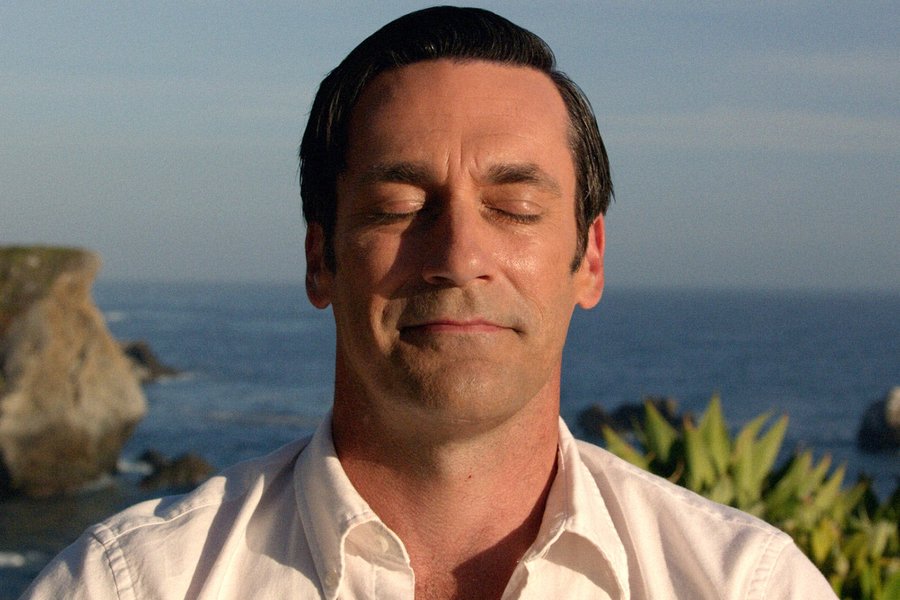
don bliss
Serenity Now!

Don has stayed at EsalenWorld long enough to find his bliss. His moment with the invisible man in group therapy was the falling beam. He is truly a changed man. This is perhaps the most human and humane moment we’ve seen from Don in the entire series.

Jon Hamm as Don Draper - Mad Men _ Season 7B, Episode 14 - Photo Credit: Justina Mintz/AMC
We just want to be loved. Is that so wrong?

But like Flitcraft, he’ll be back to the same old same thing soon enough.

There’s been some Internet squabbling about what the quick cut from blissful Don to this Coke ad meant. My take is that Don truly has changed, that he has had an insight into his nature and the ways he’s fucked everything up, and that he is on his way to forgiving and accepting himself in a way he never has before, and resolving to do better from here on. And that his experience sitting cross-legged on the ocean cliffs has given him the insight he needed to create one of the most legendary advertisements ever. And please note: I do not view his little grin as a moment where he cynically realizes that he can convert this moment of personal growth into a great ad. At that moment, he’s just grooving with the moment. And later, when he appropriates that genuine moment for an inherently inauthentic commercial moment, he likely has no inkling of the inherent cynicism of the conversion. It’s just who he is.<fn>Refer to the parable of the monkey and the scorpion crossing the river. Nature!</fn>

So what?

One of the ongoing themes of Mad Men has revolved around the question of “Can people ever change?” And I think the show has come squarely down on the same answer Hammett offered in the Flitcraft parable: Absolutely. Sort of.

I’d go with this. As with Flitcraft, Don experienced a true, honest, gut-wrencher of a life-altering experience, and I’m willing to accept that he has changed, maybe even for the better; maybe not. And that, like Flitcraft, he gets used to the after-effects of his epiphany, and slowly resumes the life he knows: ad man, probably re-married somewhere near where he once lived, subtly altered, somehow, but still the same Don/Dick as ever. The only difference now is that he is willing to admit – to himself, to others – his failings, and to remember them. And rather than deny the past – the identity theft, the affairs, &c. – he acknowledges it and accepts it as part of himself, and then gradually gets used to the beams not falling any more.

Because I think that’s how it works for most of us.<fn>I accept that there are people who radically alter their lives and habits and everything about themselves, either as a response to experience or as an act of pure will. If you are one of these, I suspect you are one in a (b)(m)illion. The rest of us muddle ahead as best we can.</fn> We experience these moments, these transformative events, and swear that we will never forget the lesson learned, the way we feel, the glimpse of truth. And we mean it, absolutely, but over time, the comfortable rhythms resume, and we are still pretty much who we were before.

Changed? Yeah, you bet, just as everything we experience makes an impression on our psychology, our exchange with and understanding of our world. But are we any different? I’m not so sure.

To borrow from another Bogart moment, I’m not sure any of this blathering amounts to a hill of beans in this crazy world. I believe that the stories we read in books and on the screen and stage and on the electric picture radio box matter because, at best, they reflect something back our way that helps us understand ourselves more clearly, or maybe to understand other people differently. That our effort to read the stories tills fertile ground for that urge we (some of us!) have to know ourselves better, and to, perhaps, find a way to incrementally change over time, perhaps even for the better.

My thought? Mistrust the epiphany! It’s too grand. But the little glimmers of a-ha? Gather them like a squirrel gathers nuts.

Or not. Not for nothing, after Spade relates the Flitcraft story, femme fatale and murderess Brigid is utterly unimpressed. “How perfectly fascinating,” she says, eager to turn the conversation back to her favorite subject: herself.

Some people just don’t do self-reflection. And sometimes, I envy them. But not often.



My Favorite World #25

The A/C is busted and it’s fking hot; the dryer repairman is making his third visit in 2 weeks; I’m working under deadline on a story that just won’t gel. This post is a day late, and the grass still needs cutting. I know the rent is in arrears, the dog has not been fed in years. It’s even worse than it appears.

But it’s alright.

bestbrightest
That woman in the middle? That’s my girl.

That’s my wee baby girl in the middle. She received a Best and Brightest Scholarship award last night, somehow, despite still being 3 years old and fitting on my shoulder like a kitten, despite still being in pigtails and braces and having a broken arm, this wee baby girl has become quite the amazing young woman. I reel, I gape in amazement, I cry. I bust all my buttons.

Here’s a note from a good pal this morning upon hearing the news:

I remember when she was five: “what are you thinking about, Anna?” “Oh, I’m trying to figure out what the square root of 20 is, it has to be between 4 and 5 right?”

This kid is one of my heroes.

My Favorite World.


I’m Shocked, Shocked I Say

So Tom Brady knew – or probably knew, or should have known  – that he was playing with tampered balls in the Super Bowl. I’m shocked that such a thing happened.<fn>He received a 4 game suspension for this misdeed. By way of comparison, a player last year received a 2 game suspension for beating the shit out of his pregnant wife…on video. Such is the moral equation of the NFL. I’m shocked.</fn>

And apparently, one of the boxers in the big bout last weekend likes to beat up women when he’s not beating up men in return for huge paychecks.<fn>He beats the women pro bono.</fn> Shocked, I say. And his opponent, the other boxer? A raging homophobe. Shocking.

And so on.

bartleby
Professional Obligations

Professional obligations prevent me from delving deeper this week, so I’ll throw this discussion back to one of the first i2b posts and you can decide if it connects. I’ll be back with some nominally original thinking as soon as the man gets off my back.


My Favorite World #24

It’s book week at MFW!

Two great reads under my belt in the past few days – Walter Mosley’s Debbie Doesn’t Do It Anymore and Haruki Murakami’s Colorless Tsukuru Tazaki and His Years of Pilgrimage. Coming off a failed attempt at Donna Tartt’s The Goldfinch, it was a relief to pick up a couple of winners.

I just finished the Murakami this afternoon, and it pushed all my buttons. Deeply felt, beautifully written<fn>If the translator is to be believed.</fn>, and paced like a slow walk in the woods. Tsukuru is a 36 year old man who suffered a terrible sadness at age 20, nearly died (or attempted suicide) as a result, and has lived a dull and hermetic existence ever since. The book is his long-overdue journey to understand (or not) and come to (or not) a sense of acceptance. It seems that Murakami’s lifelong project is to try to make sense of loneliness and alienation, and in this book it’s no longer buried under metaphor; the loneliness is front and center this time.

It’s almost a trademark of Murakami to focus on a disaffected, emotionally frozen protagonist. He’s done it often, and well, but it never feels as if he has settled into formula, from Toru Okada in Wind Up Bird Chronicles to Kafka Tamura in Kafka on the Shore to Tengo Kawana in 1Q84. Tsukuru is similar to these characters, but distinctly his own man, no small irony with the central conceit of the novel asserting that he is inherently bland and colorless.

The ending<fn>Which I loved!</fn> leaves many questions unanswered, and as I approached the end and realized this was to be the (ir)resolution, the sense of warmth and affection I felt for Tsukuru multiplied itself. Some people hate the unresolved ending, but I’m not one of them.<fn>Please refer to the Legal Disclaimer at The Immunity Manifesto for details.</fn> I loved the ending<fn>Yes, loved!</fn>, one of the most satisfying book closings I’ve enjoyed in years.

Previous Murakami novels include Kafka on the ShoreNorwegian WoodThe Wind Up Bird Chronicle, and 1Q84. I loved them all, and there are many more waiting for me. He’s hugely popular in Japan; Colorless Tsukuru sold over 1 million copies in the first week of release in Japan. He’s worthy of the hype.

(btw, my daughter’s English class read Kafka on the Shore last year. I was pretty excited about this and I re-read it along with her. But at some point in the reading, one of the students told her mother that there was s-e-x in the book. Said mother stormed into the school and demanded that they stop teaching the book. Sadly, the school caved. I remain furious with this meddlesome, bible banging rube. Definitely not a contributor to My Favorite World.)

There are some similarities between Tsukuru and The Goldfinch. The protagonist in each book suffers a traumatic emotional episode as a teenager. Both books explore in great detail the interiority of the main characters, and do so at a slow, nearly glacial pace. Yet Tsukuru was so compelling I read the full 400 pages in less than two days; with the The Goldfinch, I could not wait to put it down every time I picked it up, and after 200 pages over two weeks, I finally couldn’t stand another word of it. I can’t put my finger on why, necessarily, other than I experienced Tartt’s writing as slooow for the sake of being slow, almost like a technical demonstration.<fn>Watch me! Watch me!</fn> With Murakami, the slowness had a forward rhythm to it that gave me the sensation of living inside Tsukuru’s insular and measured world; it felt like an organic aspect of the experience rather than a parlor trick.<fn>I realize I’m in the minority on Goldfinch, and do not suggest that if you liked it you’re wrong or anything like that. I might actually have liked it at another moment in my life. Books are funny that way.</fn> End of crappy comparative lit exposition…read the Murakami. You’ll be glad you did.

debbie

Walter Mosley continues to amaze. He’s written more than 45 books, and I’ve read around 30 of them. None have made me feel like I wasted my time. Debbie is about a porn megastar in L.A. who decides to make a break from the business. Mosley gets deep behind her character’s motivations and history; we get a real sense of Debbie as a person, not just, as she puts it, “a set of orifices on the screen”. Add to that a suspenseful plot and Mosley’s mastery of language and sly sense of humor…well, it’s a quick read and a winner. And as always, Mosley uses his characters and plots to examine the dynamics of life as an African-American.

Sitting at hand is the latest in Mosley’s Easy Rawlins series, number 13. Like most of his fans, Rawlins is where I first got to know Mosley, starting with Devil in a Blue Dress in the early 90s. Unfairly, this series about an accidental LA private eye in the post-WW2 era got Mosley pigeon-holed as a mystery/crime writer<fn>A genre I truly love, btw.</fn>, but he is so much more. Rawlins is the author’s eyes and ears, showing and interpreting the post-war experience of African-Americans in Los Angeles.<fn>Think Chinatown from the perspective of the black community.</fn> The plots and mysteries are always top notch and keep you on the edge of the seat, but they are in some ways incidental to Mosely’s central project – an exploration of the political and cultural factors that served to define the dimensions of what it means to be Black in White America, and what that means to his primary characters.

rose

So I read the first couple of pages of Rose Gold and began to think I should go back and re-read the series before I read this one<fn>I first read Devil in a Blue Dress about 25 years ago.</fn>, just binge it like a Netflix series. I have a huge stack of reading on my nightstand, so this feels like a scary commitment, but it might be time to re-visit the origins of Easy and Mouse and Jackson Blue.

By 1995, Denzel Washington used his clout to get Devil on the screen. In a sane world, this should have been a long-running franchise, but leave it to Hollywood to fuck up a perfectly good crowbar. Still, the movie remains memorable as the first time I laid eyes on this guy.<fn>Not entirely true. It turns out I’d been watching him for a few seasons in a better-than-average tv series called Picket Fences, but he was so completely transformed in Devil that I didn’t realize it for a while. One night while watching him play the quiet, dapper DA in the show, it hit me. His great career is no surprise…the guy had chops from the start.</fn>

devil_in_a_blue_dress-cheadle
Don Cheadle as Raymond “Mouse” Alexander

This was Don Cheadle’s breakthrough, as Easy’s best friend Mouse. A homicidal criminal and true blue friend, Mouse is one of my favorite characters out of any book. Denzel was great as Easy, but Cheadle just nailed this role. You literally can’t look away when he’s on screen. He is absolutely one of the My Favorite World all-stars.

All this leads me to think I should also re-read The Man in My Basement, which is my favorite Mosley to date. And that leads to the Socrates Fortlow and Leonid McGill books, and his sci-fi novels and stories, and, and, and. He has demonstrated time and again that he transcends the crime writer straight jacket.<fn>Hell, Man in my Basement is way closer to Chekhov than Chandler.</fn>

Seriously, 45 books in 25 years. That’s some badassery right there.

So to sum it all up….

Haruki Murakami:

murakami

Walter Mosley:

Walter-Mosley-Quotes-2

My Favorite World.