All the Critics Love U in New York
If there’s any celebrity you can be sure you did not know in any significantly real way, it was Prince. Shape shifter, name shifter/eraser, master of every style you can name. Intensely private and essentially flamboyant. Exhibitionist. Hermit. You don’t know him except in the ways you think you do, and that has as much to do with what you wanted him to be as it does with which little pieces of mythologizing he wanted you to see at any given time. Like the classic Trickster of legend, he could present multiple faces at the same time, and the face you got to glimpse, briefly, depended on which side of the road you were standing on. If Prince had been around then, Kurosawa could have made this pint-sized product of Minni-freaking-sota the centerpiece of Rashomon. That would have been cool.

What do I know of Prince? We’re roughly the same age. He’s probably the most under-appreciated guitar player in like ever. Over the years that I have been heralding him as easily the best thing since Hendrix and sliced bread I’ve received more than a few puzzled looks and dismissive chuckles about me just being a contrarian. This week, many people were surprised when Billy Gibbons described his playing as “sensational”.

But even that is only a piece of it. From his textbook knowledge and respect for those who came before him – JB, Sly, Jimi, Miles, George Clinton, &c. – to his savage dance chops and ultra-sharp fashion sense, to his early adoption and mastery of technologies like the Linn Drum; the guy put a package together that was both historically intelligent and, somehow, way out in front of the coming surge of hip-hop and Michael Jackson/Madonna style pop that followed him by a few years. The man had his gifts. Add in an almost incomprehensible work ethic, and you have Prince.

How Prince helped me know myself comes down to this simple question:

How could anyone possibly fail to recognize such evident talent?

Probably the way that I did.

Because instead of listening, I reacted to the packaging cues that came with the Prince product. And because he hit the scene in the late 70s with a funky beat, puffy shirts, lots of synthesizers, and a (deceptively) silly reliance on lyrics about fucking, I saw him clearly for what he was: just another callow Disco Boy, a Travolta, a Bee Gee.

It’s hard to remember (or, if you are a little younger, comprehend) the degree to which DiscoSux fever encompassed the world of funky music. Earth, Wind & Fire, James Brown, P-Funk: all these and more took their share of unfriendly fire from people who were essentially painting the entirety of black popular music as beneath-contempt shit.

DiscoSux fever was a symptom of reaction against gay and minority encroachment into the historically masculine world of rock and pop. This music was aimed at gender-fluid communities and urban black folk. For a generation of mostly white, hetero-norm critics and fans for whom rock’n’roll equaled priapic guitar stroking and golden-maned Dionysi sporting socks stuffed into spandex trousers, this was music that threatened the natural order. <fn>The pulse belonged on the 1 and 3, dammit, none of this 2 and 4 backbeat shit. Whaddya, Disco Duck?</fn> It was outsider art storming the academy. And I was a privileged, by-birth member of the patriarchal academy, though I didn’t even know that such a thing existed; such is the blindness of by-birth membership.

Prince said fk all that noise, and it was pretty clear that he was throwing down on, well, people like me.

Look out all you hippies, you ain’t as sharp as me
It ain’t about the trippin’, but the sexuality
– All the Critics Love U in New York

Hey. I resemble(d) that remark.

So I could “listen” to When Doves Cry or 1999 and quickly sort this alleged genius off into the “just another over-hyped fraud” bin.

In that same song, this upstart had the nerve to sing:

It’s time for a new direction
It’s time for jazz to die

As a burgeoning jazz-bo, I tooks what I tooks and it was more than I could takes. I didn’t need to hear the music behind this pixie poppinjay. These crude insults told me all I needed to know! Pistols at dawn!

Later, when Miles compared him to Duke Ellington and Chopin, it was easy to dismiss the comments as Miles trying to glom onto the popularity of the younger phenom. Because come on: he’s really just another Disco Boy, and everybody knows that DiscoSux, so pass the bong and cue up some Coltrane or some real rock’n’roll. Dude.

One night in 1993 I watched a terrific Neil Young Unplugged on MTV<fn>In those days, children, the M stood for “Music”. You can look it up!</fn>. The next show was Prince live in some mega-arena, and I watched it and thought, “Meh, pretty good” and then he walked offstage and into a limo that took him somewhere and he walked into a small club and took the stage and proceeded to melt my face with a yellow guitar and the most scorching Hendrix-style blues I’d heard since before Stevie Ray died. For the next hour I was slain. I’ve been listening to Prince ever since.

So what does the phenomenon of Prince teach me about myself? Every time I hear his music, even as I am digging it down to my toes, I am reminded that I am a fallible human being, prone to unpleasant bigotries and prejudices that cause me to stop paying attention to what is real and true. The impulses that put me on auto-piloting sort mode – this person is this, that music is that, I don’t like “those” kinds of people/music/movies/food/&c. – are the things that make me miss the My Favorite Worldness of life. It’s good to have a ready reminder – one that the iPod throws up randomly and often – that for all my pretense to erudition and discernment and such like, I am just as likely to react like a dope as I am to apply any kind of intentional awareness to, well, anything.

Which means, naturally, that any opinion I hold is inherently suspect and worthy of re-examination. Consider yourself duly warned.

The most delicious part of the irony is that the song I quote above, had I bothered to listen to it in 1983, would have delivered exactly the kind of face-melting guitar heroics that won me over ten years later. Check it.

https://www.youtube.com/watch?v=pJxt_Ey6tbo

Who knows? I was full of myself in those days<fn>Unlike now, when I am extremely humble and enlightened.</fn>, so I might have dismissed it anyway.

Thanks, Artist Who Formerly Bestrode The World as Prince. Somehow, having you be the constant reminder of my proclivity to dopiness ain’t all that bad. You sexy motherfker.



Jobz Are Us: The Ethical Dilemmata of the Humble Scrivener

Toiling away here in the bloggy vineyard, Your Narrator finds himself in near-constant search of gainful, remunerative scribbling. Oh sure, regaling the tens of loyal i2b followers with insight, pith<fn>Yeth. Pith.</fn>, and tres bon mots in return for your undying adulation is all the reward an inky wretch could hope for. But the family has this annoying tendency to, you know, eat, so I expose my tender talents to the cruel world in hopes that someone will toss a few shekls my way.<fn>That Donate button over to the right has not brought the expected riches, needless to say.</fn> <fn>The mere mention of which – the Donate button, that is – is of course, a classic example of shameless whoring, one which allows the reader a choice between casting judgement on Your Narrator or of empathizing with his plight.</fn> <fn>And, also too, this mentioning – re: the judgement v. empathy conflict – potentially instantiates a frisson of guilt in the freeloading reader, which pointing out represents a further, and perhaps more pathetic, instance of Narratory whoring.</fn>

So I troll, I dig. I hustle. And occasionally, I am rewarded beyond my wildest dreams when I find an inducement like this:

Do you love essential oils? Do you love to write about them and take pictures?
[….] Essential Oil company is looking for someone who is passionate and knowledgeable about essential oils. We currently have a blog and we are looking to add guest editors/bloggers to our mix. Will will pay per post which will need to include general information about essential oils, DIY projects, recipes or other ideas. Posts must include images.

The photo at the top accompanies this hustle, which appeared on Craigslist,<fn>Pro tip. Job ads on Craigslist are maximum sketchy.</fn> I love this: in itself, it appears to have been written by a 7-year old ESL student. “Will will pay…” But scoreboard! They realize they need a writer!<fn>A plight more common that most would think, and one that goes unrepaired despite the glut of folks like me who stand at the ready to make your communications shine!</fn> <fn>Too much hard sell? Sorry, got a little over enthused.</fn>

Further, its appeal to the aspirant writer’s passion for essential oils bears all the earmarks of a near-empty paycheck for the writer’s work. Come for the oil! Stay for the love! Plus, photography!!!

Really, Your Narrator chortled heartily at this one, not even needing to get into the 4th grade trick of mis-attaching the modifier in a way that throws shade as to which is truly essential in their minds: the oil or the blogger.<fn>Fun fact: if you are picky and priggish about language and its (mis)use, you will never find yourself unamused in our culture. You may also never find yourself invited to parties and the like. Is that trade-off worth it?</fn>

But this is far from the funniest/oddest job description I’ve ever heard. Travel back through the misty clouds to last fall….

The result of a hot tip, I found myself a-phone with a marketing agency that specializes in providing ghost-bloggers/tweeters for various publishers and their author list. This allows the tormented author of belle lettristic masterpieces (as well as authors of, let us say, non-bl titles) to maintain a daily presence on the Internet tubes as a witty, friendly, ‘hey-I’m-your-old-pal here sharing recipes and anecdotes and asides as I take frequent (up to ten a day) breaks from my bl and/or non-bl musings’, when in fact, a writer working under deadline, regardless of the relative bl and/or non-bl merits of the work, definitely does not have surplus time/wit/inclination for such base-level whoring.<fn>That’s for guys like me!</fn> Thus does it fall to schlockingly underpaid ghost writers to maintain the illusion of your favorite author as an active and engaged pal with her readers, when in fact, she is likely cranking out sub-mid-list potboilers at a rate that would have made Elmore Leonard quail.

And let’s go ahead and get out of the way any illusion re: the bl and/or non-bl divide. The authors/titles are decidedly down the prestige meter here; we’re not talking anyone/thing you’d likely read about in the NYRB or NYTBR. In fact, what we had in this case was a stable of ghost-writers churning out mass-pulp fiction under specific trade names, kind of like the Nancy Drew and Hardy Boys titles of my youth, but without quite as much class.

So, here I am, spinning myself as the perfect fit for the job of ghost-writing social media content for someone who does not exist but is rather being made manifest by a gaggle of scribblers who, like myself, are ghost-writing for some nom de plume who does not really exist.<fn>This delightfully meta recursion could go on forever, like one of those Nam June Paik installations with video cameras and monitors replicating into infinity. Could I get so many (imaginary) authors assigned to me that I would have to sub out the daily Intertubes witticisms to yet another level of people pretending to be someone pretending to be a person who does not exist anywhere other than a book catlague?</fn> <fn>Even more challenging: assuming the level of one’s persona-creating prowess – maybe even to the point where you’ve really devised some seriously recognizable and individuated character traits and proclivities for these authors who do not truly exist – would one also be able to deploy the epic juggling chops one would need to keep each of the various non-extant “people” sorted out in one’s daily creation of “witty, friendly, ‘hey-I’m-your-old-pal here” dispatches, or would eagle-eyed readers be able to detect your various fabricated personae bleeding one into another, thereby undermining the, not integrity, no, but the structural resilience of the whole facade. Say it with me, people, this thing is getting fraughter by the minute.</fn>

It turned out that this agency had two specific clients. One is a publisher of potboilerish steampunk thrillers, but, said the agency rep, they had plenty of people to keep that social media illusion rolling. The other publisher, said the rep, presented a little more of a challenge, and this is where she hoped I “might be able to help, but, ah, it is, well, a little delicate.”

Interest engaged! Do tell, what is this mystery challenge?

Please don’t be offended…

Offended? Damn, I’m dying to find out! Tell me, tell me, please!

…but how would you feel about ghost blogging for authors of gay male erotic fiction?

Ya gotta admit: as job-related questions go, this beats out even a gold standard like “Do you love essential oils?” by a country mile.

You would have been proud of Your Narrator. He was silky, unruffled, and decidedly unoffended. This was some kind of challenge. Could I do it? Who knew? So I exuded that reliable and unearned confidence that served me in good stead all these years.

Yeah, I’m pretty sure I could handle that. I love new challenges. But you should know that I’m a 30-year married hetero with two kids.

There was a relieved sigh at the other end of the line (apparently, the agency rep<fn>Who, as it happened, was breast-feeding her child during our call, a fact that she had shared early on in our telephonic relationship for reasons that were not completely clear. But I don’t judge. I was likely in boxers at the time, myself, though there was no human creature attached to me.</fn> had borne the brunt of more than a few churchy/homophobic rants), and she said:

That’s ok. Most of the authors aren’t gay, anyway. In fact, most of them are straight women.

I allowed that this was a fascinating tidbit. Please, do go on.

Yeah, in fact, we did some market research and discovered that 85% of all our sales were to married women between the ages of 40-55. Almost all of the authors fall in that group, too.

You know what they say (and of course, they are always right): You can’t make this shit up.

So to re-cap: the job was to provide ghost writing services to authors who were in fact ghost writers themselves, writers pretending to be differently gendered and gay; straight women writing pornography (excuse, erotica) about man-on-man/men encounters for other straight women. And my role was to execute the friendly/witty/your-good-pal online personae to provide the so-called authors’ fans with a sense of connection one-to-the-other. I believe this is a situation for which the word simulacrum was specifically coined.

I did not get the gig. I guess things were already confused enough without dropping an aging, hetero, patriarchal penis person into the mix.

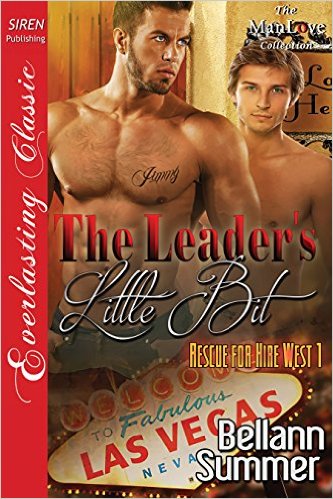
So next time you are spot a book like this, keep this little tale in mind. It may not be quite what you think. Or, if you are a married woman between the ages of 40-55, it might be exactly what you think.

This is not from the publisher in question, but it is pretty representative of the title list I saw.

Who needs a Jade Helm conspiracy when this kind of thing is going on?

My. Favorite. World.


Infinite Quest

Sept 12 – David Foster Wallace died 7 years ago today. Maybe died isn’t the right word, though it’s at least partly true. He killed himself; took his own life. This fact still makes me sad and angry and scared all at once.

The best way to counter these feelings is to read some of his work.<fn>If for no other reason than that his work is the only part of him that we have any legitimate claim to. Angry at the guy? Shit. I owe him.</fn> His essay from the January, 1996, issue of Harper’s, which became the title piece from his collection A Supposedly Fun Thing I’ll Never Do Again, is the single funniest and most “readable”<fn>Readable here connoting ‘something not too weird or difficult’. In fact, everything I’ve read by DFW – which is pretty much everything that’s been published plus a glimpse of a few of his notebooks at the Whitney Biennial – is terrifically readable and worth every second it takes to look up unusual words, refer to yet another footnote, or just to re-read certain sentences over and over because they are just too wonderful to take in at once.</fn> piece in his entire output. I’ve just finished it for the eleventieth time and it’s got me hungry for more.  E Unibus Pluram: Television and U.S. Fiction” is up next,and it’s sort of an essential piece for anyone interested in culture and the challenge of retaining our humanity amidst a dazzling array of shiny objects.

I find it by turns amusing and annoying that DFW is characterized as a fetish object of a hipster crowd way younger than me, that he somehow is the prototypical voice of ‘this’ generation. This is bullshit: DFW is of my generation. Our lives tracked more or less the same time span, though mine has endured a tad longer. In Infinite Jest, he wrote of a future that is more or less now; really, though, he was writing about a present-then that was the product of the culture of our childhoods.

It also pisses me royally that Infinite Jest is known as that book that everybody bought and nobody ever really read, save for a few precious bookish beardos. This tired trope likely arose from critics and other malcontents who felt the need to have/express an opinion but were too lazy to bother reading the actual book – thus inoculating themselves from accusations of laziness, because duuuuude, it’s like Finnegan’s Wake, knowhatimean?<fn>Pass the Bret Easton Ellis and the McInerney. It’s easier to chew.</fn> I grant the first 60-80 pages are little disorienting, but after that, it’s a roller coaster thrill machine that is every bit as addictive as The Entertainment that serves as the book’s macguffin. A book about addiction that is thoroughly addicting? Even better, a book that has its characters agonizing over and within their addictions while you, the reader, begin to wonder if maybe you ought to put the book down and eat or shower or go to work or something, but no, screw that, keep reading. That’s some badass legerdemain right there, people.

DFW is enjoying something of a mass(ish) cultural moment right now. There’s that movie with Jason Segal as Wallace, based on an interview transcript from the mid-90s, that has DFW’s surviving family suffering their own case of the fantods, suggesting with no small amount of justification that this kind of filmifaction of DFW is exactly the kind of mediated nonsense that he, DFW, would have hated and mocked with relentless passion. But no matter: it is, as the DC punditocracy like to say about every fabricated scandal, “out there”, and it thus seems to have generated a strange<fn>Strange because he died only 7 years ago, though it feels much longer, likely because he had been mostly silent for so long.</fn> renaissance in DFW fandomry and scholarship.<fn>Which, if you’ve read any of the scholarly work to emerge so far, is barely distinguishable from the fandomry, save a certain highly recognizable tone of pedantry apparently essential for academic publication.</fn>

Curiously coincident with the movie was the publication this year of an enormous brick – suitable for a guy who wrote the epically brick-like Infinite Jest and The Pale King – called The David Foster Wallace Reader, which presents around 1000 pages of essays, articles, short stories, and novel excerpts, and, most importantly, a few hundred pages of previously unreleased and obscurely published early works. My favorite part of the book are the notes and class syllabi he used for teaching. But mostly, I think, the people who bought it were, like me, yearning to place another DFW brick on their shelf, knowing full well that this was the closest we were going to get ever again.

I know there are other writers out there who deserve as much attention as I give Wallace. In fact, there are several who actually do get even more because of the relatively small output Wallace left behind.<fn>Rushdie, Moseley, Delillo to name a few. When do these guys ever sleep?</fn> But there is something about Wallace that drills right into my core.

Years ago, long before his death, someone asked me why I liked DFW’s writing so much. I said it was because reading him was like hearing my own voice inside my head if I had a better vocabulary and were much smarter. We were roughly the same age, grew up with the same general atmosphere of teevee, consumption, weird conformist culture, and tennis. Reading him felt like reading myself.

That was a pretty comforting thing, having someone out there grappling with the same kinds of angsty, middle-class, white boy problems, taking things on from a somewhat nerdly perspective but also bringing that weird Carlinesque outlook to the absurdities that our cossetted upbringing seemed to cultivate like mushrooms. Well, it was comforting right up until the day he killed himself. Then it became fucking terrifying.

Because here was the crux: here’s this guy, representing my mutant tribe of people who grew up inside the privilege and the comfort and the sheer whiteness of it all and knew that there was something amiss, that this incessant anomie was no accident, was actually not just a product but was actually a feature of the environment. And he saw it and got it and reported on it in a way that let us hold our deformity up for inspection and find some kind of strategy for dealing with the back-and-forth of we-have-no-right-to-complain-but-jesuschrist-things-sure-are-a-bundle-of-fuck. And in doing so, he won accolades, received a Guggenheim and a truck full of other awards. Had a fucking endowed Roy Edward Disney Chair in Creative Writing created just for him at Pomona College – dude looked like he had the world on a string.

And so one hears the news and goes, damn, that guy had it going on and I’m barely stringing a decent sentence or two together outside of my little whore gigs where I’m crafting allegedly pithy messages that are making the world a safer place for insurance adjusters or some such. And we’re the same age and have to wonder, his voice sounded just like my voice (if I were smarter &c.), and my shit’s nowhere near as together as his shit (the imagination at this point has its own engine and power source), but he took a look at it all and decided, nope, too much to bear, and took lights out. How do I measure into this equation?

Add to this that so far in that year two of my friends had taken the same way out, and that less than two months later another friend – all of us around the same damn age, mind you – made the same choice, and I gotta tell you: I was terrified.

We pretty quickly started hearing about how his was the end battle of a long life struggling with clinical depression, and that his family were not all that surprised by the event. I re-read Infinite Jest that fall and was struck by how much sadness was there. It was just bone-breakingly sad to read, so I read it again to see if I had been insane to recall the book as so wickedly funny. Turns out it was both – both incredibly funny and horribly sad and filled with almost too much truth about how we try to deal with a world that serves up both sad and funny in such apparently random and heaping servings. And that – crucially – that the only apparent strategy that made any sense was to find some way of connecting, really, with someone else. And then, to accurately describe how fucking hard that can be, to make that connection, not matter how much you know you should.

And so what does he – or at any rate, his thoughts that made it to a page – what do these ideas do for me now? I mean, crafty fking christ, if the guy who wrote the way you thought you’d like to write ends it all so gruesomely, what’s left?

Well, first I was left confused and scared and, frankly, pretty depressed. <fn>His death was not the cause of my depression, per se, but that this should have come along at a time when life was what h/we would refer to as fraught made things even more, well, fraught.</fn> But later – and especially after The Pale King came out, unfinished warts and all – I saw something else. Instead of thinking I might write that way if I were a “real” writer – and not just some ho for hire – I started to think about maybe, sort of, maybe actually being a real writer, maybe doing the hard work required to figure out if you have anything to say and the ability to say it.<fn>The jury remains forever out on this question. Ask any writer sitting in front of a blank page.</fn> But then time passed and nothing came of it and I ignored this kind of insistently annoying Epiphany-like thing that refused to be ignored. Which of course, the trying to ignore that which refuses to be ignored, only engenders more angsty fraughtness, &c.

And then, I endured My Apocalypse, and a couple of weeks after I left hospital, I was lying on the sofa in a dark room when – and I shit you not – when an entire written piece started to appear full-blown on the ceiling.<fn>And yes, there were footnotes on the ceiling, and complete sentences, too.</fn> And I rushed to the computer for like the first time in 4 months and sat down and wrote The Chronicle in its entirety and started “publishing” it in pieces on the Facebook machine. And lo, it was rough and sloppy and funny and tender, and my Epiphany-like thing just smiled quietly to itself.<fn>Some of you have read The Chronicle. It is under revision, but you got the bloggy first draft blast. You’ll tell your grandkids someday.</fn>

And here we sit, faithful denizens of this here bloggy vineyard – which by no coincidence whatsoever takes its title and raison d’ecrir from The Pale King the words tumbling down like a poorly constructed simile on a shifting foundation of soft metaphors. And I thank DFW for his words – his Work, for it was truly some audacious labor – and for his ability to stave off his demons for as long as he did. He gave us what he had. I can miss him and wish he were still writing for us, but I can’t be angry at him for checking out. Just sad. And, oddly and thankfully, a little inspired.

So today, hot on the heels of National Suicide Prevention Week<fn>Which irony would not be lost on D.</fn>, I’ll thank all of you to remember, also, too: shit’s never as dark as it may seem. When the imagination creates it’s own dark engine and gloomy source of power, reach out. Keep going. The quest, it is infinite.


Oh for the love of….

Well here we are again, a gaggle of bible thumpers declaring victimhood because a book threatens the very ground of their beliefs.

It’s bad enough when a parent helicopters into a school to protect his little precious from bad words and strange ideas. But now we have college students sheltering themselves from the horror of a broad education. Assigned a graphic novel<fn>In my day, we called them comic books, and we liked it.</fn> for summer reading, freshman enrollee Brian Grasso, Duke University Class of ’19, took a look at Alison Bechdel’s Fun Home and declared that he would not read it because of the book’s “graphic visual depictions of sexuality”.

I feel as if I would have to compromise my personal Christian moral beliefs to read it,” Grasso wrote in the post.

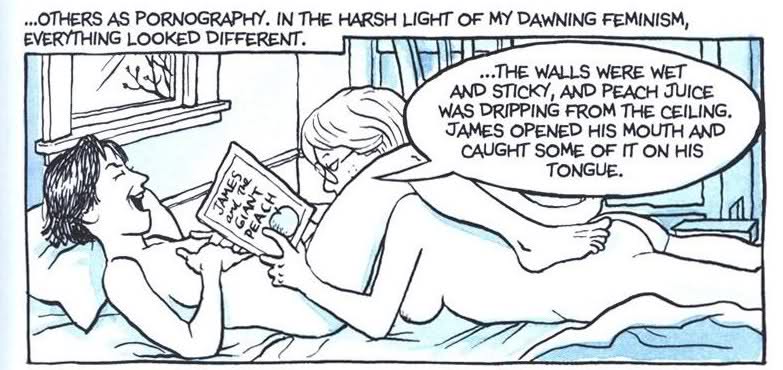
FWIW, the so-called “graphic visual depictions of sexuality” are all icky gay stuff. Naturally. To wit:

fun home
Look away! Look away!

Another student wrote in an email that:

The nature of ‘Fun Home’ means that content that I might have consented to read in print now violates my conscience due to its pornographic nature.”

It’s hard to tell, but I think this means he would have been okay with reading a steamy sex scene, but a pen and ink illustration of same would threaten his mortal soul. The grammar and theology behind the email make for a tough nut, crackwise. Perhaps it has to do with the confusion this book might create in re: a beloved children’s book:

Roald Dahl would probably approve

I must lead a sheltered life, but I had not heard of this book before today. Now, thanks to the squeamish guardians of morality in Duke’s Class of ’19 – and, to be honest, this intermède de peche juteaux – it has risen to the top of my to-read pile.

There’s a bit of a skewed parallel between this kerfuffle and last week’s tempest over The Curious Incident of the Dog in the Nighttime<fn>Is a skewed parallel even a thing? Geomathematically, perhaps not, but I’m kind of loving the challenge of visualizing one, so a thing it is, says I. If this offends, you can either write your own blog or organize a protest against my invocation of such an abomination to Euclidean purity.</fn>. In that case, it was busybody parents invoking their right to “raise their children as they see fit” while not so incidentally depriving the children of less hysterical parentage the opportunity to grapple with new ideas.

In this week’s episode in willful ignorance, it is the busybodies’ spawn invoking the right to remain unsullied by ideas that are new or unusual.

School-wide book assignments for incoming freshmen are a staple of college curricula these days. It provides a nexus for the entire incoming cohort to discuss, debate, and argue the merits/cons of a specific work. It does not ask that anyone abandon their faith or accept a new idea that offends them.

It does, however, ask that students at least consider a perspective that may be new to them. It asks them to begin to think for themselves, to analyze information that is new and challenging. And that, alas, seems to be the core of the offense that these tender lads and lasses cannot bear.

Exposure =/= indoctrination. Is their belief set so tenuous that a comic book would cast it asunder?

“I thought to myself, ‘What kind of school am I going to?’” said freshman Elizabeth Snyder-Mounts.

You’re going to Duke University, child, source of 8 Nobel laureates, 3 Turing Award winners, and 25 Churchill scholars. These are not honors that typically accrue to people who are afraid of a comic book. Duke has no religious affiliation. It has ranked in the top ten US universities for the past 20 years.

Duke did not seem to have people like me in mind,” Grasso said. “It was like Duke didn’t know we existed, which surprises me.”

More likely, Duke knows people like Grasso exist and they don’t care about catering to their narrow minds. Universities exist (at least in theory) to expand the minds of its students, to give them access and exposure to information that falls outside the experiences they bring to campus. If a student does not wish to have his tender feelings bruised from an encounter with new ideas, there is a simple solution: stay home. Get a job or go to a trade school.<fn>Or go to one of the bible-based schools where the mission is to keep you safely cocooned inside your ignorance.</fn>

The student is asked to read a book, not adopt it as a how-to-live manual. The student is asked to bring a sense of skepticism to the exercise, to read with critical awareness, and to come to some conclusions about what they do/do not believe. Until the next book, and then it happens again, believing something new, discarding something old, re-believing something old, and so on. In the end, the student arrives at some semblance of understanding herself –  what she believes, what she is willing to fight for, what she holds dear.

“In the end.”

I suppose I should reveal the deep, dark secret around this: there is no “end” to all this. It lasts a lifetime. This may be the most wonderfully maddening aspect of being an alive, alert human being. Exposure to a range of ideas in the course of one’s education is a terrific foundation for this kind of rich, multi-layered life.<fn>Of course, this D.D. secret might be terrifying to some, to those who want an answer now that will confer certainty and foundation to every challenge that will come their way. These are the people who wish to protect themselves from strange new ideas. Those things shake the earth beneath our feet. Scary stuff.

I will give the frightened flowers of Duke’s Class of ’19 this much: They are not trying to impose their fear of learning on anyone else. They just want to be able to close their senses to something that scares them. And the powers at Duke are letting them have their way. That’s probably as it should be. You can lead a horse to water.<fn>Or you can lead a horticulture &c.</fn> But somewhere, somehow, a strange idea is going to sneak through and these students will be utterly unprepared for the shock.

By the same token, students who invoke the recently-minted trigger warning concept should also receive consideration. If someone really, really objects to certain kinds of material – for whatever sincerely held reason – she should be allowed to opt for an alternate curriculum. Perhaps that student should reconsider his field of study if this happens too often, just as those who feel that religion makes them incapable of fulfilling their professional duties should consider a different line of work.<fn>Mennonite airline pilots, perhaps?</fn> But in no case should the sincerely held beliefs of one, or a few, or even of a majority, be used to interfere with the rights of everyone else to learn what the school offers to teach them. And if your school insists on teaching you about knowledge you’d rather not deal with, go somewhere else.<fn>I’m pretty sure I would not appreciate the curriculum at Bob Jones University.</fn> And it’s way past time our society stopped privileging complaints based on religion over other kinds of objections. If a student really wants out, let her out, whether it’s because of religion or gluten or an objection to the teacher’s cologne. And everybody else goes on with their business.

As it happens, as I was writing this lament about how some kids these days are wasting their opportunity to learn and to embrace their humanity in full, I was alerted to a new opinion piece in our local fishwrap in which one of the local students affected by the Curious Dog kerfuffle lamented the loss she felt from the affair. This is a young woman whose curiosity for new ideas is undampened.

Here’s a point J.W. makes well:

Telling students to avoid books containing “wayward beliefs” implies we are incapable of thinking for ourselves. The removal did not give parents the freedom to parent, but instead attacked freedom of thought.”

That’s the story in a nutshell. The fear of ideas and the attempt to run away from them, to pretend they don’t exist, leads to nothing good. Suppressed ideas become alluring, forbidden fruit, suffused with the aura of being “naughty” or “bad”. The refusal to grapple with them in the light gives them greater power. And when the time comes – and you bet your last dollar it will – when the time comes that the sheltered innocents are forced to face the world as it is, the ground will shake and the walls will crumble. This story is as old as time.

I worry about the students who are supposedly ‘getting an education’ when all they are really getting is a piece of paper that says they hung around for 4 years or so. These people are a danger to themselves and to our society’s ability to govern itself.

But then again, students like J.W. and all the others like her – curious, awake, alive – just might give this cynical old coot cause for optimism. <fn>For real.</fn>