Your Electric Picture Radio Box Matters #3: The Critical Importance of Myth (#BlackJesusMatters)

“We tell ourselves stories in order to live” – Joan Didion

“We tell each other stories in order to live together” – i2b

People accuse the i2b team of elitist snobbery, of being blind and deaf to the kinds of entertainment that “real people” might enjoy. P’tah, saith the team: The i2b brow covers the full range, from low to high and all points in between.

In that spirit: NBC’s Jesus Christ Superstar Live in Concert was just about perfect in every way.

The sets and staging, the costuming, the direction: all of this was as good as it gets. The cast was superb, especially the Broadway pros. Better: the cast was determinedly multi-culti and scruffy as hell, all angular haircuts and tattoos.<fn>America’s grumpy pervert uncle Bill O’Reilly took to Twitter to decry this last bit. Get off his lawn.</fn> In this production, Jesus is a Black man, his “companion” a White woman. You better believe Black Jesus Matters.

Sara Bareilles and John Legend as Mary and Jesus

The expected troll backlash from the religious right never really materialized. A fair number of theologically inclined folks complained that JCS does not include the actual stone-rolling-aside episode, a resurrection<fn>See what I did there?</fn> of a now 48-year old gripe, but it is hard to see that anyone thinks this production short-shrifted the Christ’s ascension. Not to blow the suspense with spoilers, but there has never been a more effective evocation of the Crucifixion than this.
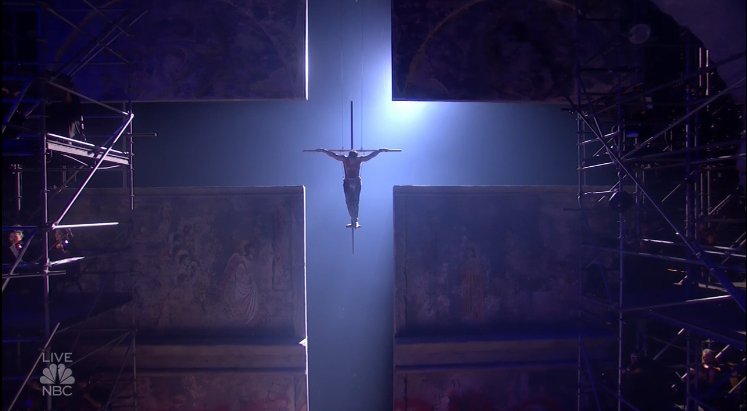
A Black Man, dead at the hands of a brutal state, becomes a symbol

Of note: as Jesus ascended, every member of the cast Took. A. Knee.

The Christ myth may indeed be the Greatest Story Ever Told. I write this as a fully convinced atheist, but that really isn’t germane, any more than are my thoughts about the reality of Hogwarts or Mordor. This is strictly about the narrative, and this story has it all: rebellion, romance, social justice, and brutal oppression. It’s about class division and capital punishment and the mechanics of social movements. And crucially, it is about betrayal.

When the original JCS album came out in 1970, I damn near wore the grooves flat. Raised in church, indentured as an altar boy until such time as I could effectively object, I was taken by the representation of Jesus as a man, a mortal product of time and circumstance. Divine? Maybe, maybe not.

Die if you want to, you innocent puppet.
– Pontius Pilate to Jesus

And what about Judas? History’s greatest villain, condemned by Dante to the 9th Circle, he remains by far the most complex and interesting character in the myth. But I, like many others, was raised with a black and white conception of Jesus-good-Judas-bad, a stance that pointedly ignores the fact that without Judas, there is no arrest, crucifixion, and resurrection. No Judas? No Christianity. This was one of our earliest lessons in ambiguity, and it remains perhaps the most prevalent.

Through many a dark hour
I’ve been thinkin’ about this
That Jesus Christ was
Betrayed by a kiss
But I can’t think for you
You’ll have to decide
Whether Judas Iscariot
Had God on his side.
– Bob Dylan, “With God On Our Side”

As good as Legend was as Jesus, Brandon Victor Dixon’s Judas stole the show. Already a Broadway giant, most recently as Aaron Burr in Hamilton, Dixon can write his ticket to any destination as of last night.<fn>The fact that Dixon was the actor who gave VP Mike Pence a public dressing down after a Hamilton performance only makes him all the more spectacular. And then the man offers the Wakanda Forever gesture during the curtain call?!?! FTW!</fn>

One of the great feats of JCS is the representation of Judas as something more than a cardboard villain, more nuanced than Palatine or Voldemort.<fn>The bad guy=pure evil equation has never offered much dramatic possibility.</fn> Judas had insight into the perils of personality cult. In the first song, he warns “all the good you’ve done will soon get swept away / You’ve begun to matter more than the things you say”, a timely caution for our favorites in current social movements as they navigate that assembly line of hero creation and defenestration that remains popular 2000 years on.

You’d have managed better if you’d had it planned.
Why’d you choose such a backward time in such a strange land?
If you’d come today you could have reached a whole nation.
Israel in 4 BC had no mass communication.

The depiction of the crowd as a gaggle of media hounds after the arrest of Jesus was a clever twist (as was the wide use of cellphones among the cast) that framed the events in relation to current movements like #NeverAgain and #BlackLivesMatter. The production may not have been conceived with these in mind, but you would have to deliberately choose to not see the echoes.

Every word you say today.
Gets twisted ’round some other way.
And they’ll hurt you if they think you‘ve lied.

Judas, famously, betrays Jesus with a kiss. In the JCS depiction, Jesus gathers Judas in a tight embrace, a clear display of affection for his old friend who, like himself, finds himself a pawn of forces beyond their reckoning. Is Judas, the universal symbol for betrayal and damnation, forgiven here by Jesus, the singular emblem of mercy and redemption in our canon? God, I hope so. Dante be damned.

I’ll go toe-to-toe with anyone to defend the premise that re-tellings like JCS – and Scorsese’s Last Temptation of Christ – do more to imbue the myth with the kind of layered meanings that encourage considered reflection and exploration than do the Sunday school bromides of my youth. Is Judas a man beyond redemption? Perhaps, although it’s hard to imagine a more vibrant redemption than Judas returning from the grave in a sequined tank top to tear the roof off the joint with the anthemic title song.
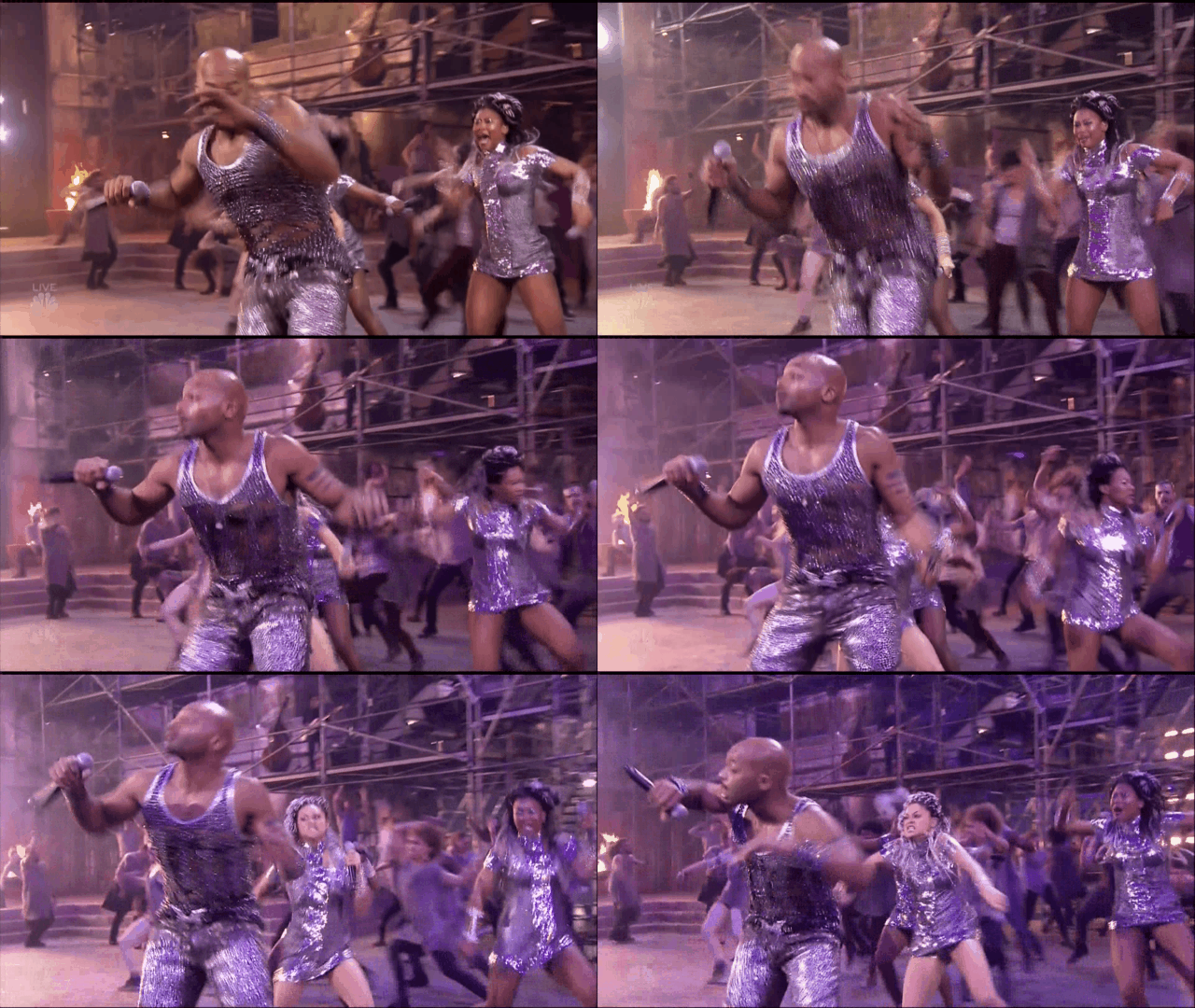
When I come back from the grave, I want to be this fabulous.

I have not listened to JCS in more than 20 years, not since the Atlanta music community<fn>Spearheaded by multi-talented Michael Lorant as a gun control benefit vehicle following his own shooting during a botched holdup; some things never change.</fn> mounted a terrific production of JCS with the Indigo Girls in the two lead roles. Presenting the out and proud Amy Ray as Jesus – and she killed it, from the moment her disembodied voice blasted into the Variety Theater on opening night – and the out and proud Emily Saliers, as Jesus’ “companion” Mary, was a provocative and daring move, well beyond central casting’s White Jesus, and surely the most daring JCS casting ever sold. Until now.

The diversity of casting and the representation of the apostles as scruffy misfits alone made the NBC production a statement. The presentation of Jesus as a Black man, and his female companion a White woman, could fairly be interpreted as a poke in the eye of America’s conservative culture warriors. For centuries, Western culture has insisted on depicting Jesus as some kind of Nordic or Aryan icon. Not this night. I’ll say it again: Black Jesus Matters, and the fact that NBC presented a depiction of the Christ myth that leaned hard on inclusion and diversity, and on the holiest day of the Christian calendar no less, is no small incident in the current climate.

Or maybe I’m wrong, and this is all about nostalgia and the willingness of a corporate behemoth like NBC/Comcast to manipulate us all for profit. It is certainly possible. No doubt, nostalgia plays a large part in my emotional response to JCS. A big part of my childhood, I know the lyrics and music to this show inside and out. Judging from Twitter, I am one among many. It is as firmly imprinted as any cultural artifact can be.

But it has to be more than that. The score, not astonishing by any measure, is filled with earworms and memorable lyrics, and the libretto is filled with doses of sly humor. King Herod’s song is campishly funny, made even more so by the stunt casting of Alice Cooper. (How Legend managed to kneel in front of Alice Freaking Cooper through that piece without cracking up is beyond me.)

My favorite gibe comes during the Last Supper, when most of the apostles are drunk with wine and enthusiasm for a movement they do not fully comprehend.

Always hoped that I’d be an apostle
Knew that I would make it if I tried
Then when we retire we can write the gospels
So they’ll all talk about us when we die.

Perhaps the Gospels were the first tell-all memoirs, the Apostles the creators of the genre. Scores of ex-White House staffers offer their thanks.

There was a ton of energy surrounding the performance, and the decision to have a live audience served JCS well where other recent broadcast musicals fell short. There was an apparent emotional connection at work in the venue, and that spilled over to the broadcast, even where it created technical issues with sound balance and such. But quibbling over mix problems is as beside-the-point as griping about commercial interruptions. Success for such a production comes down to a central concern: can the viewer emotionally connect?

So?

I admit it. I spent most of the evening with my cheeks wet. Mary doesn’t know how to love him. Judas doesn’t either. Jesus has galvanized a movement that is spinning out of his control. He recognizes too late that his followers are not up to the tasks of the movement, aside from Judas, perhaps, a man who is destined to betray Jesus to death. Jesus confronts the money changers and runs them from the Temple. For his trouble, Jesus is swarmed by lepers and other afflicted supplicants; pulling and tearing at him, everybody wants a piece for themselves no matter the cost to their saviour. The devoted dozen fall asleep as Jesus fairly begs someone to stay awake with him in his last night of freedom. Then comes Peter’s betrayal, three times, and Magdalene’s comment, “You’ve gone and cut him dead.” Then there is the agonized death of Judas, the man who made Christianity possible, recognizing that he is, indeed, damned for all time.

And finally, most of all, the Crucifixion, Jesus ascending and drifting into the mist on his tiny cross – “My God, my God, why have you forgotten me?” – framed by a giant cross, backlit until he disappears into pure light? As powerful and moving as it gets. Michelangelo can only shake his head and say, “Damn, that was fine.”

Despite the insistence of the devout that Jesus is indeed a manifestation of the one, true God<fn>Setting aside Nicene confusions of a Trinity that is or is not in fact a single entity</fn>, the way we tell ourselves/each other stories all but guarantees that there is not a single iconic representation of Jesus that prevails universally, despite the best efforts of Renaissance artists and the various approved councils, papal conclaves, and authors like Dante and Milton.<fn>Always keep in mind that a great deal of myth that people assume is from the Bible is in fact addenda created centuries past the authoring of Revelations.</fn>

All of which means that when a major teevee network devotes millions of dollars to a star-studded presentation of the Christ myth – on Easter Sunday, no less – it is worth paying attention to how this story is being told. Which Jesus, or whose, is always a question worth asking. Is this the Jesus of Harriet Tubman or Robert E Lee? Is this blond and blue-eyed Jesus or Jesus with dark skin and napped hair? Is this Jesus divine or mortal?

JCS does unbelievers the service of offering a Jesus that can belong to anyone.<fn>This may in fact be the greatest objection conservative theologians have to the proceedings.</fn> Watching it, I am reminded that even the non-believing “I” can have a Jesus, just as I can have my Beowulf, my Hamlet, my Ulysses, my Jean Valjean. Interpret the myth as you will, in a way that enables and ennobles you.

If your slate is clean, then you can throw stones.
If your slate is not, then leave her alone.

These are stories we tell ourselves, in order to live. They belong to everyone.


Validation is Not Just a River in Egypt

Validation. Some people crave it. Some could care less. Most of us probably fall in the muddy middle, swinging willy nilly between craving and caring less.

Sometimes, Your Narrator is reasonably content – yea, even fully satisfied – to do something well and enjoy the doing for its own sake. A well-written post. A nicely turned phrase. A lyrical, melodic line on the guitar. Mastering a new tune. That sort of thing.

Sometimes, YN is r/c – yea, even f/s – with a household chore done well. A clean toilet. A well trimmed hedge. Freshly cut grass. And so on.

Doing something well truly offers its own rewards. Really. No, really.

Usually.

Other times, invisibility seems to have taken over. The good post, the nicely turned melody, the simple chore…if a positive act falls alone in the forest, has it really happened? And even if it has….so the fuck what? Somebody pay attention!

So knowing well that the doing should be sufficient, what swings me to the opposite pole of neediness, of craving the validation? Is this a fundamental weakness? Or is a core need to be seen –  and dog forbid, maybe even appreciated – a natural part of the human condition, something as inevitable as hunger or thirst or lust or a desire to lay on the sofa and watch old movies with bags of chips and such?

Whichever is true, the need for validation combined with an ongoing absence of validation is one of my triggers, that set of conditions that puts you off your game, in a funk, down the hole, around the bend, {your preposition here} the {wherever}. And then it gets dark.

community_chest_doctors_fee_card_by_jdwinkerman-d7omi4d

It’s been a rough year. The remnants of that damned tick have at last receded into the memory mist, but employment remains elusive. (The news stories we’ve heard about how tough it is for someone over 50 to get work are not fairy tales. It just plain sucks out there.) Some plans and hoped-for outcomes fell to the ground. Other plans and h/f/o hang like undropped shoes. Hope began to feel banal and futile; at best, hopelessly naive. Pessimism became its own reinforcement.

The prescribed remedy – go ahead and do the work anyway – is easier said than done. Some people always seem to be able to muster the energy to persevere. (Or perhaps it only seems that way?) I’m not one of them. Sometimes, despair wraps its bony fingers around my neck and stops me in my tracks.

But.

Things are looking up, it’s always darkest just before the dawn, I can see clearly now, &c. The feelings of dread pass, and of course they always have, so no big surprise there. It’s not as though I’ve been lying on the floor counting ceiling tiles. Life has been pretty busy. There is an article commission – a musicological exposition that has never been made in such detail or with such care – that has occupied most of my writing time. It’s going to be pretty great. I know this because I’ve had two good readers give me the reality check. Validation! I knew (or thought) it was good, but the doubt crept in. The Greek Chorus knew just which tune to call to undermine confidence.

I really sweat blood on this article. A true labor of love, very important to me in so many ways. And now that it’s turned the corner, I’ve got my belief back. I can’t wait for everybody to see it.

171626959-shroomeryflyer-monopoly

Along with that, a couple of other h/f/o have turned my way. And even though none of it amounts to a nickel of income – yet, anyway – there are glimmers of light down the tunnel that might not be an oncoming train. Not gonna get too far out on the optimist limb just yet, but there might be, dare we even whisper it….hope.

Maybe even for the i2b blog. Or maybe not.

My first post at this little bloggy vineyard went up around a year ago. My last post went up about two months ago. Up until that last one, Your Narrator had been doing pretty well, keeping the entertainments rolling and the rants roiling. And then….

And then, the well just seemed to run dry. The Writer could not. Or did not. It’s unclear.

One of a thousand cuts: it seemed that there was no real interest in the blog. A handful of visitors here and there, the gears wouldn’t catch. Attention must be paid!

Mostly, the blog has been a great experience. My writing improved week to week, and at its (my) best, the knowledge that I had to generate something more or less reasonably kind of readable and interesting triggered me to be more engaged with the world, always on the eagle-eye to spot another cool story.

But dammit, now I needs me some validation.

Community-Chest-You-Have-Won-Second-Prize-In-a-Beauty-Contest
Who? Lil ol me?

I had to turn off the Comments function on the blog because I was getting 50-60 spam comments on every post. Actual reader comments averaged well below one per post. Not validating!

But strangely enough, the most validating of all comments ever posted here actually came from a spam bot. To wit:

What i don’t understood is in reality how you are not actually a lot more neatly-appreciated than you may be right now. You are so intelligent. You know therefore significantly in terms of this subject, made me in my view consider it from a lot of various angles. Its like men and women are not fascinated except it is something to accomplish with Girl gaga! Your individual stuffs excellent. At all times care for it up!

That was from Tanya3756dc from Uzbekistan. God, how I miss her unwavering support.

Eventually, I added a Donate button to allow grateful readers to show their love – measured in dollars, naturally. That generated exactly zero responses. Zee. Row. Along with the other rejections and dead ends (real and perceived), it all just felt pointless. I was a young Alvy Singer facing the inevitable outcome of an expanding universe. Homework? What’s the point?

But I’m open to reasonable persuasion. This is your chance to ensure that the hard-hitting social commentary and enlightening cultural musings that you’ve grown accustomed to over the past year keep on coming. After all, as Tanya3756dc reminds us: “At all times care for it up!”

Do you, patient reader, love me the way my T3756dc does?

If you send me an email (rob at jakelegg dot com) – imploring me to, for god’s sake, don’t stop the blog, the world will be a bitter and barren place without it – I will take your plea under advisement and perhaps send you a commemorative tote bag. (No, I won’t.) The more you beg, the more you fawn, the more your vote will count.

If you really want your vote to count, click on that Donate button at the top of the right column and drop a few shekls in the tip jar, I will come to your house and recite a blog post written specifically for you while I massage your neck and shoulders with essential oils. (Much as I’d love to, no. Not really.) Remember, the more you give, the more you truly love me.

I’ve done some calculating, and I figure if ten of you donate about $5000 each – or if 50 of you donate $3246 (that’s less than ten dollars a day!) – everything is gonna work out fine, the blog will continue, my dog will get to eat again, and I can get a new coffee mug that does not leak.

Give, or the blog gets it.

emoticon-pointing-a-gun-on-his-head-369

Operators are standing by.

monopoly-chance-card-generator
Actually, the jangle of coins makes me nervous. Quiet folding money only, please.


Infinite Quest

Sept 12 – David Foster Wallace died 7 years ago today. Maybe died isn’t the right word, though it’s at least partly true. He killed himself; took his own life. This fact still makes me sad and angry and scared all at once.

The best way to counter these feelings is to read some of his work.<fn>If for no other reason than that his work is the only part of him that we have any legitimate claim to. Angry at the guy? Shit. I owe him.</fn> His essay from the January, 1996, issue of Harper’s, which became the title piece from his collection A Supposedly Fun Thing I’ll Never Do Again, is the single funniest and most “readable”<fn>Readable here connoting ‘something not too weird or difficult’. In fact, everything I’ve read by DFW – which is pretty much everything that’s been published plus a glimpse of a few of his notebooks at the Whitney Biennial – is terrifically readable and worth every second it takes to look up unusual words, refer to yet another footnote, or just to re-read certain sentences over and over because they are just too wonderful to take in at once.</fn> piece in his entire output. I’ve just finished it for the eleventieth time and it’s got me hungry for more.  E Unibus Pluram: Television and U.S. Fiction” is up next,and it’s sort of an essential piece for anyone interested in culture and the challenge of retaining our humanity amidst a dazzling array of shiny objects.

I find it by turns amusing and annoying that DFW is characterized as a fetish object of a hipster crowd way younger than me, that he somehow is the prototypical voice of ‘this’ generation. This is bullshit: DFW is of my generation. Our lives tracked more or less the same time span, though mine has endured a tad longer. In Infinite Jest, he wrote of a future that is more or less now; really, though, he was writing about a present-then that was the product of the culture of our childhoods.

It also pisses me royally that Infinite Jest is known as that book that everybody bought and nobody ever really read, save for a few precious bookish beardos. This tired trope likely arose from critics and other malcontents who felt the need to have/express an opinion but were too lazy to bother reading the actual book – thus inoculating themselves from accusations of laziness, because duuuuude, it’s like Finnegan’s Wake, knowhatimean?<fn>Pass the Bret Easton Ellis and the McInerney. It’s easier to chew.</fn> I grant the first 60-80 pages are little disorienting, but after that, it’s a roller coaster thrill machine that is every bit as addictive as The Entertainment that serves as the book’s macguffin. A book about addiction that is thoroughly addicting? Even better, a book that has its characters agonizing over and within their addictions while you, the reader, begin to wonder if maybe you ought to put the book down and eat or shower or go to work or something, but no, screw that, keep reading. That’s some badass legerdemain right there, people.

DFW is enjoying something of a mass(ish) cultural moment right now. There’s that movie with Jason Segal as Wallace, based on an interview transcript from the mid-90s, that has DFW’s surviving family suffering their own case of the fantods, suggesting with no small amount of justification that this kind of filmifaction of DFW is exactly the kind of mediated nonsense that he, DFW, would have hated and mocked with relentless passion. But no matter: it is, as the DC punditocracy like to say about every fabricated scandal, “out there”, and it thus seems to have generated a strange<fn>Strange because he died only 7 years ago, though it feels much longer, likely because he had been mostly silent for so long.</fn> renaissance in DFW fandomry and scholarship.<fn>Which, if you’ve read any of the scholarly work to emerge so far, is barely distinguishable from the fandomry, save a certain highly recognizable tone of pedantry apparently essential for academic publication.</fn>

Curiously coincident with the movie was the publication this year of an enormous brick – suitable for a guy who wrote the epically brick-like Infinite Jest and The Pale King – called The David Foster Wallace Reader, which presents around 1000 pages of essays, articles, short stories, and novel excerpts, and, most importantly, a few hundred pages of previously unreleased and obscurely published early works. My favorite part of the book are the notes and class syllabi he used for teaching. But mostly, I think, the people who bought it were, like me, yearning to place another DFW brick on their shelf, knowing full well that this was the closest we were going to get ever again.

I know there are other writers out there who deserve as much attention as I give Wallace. In fact, there are several who actually do get even more because of the relatively small output Wallace left behind.<fn>Rushdie, Moseley, Delillo to name a few. When do these guys ever sleep?</fn> But there is something about Wallace that drills right into my core.

Years ago, long before his death, someone asked me why I liked DFW’s writing so much. I said it was because reading him was like hearing my own voice inside my head if I had a better vocabulary and were much smarter. We were roughly the same age, grew up with the same general atmosphere of teevee, consumption, weird conformist culture, and tennis. Reading him felt like reading myself.

That was a pretty comforting thing, having someone out there grappling with the same kinds of angsty, middle-class, white boy problems, taking things on from a somewhat nerdly perspective but also bringing that weird Carlinesque outlook to the absurdities that our cossetted upbringing seemed to cultivate like mushrooms. Well, it was comforting right up until the day he killed himself. Then it became fucking terrifying.

Because here was the crux: here’s this guy, representing my mutant tribe of people who grew up inside the privilege and the comfort and the sheer whiteness of it all and knew that there was something amiss, that this incessant anomie was no accident, was actually not just a product but was actually a feature of the environment. And he saw it and got it and reported on it in a way that let us hold our deformity up for inspection and find some kind of strategy for dealing with the back-and-forth of we-have-no-right-to-complain-but-jesuschrist-things-sure-are-a-bundle-of-fuck. And in doing so, he won accolades, received a Guggenheim and a truck full of other awards. Had a fucking endowed Roy Edward Disney Chair in Creative Writing created just for him at Pomona College – dude looked like he had the world on a string.

And so one hears the news and goes, damn, that guy had it going on and I’m barely stringing a decent sentence or two together outside of my little whore gigs where I’m crafting allegedly pithy messages that are making the world a safer place for insurance adjusters or some such. And we’re the same age and have to wonder, his voice sounded just like my voice (if I were smarter &c.), and my shit’s nowhere near as together as his shit (the imagination at this point has its own engine and power source), but he took a look at it all and decided, nope, too much to bear, and took lights out. How do I measure into this equation?

Add to this that so far in that year two of my friends had taken the same way out, and that less than two months later another friend – all of us around the same damn age, mind you – made the same choice, and I gotta tell you: I was terrified.

We pretty quickly started hearing about how his was the end battle of a long life struggling with clinical depression, and that his family were not all that surprised by the event. I re-read Infinite Jest that fall and was struck by how much sadness was there. It was just bone-breakingly sad to read, so I read it again to see if I had been insane to recall the book as so wickedly funny. Turns out it was both – both incredibly funny and horribly sad and filled with almost too much truth about how we try to deal with a world that serves up both sad and funny in such apparently random and heaping servings. And that – crucially – that the only apparent strategy that made any sense was to find some way of connecting, really, with someone else. And then, to accurately describe how fucking hard that can be, to make that connection, not matter how much you know you should.

And so what does he – or at any rate, his thoughts that made it to a page – what do these ideas do for me now? I mean, crafty fking christ, if the guy who wrote the way you thought you’d like to write ends it all so gruesomely, what’s left?

Well, first I was left confused and scared and, frankly, pretty depressed. <fn>His death was not the cause of my depression, per se, but that this should have come along at a time when life was what h/we would refer to as fraught made things even more, well, fraught.</fn> But later – and especially after The Pale King came out, unfinished warts and all – I saw something else. Instead of thinking I might write that way if I were a “real” writer – and not just some ho for hire – I started to think about maybe, sort of, maybe actually being a real writer, maybe doing the hard work required to figure out if you have anything to say and the ability to say it.<fn>The jury remains forever out on this question. Ask any writer sitting in front of a blank page.</fn> But then time passed and nothing came of it and I ignored this kind of insistently annoying Epiphany-like thing that refused to be ignored. Which of course, the trying to ignore that which refuses to be ignored, only engenders more angsty fraughtness, &c.

And then, I endured My Apocalypse, and a couple of weeks after I left hospital, I was lying on the sofa in a dark room when – and I shit you not – when an entire written piece started to appear full-blown on the ceiling.<fn>And yes, there were footnotes on the ceiling, and complete sentences, too.</fn> And I rushed to the computer for like the first time in 4 months and sat down and wrote The Chronicle in its entirety and started “publishing” it in pieces on the Facebook machine. And lo, it was rough and sloppy and funny and tender, and my Epiphany-like thing just smiled quietly to itself.<fn>Some of you have read The Chronicle. It is under revision, but you got the bloggy first draft blast. You’ll tell your grandkids someday.</fn>

And here we sit, faithful denizens of this here bloggy vineyard – which by no coincidence whatsoever takes its title and raison d’ecrir from The Pale King the words tumbling down like a poorly constructed simile on a shifting foundation of soft metaphors. And I thank DFW for his words – his Work, for it was truly some audacious labor – and for his ability to stave off his demons for as long as he did. He gave us what he had. I can miss him and wish he were still writing for us, but I can’t be angry at him for checking out. Just sad. And, oddly and thankfully, a little inspired.

So today, hot on the heels of National Suicide Prevention Week<fn>Which irony would not be lost on D.</fn>, I’ll thank all of you to remember, also, too: shit’s never as dark as it may seem. When the imagination creates it’s own dark engine and gloomy source of power, reach out. Keep going. The quest, it is infinite.


In Defense of Shame

I come here not to bury shame, but to praise it. Sort of.

There has been a surge in the media about the damaging impact of shame on our individual psyches. In general, these are pretty much outstanding discussions about how we internalize shame and allow it to debilitate our lives in ways subtle and not-so. In particular, I recommend this talk by Dr Brene Brown:

Dr Brown’s talk, and her fine book Daring Greatly, have been very useful in my recent evolution into whatever it is that I am about to be becoming. I’m not a big fan of the self-help genre, but I am glad I read this one. She’s funny and she has some humane advice for people who are susceptible to shame.<fn>Most of us, really. Just not the ones who should be. See below.</fn>

Right along these lines we’ve seen a recent TedTalk from Monica Lewinsky, and while it is not as essential as Brown’s talk, it is a pretty gutsy appearance from a woman who was put into the stocks in the public square on a scale that is still hard to understand.<fn>That she was not crushed to dust by that horrific ordeal is really hard to believe. Respect!</fn> In So Youve Been Publicly Shamedwriter Jon Ronson relates episode after episode of gang-shaming to illustrate the ways public shaming via social- and traditional-media has become a slithering beast that titillates and thrills the pitchforked mob as it consumes and spirits away everything in its path.

what rough beast, its hour come round at last, slouches towards Bethlehem to be born?

And I am in pretty solid agreement with these folks. Shame and shaming are powerful weapons, especially when turned on the basically powerless – children and teens, especially, but human beings generally. And as Lewinsky notes, it has devolved into a sort of blood sport that treats its targets as disposable widgets that exist outside of a human frame. It is random, cruel, and serves no real purpose, unless one considers the development of smug superiority a purpose.

But I have to admit to longing for a time when shame was a useful check on more egregious human behaviors. Now surely, I do not accept that a young man exploring his sexuality in the privacy of his dorm room is a worthy target, any more than is the careless Tweeter who is so-to-say exhibiting his/her ass through imbecilic tweets deserving ruination for what amounts to minor stupidity. Nor does a child deserve to be humiliated to ensure a change in behavior, an all too prevalent mode of adulting, one that is probably just as damaging as being quick with the belt.<fn>My first day of school in a new town, we arrived 3 days after classes began. One teacher, when I handed her my forms, snarled, “Class started 3 days ago and you’re late. Aren’t you ashamed?” I literally could not look at that beast for the entire school year. You bet I was ashamed, but I had no idea why. The shame should have belonged to her.</fn>

So true, a lot of the instances of shaming and humiliation amount to nothing better than blood sport, a distillation of the paparazzi-hounding that celebrities must endure. And it is a favorite tool of deflection among those who feel shame but wish it to belong to someone else.<fn>Let us consider the careers of the modern-day Savonarolas like Swaggart and Haggard and Westwood Baptist.</fn> Surely, we would be better off as a society if we could all just leave each other the fuck alone, or at least mind our own damned business. Most of what we are induced to pay attention to has absolutely nothing to do with us. Look away, fercryinoutloud.

But as rampant as this kind of shaming has become, we have lost shaming as a tool in the realm where it could really make a difference.

Some years back, a pal and I were philosophizing about the havoc St Ronaldus Maximus had wreaked upon our land. At one point, we came upon this damning formulation:

Reagan erased shame from our public vocabulary.

Rick Perlstein’s book The Invisible Bridge: The Fall of Nixon and the Rise of Reagan presented this idea in a different form:

…all that turbulence in the 1960s and 70s had given the nation a chance to finally reflect critically on its power, to shed its arrogance, to become a more humble and better citizen of the world – to grow up – but Reagn’s rise nipped that imperative in the bud…Then along came Ronald Reagan, encouraging citizens to think like children…”

This was amply demonstrated in the reaction to the movie Wall Street; when Gordon Gekko declares that “Greed is good!”, too many viewers mistook his character as the hero of the morality play, with Bud Fox seen as the schmuko loser for having some shred of human decency.<fn>A similar mis-reading came with the more recent Wolf of Wall Street, wherein the lunatic behavior of the main characters was received as some kind of model for emulation.</fn> Up until the Reagan raj, greed and excessive consumption were generally agreed to be shameful, poor behavior. No more: Lifestyles of the Rich and Famous should have set the tumbrels rolling and the pitchforks aloft. Its impact was the opposite – the repugnant people wallowing in their tacky excess became heroes. Did they deserve shaming for being rich? Hell no. But their tasteless and thoughtless exhibitionism certainly earned them the kind of revulsion one might feel for public masturbators or pet-torturers. Instead, what we saw was the elimination of shame as a response to shame-worthy behavior. Even those rapacious bastards Rockefeller, Carnegie, &c. had the wit to recognize that they had to offer philanthropic gestures to counterbalance their shameful behavior.

Why, asks the frustrated reader, is this worthy of 1000+ words at this particular moment in time? What spurs this unhinged diatribe?

Two words: Judith Fucking Miller.<fn>One of those words is a bonus.</fn>

Of late, this war cheerleader and proven fabricator has been making the rounds to promote her book, and is being treated on the electric picture radio machine as a reputable person who deserves respect. Yet she offers no apology for her part in the fraudulent sale of a war that claimed over 100,000 lives.

She has no shame. She should. She should wear sack-cloth and crawl on her knees cleaning bedpans at Walter Reed until her last breath. Instead, she is collecting checks.

Is Bill Kristol (to name yet another keyboard kommando) ashamed of being absolutely wrong on every major question while cheerleading other people’s children to war? This mendacious hack isn’t even worthy to clean the bedpans.

Are any of the architects of war ashamed? Are the Masters of the Universe, those geniuses of financial innovation who drove the economy into a ditch, ashamed?

Does Henry Kissinger feel shame?

Rumsfeld? Cheney?

Not so much. No matter how wrong or damaging these people have been, they never seem to have to pay for their track record. I mean, Jesus H Christ bearing false witness, what does it take for someone like that to be shunned, to be told firmly to please shut up and go away? I’m not asking for ritual seppaku – though I would not be opposed – but some sense of decency and remorse would be a good start.

Is the inability to feel shame a perfect definition of sociopathy?

OK, wise guy pointy headed liberal writer – who decides whether something or someone is shame-worthy?

Ah, the judgement call. And aye, there’s the rub. And it may be that any usefulness that shame once had is now gone, frittered away on our reflexive addiction to piling on whenever a Kardashian or a sportscaster or an athlete acts the public (or semi-private) tool. And our cultural tendency to focus on the trivial<fn>e.g., Jameis Winston’s asinine public performance of “fuck her right in the pussy”, which remains the only act that has earned him any disciplinary action</fn> renders shame that much less useful in cases where it is called for. Because if the tool we use to shame Kelly Clarkson for having the gall-durned nerve to appear in public before losing her baby weight is also the best we can do when a monster like John Bolton<fn>Yeah, this miserable fuckwit.revoltin_bolton </fn> can’t shut his goddam piehole no matter how many times he’s proved wrong, well, I’m not sure that opprobrium has any heft anymore.

I’ll give this much to Nixon – I believe he knew that his misdeeds were shameful, and knew it so well that it drove him to even more misdeeds to hide the first ones. Reagan and his gang were just the opposite: they replied with a wink and a nod, letting us all know that shame was no longer a reasonable response. You take what you want, do what you want, and never, never apologize.

I mean, really…some people just have no shame.

A despicable human being and an animal that inspires awe, even in death.
A vicious monster alongside a noble beast that inspires awe, even in death.

This wretched woman has been subject to a flood of online shaming. Does she deserve it? I say absolutely. Is it making any difference? Probably not. She’ll be out gunning down more creatures soon, no doubt, and Ricky Gervais is racking up the hit counts.

Still, I defend the potential utility of shame. Properly recognized, it should serve us all as a guide in our personal decisions and behavior. I agree<fn>Hell, I know too well</fn> that shame can become a distorting force that can cripple a person. But still, the old adage of ‘never do anything you wouldn’t want your Mother to see you do’ certainly has shame at its core. But that’s not necessarily so wrong.<fn>If you grew up under a Mommie Dearest scenario, my apologies. But there must be someone, living or dead, whose admiration you value. Let that person/entity be your invisible observer.</fn>

Maybe shame is just for the little people now? Or maybe it’s just another form of entertainment, the precursor to and inevitable outgrowth of reality teevee. If that’s it, we’re all the lesser for it.

PS – This is a great book that explores the notion of shame far better than I do, but in a different cultural context.

Read this.
Read this.